Shreebird Nature Wisdom | Episode 1
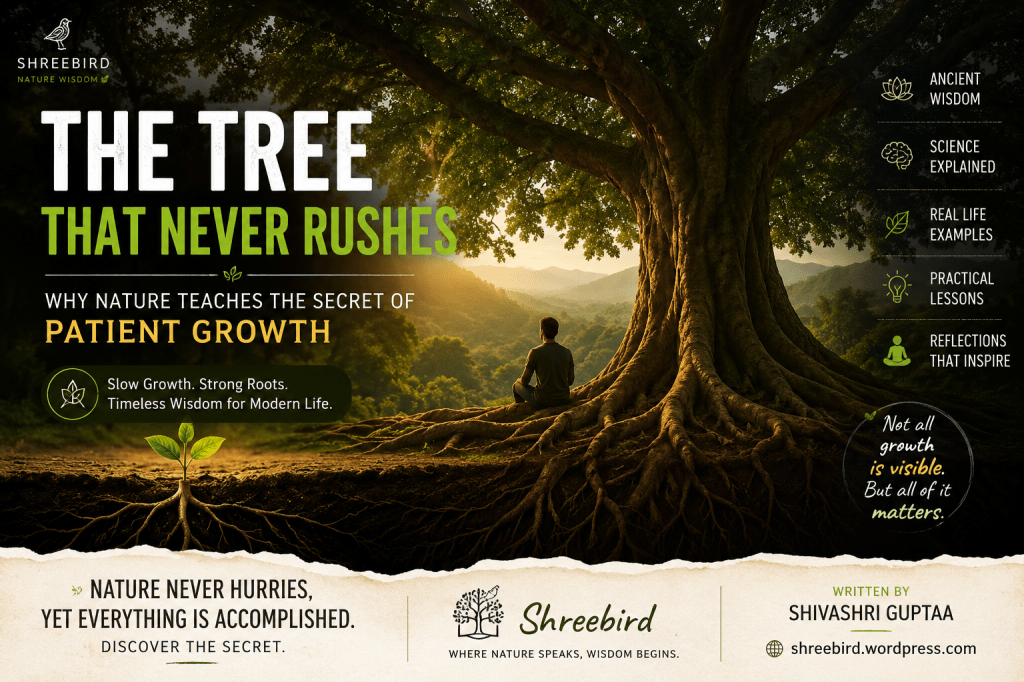
📌 Focus Keyword: Patient Growth Through Nature
⏱ Estimated Reading Time: 8–10 Minutes
🌿 Meta Description
Discover how nature teaches the timeless wisdom of patience through the silent growth of trees. Explore ancient Indian philosophy, science, and practical life lessons in this inspiring Shreebird article.
🍃 “Nature never competes. Yet everything in nature reaches its fullest potential.”
Have you ever stood beneath a centuries-old tree and wondered how it became so magnificent?
Not in a week.
Not in a year.
Not even in a decade.
Long before its branches stretched toward the sky, long before birds built nests upon it, and long before travelers rested in its shade, that tree spent years doing something almost nobody noticed—it was growing its roots.
In today’s world, this idea feels almost revolutionary.
We live in an age where success is expected instantly. Social media celebrates overnight achievements, viral fame, and quick results. Every scroll shows someone buying a dream house, launching a successful business, traveling the world, or reaching a milestone that makes us question our own progress.
Without realizing it, we begin measuring our lives against carefully curated moments from someone else’s journey.
The result?
Anxiety replaces patience.
Comparison replaces gratitude.
Speed replaces wisdom.
Yet if nature could speak, it would gently whisper a different truth:
“Everything meaningful takes time.”
A tree never wakes up worrying that another tree has grown taller.
It never apologizes for growing slowly.
It simply continues doing what nature created it to do—one root, one branch, one leaf at a time.
Perhaps that is why forests feel so peaceful.
Nothing there is trying to impress anyone.
🌱 Why Modern Life Has Forgotten the Meaning of Growth
Human history has never moved faster.
Technology evolves every year.
Artificial Intelligence transforms industries within months.
News changes every hour.
Trends disappear within days.
In the middle of all this speed, we have unknowingly developed a dangerous belief:
If something takes time, something must be wrong.
But nature completely rejects this idea.
🌳 The strongest oak trees require decades.
🗻 Mountains take millions of years to form.
💎 Diamonds are created under immense pressure over extraordinary periods of time.
🌊 Rivers patiently carve valleys—not through force, but through consistency.
Nature has never confused speed with significance.
So why do we?
Perhaps because we only celebrate visible success.
We admire the tree.
We rarely appreciate the years it spent becoming one.
🌍 A Lesson Hidden in Every Forest
Walk through any forest and you’ll notice something remarkable.
No two trees are exactly alike.
Some are tall.
Some are wide.
Some blossom with flowers.
Some bear fruit.
Some remain evergreen throughout the year, while others gracefully shed every leaf before beginning again.
Yet none of them compete.
The pine does not wish to become a mango tree.
The banyan does not envy the bamboo.
Each grows according to its own design.
Nature understands something that humans often forget:
Purpose is more important than comparison.
The moment we compare different journeys, we stop appreciating the beauty of our own.
🪷 Ancient Indian Wisdom: The Bhagavad Gita and the Tree
More than two thousand years ago, the Bhagavad Gita offered wisdom that feels even more relevant today.
Lord Krishna tells Arjuna:
“You have a right to perform your actions, but never to the fruits of those actions.” (Bhagavad Gita 2.47)
This verse is not asking us to stop dreaming.
It is teaching us to stop becoming impatient with the timing of our dreams.
A farmer cannot command a seed to become a tree overnight.
The seasons cannot be hurried.
Rain cannot be forced.
Fruit cannot appear before the roots are ready.
Likewise, meaningful success is not something we manufacture overnight—it is something we cultivate patiently.
Indian philosophy has always emphasized Karma, Tapasya (disciplined effort), and Dhairya (patience).
These values remind us that our responsibility is to nurture the roots.
The fruits will arrive in their own season.
🌱 Before We Chase the Fruits…
Imagine trying to pull a sapling upward every day because you want it to grow faster.
Instead of helping it, you would destroy it.
Many of us unknowingly do the same with our own lives.
We constantly measure our progress.
We doubt ourselves after every setback.
We expect immediate results from efforts that naturally require time.
But what if slow progress is not failure?
What if it is preparation?
Modern science, psychology, and even the hidden life of forests reveal an extraordinary truth about patient growth—a truth that explains why nature’s slowest creations often become its strongest.
Let’s explore that journey next.
🔬 What Science Reveals About Patient Growth
The remarkable thing about nature is that its greatest lessons are no longer just philosophical—they are increasingly supported by science.
When botanists study the life of a tree, they discover that visible growth is only one part of the story. Long before a tree grows taller, it invests an enormous amount of energy into developing its root system. Those hidden roots absorb water, store nutrients, anchor the tree against storms, and create a foundation for decades—even centuries—of growth.
In other words, the strongest part of the tree is often the part no one can see.
Human growth follows a surprisingly similar pattern.
Psychologists have long observed that meaningful change rarely happens overnight. Confidence is built through repeated experiences. Discipline develops through consistent habits. Expertise grows from thousands of small improvements rather than one dramatic breakthrough.
🧠 Tiny actions, repeated consistently, reshape the brain over time.
This is why reading ten pages every day is often more powerful than reading one hundred pages only once a month. A daily walk improves health more effectively than an occasional burst of intense exercise. A few moments of meditation practiced consistently can gradually strengthen emotional resilience.
Nature has always followed the principle of consistency over intensity.
Perhaps we should too.
🌍 A Recent Real-World Example
One of the most inspiring examples of patient growth can be found in environmental restoration projects across the world.
Communities, scientists, and volunteers have spent years restoring degraded forests, rivers, and wetlands. The transformation is rarely immediate. Newly planted saplings remain fragile for years before they begin supporting birds, insects, and wildlife. Healthy ecosystems emerge slowly through continuous care rather than quick fixes.
These restoration efforts remind us of an important truth:
🌱 Lasting transformation is built through commitment, not shortcuts.
Whether rebuilding a forest or rebuilding confidence after failure, the principle remains the same. Sustainable growth always requires patience.
👩🎓 An Everyday Story We Can All Relate To
Imagine two friends preparing for the same competitive examination.
The first studies only when motivation strikes. She constantly checks social media, compares her preparation with others, and feels discouraged whenever someone else seems ahead.
The second follows a quieter routine.
She studies a little every day.
She reviews her mistakes instead of hiding from them.
She celebrates small improvements rather than chasing instant perfection.
Months pass.
From the outside, both students appear equally busy.
But inside, something very different is happening.
One is exhausting herself through comparison.
The other is quietly building confidence, knowledge, and resilience.
When the examination finally arrives, success is no longer determined by who looked productive—it belongs to the one who patiently built strong roots.
Life often works in exactly the same way.
🌳 The Hidden Life of a Forest
For many years, forests were viewed as collections of individual trees.
Modern ecological research has revealed a much deeper reality.
Beneath the forest floor lies an intricate underground network of roots and beneficial fungi through which trees share nutrients, exchange chemical signals, and even support weaker neighboring trees.
A healthy forest thrives because of connection rather than competition.
How different this is from the world we have created.
Modern society often tells us that success belongs only to those who outrun everyone else.
Nature quietly disagrees.
The forest reminds us that growth becomes stronger when communities support one another.
Helping someone else succeed does not reduce our own potential.
Just as one healthy tree contributes to the health of the entire forest, one compassionate action strengthens the community around us.
🪷 Ancient Indian Wisdom: Tapasya Before Triumph
This lesson is beautifully reflected in India’s ancient spiritual traditions.
The sages who composed the Upanishads did not seek instant recognition.
Students in the ancient Gurukul system devoted years to disciplined learning before they were considered ready to guide others.
Temple architects spent decades constructing monuments that continue to inspire people centuries later.
Classical musicians practiced for thousands of hours before performing publicly.
This disciplined preparation is known as Tapasya.
Tapasya is often misunderstood as suffering.
Its deeper meaning is purposeful dedication—the willingness to continue doing what is right even when the results are not immediately visible.
A tree practices Tapasya every single day.
It keeps growing through drought.
It survives storms.
It sheds old leaves without resisting change.
It trusts the rhythm of the seasons instead of demanding permanent spring.
Perhaps that is why nature has always been one of humanity’s greatest spiritual teachers.
🌅 Success Is Not a Destination—It Is a Direction
One of the biggest mistakes we make is believing that growth ends when we achieve a goal.
Nature shows us something different.
A tree does not stop growing after bearing fruit.
A river does not stop flowing after reaching a valley.
The sun rises every morning without asking whether yesterday’s sunrise was enough.
Growth is not a destination.
It is a way of living.
And perhaps the most beautiful part of this journey is not becoming successful.
It is becoming wiser, calmer, kinder, and stronger with every season we experience.
As we reach the final part of this journey, one question remains:
If nature has already shown us how to grow patiently, what practical lessons can we carry into our own lives every single day?
🌱 Five Practical Lessons We Can Learn from a Tree
Nature is not merely something beautiful to admire—it is a guide for how we can live with greater wisdom and balance. The next time you walk past a tree, remember these five timeless lessons.
🌳 1. Build Your Roots Before You Seek Recognition
Strong roots are invisible, yet they determine the strength of the entire tree.
In our own lives, roots are our values, character, discipline, knowledge, and integrity. These qualities may not receive immediate applause, but they become the foundation that supports every future achievement.
Never underestimate the power of quiet preparation.
🍃 2. Stop Comparing Your Season to Someone Else’s
Every tree blossoms at its own time.
Some flower in spring.
Some bear fruit in summer.
Some remain green throughout the year.
None of them apologize for following their natural rhythm.
Your journey is equally unique.
Success achieved at twenty-five is not more valuable than success achieved at forty-five. What matters is not when you bloom, but how you grow.
🌧 3. Storms Do Not Mean Growth Has Stopped
Every great tree has survived countless storms.
Heavy rain strengthens roots.
Strong winds teach flexibility.
Difficult seasons often develop resilience that comfort never can.
The challenges you face today may be preparing you for responsibilities you cannot yet imagine.
🌞 4. Keep Growing Even When Nobody Is Watching
A tree continues to grow in the middle of an empty forest.
It does not wait for applause.
It does not demand recognition.
Real growth is driven by purpose—not by attention.
Whether you are learning a new skill, preparing for an examination, building a business, or healing emotionally, remember that the most meaningful progress often happens in private.
🌍 5. Leave the World Better Than You Found It
A mature tree gives far more than it takes.
It offers shade to strangers.
It provides shelter for birds.
It purifies the air.
It protects the soil.
It asks for nothing in return.
Perhaps true success is measured not by what we accumulate, but by what we contribute.
🤔 Reflection Questions
Take a quiet moment before moving on and ask yourself:
🌿 What part of my life am I trying to rush?
🌿 Am I focusing more on visible success than invisible growth?
🌿 Which habit can I strengthen today that my future self will thank me for?
🌿 Where has comparison stolen my peace?
🌿 If I trusted my own season, what fear would I finally let go of?
Sometimes, the questions we ask ourselves become the beginning of transformation.
❓Frequently Asked Questions (FAQ)
Why is patience important for personal growth?
Patience allows skills, wisdom, emotional resilience, and meaningful relationships to develop naturally. Just as trees require time to mature, lasting personal growth cannot be rushed.
What does nature teach us about success?
Nature teaches that success is not about speed or comparison. Every living thing grows according to its own rhythm, reminding us that consistency, resilience, and purpose are more important than immediate results.
How does the Bhagavad Gita relate to personal growth?
The Bhagavad Gita encourages us to focus on sincere effort rather than becoming attached to immediate outcomes. This philosophy reflects the natural process of growth seen throughout the living world.
What is the biggest lesson we can learn from a tree?
Perhaps the greatest lesson is this:
Strong roots always come before great heights.
🌿 Final Reflection
When you next stand beneath a tree, don’t simply admire its height.
Think about the years it spent growing unseen.
Think about the storms it endured.
Think about the seasons it accepted without resistance.
Think about the countless days when nothing appeared to be happening—even though everything important was.
That is how meaningful lives are built.
Not through constant urgency.
Not through endless comparison.
But through quiet, consistent growth.
Nature has never rushed.
Yet forests cover mountains.
Rivers have shaped valleys.
Seeds become mighty trees.
And spring always returns after winter.
Perhaps the universe has been teaching us the same lesson all along:
Your pace is not your problem. Your persistence is your power.
So keep learning.
Keep growing.
Keep trusting your season.
Because the strongest trees were once tiny seeds that refused to give up.
🍃 “The forest never measures success by speed. It measures life by depth. Grow your roots, honor your season, and trust that everything meant to bloom will bloom in its perfect time.”
🌿 Shreebird
Nature • Philosophy • Ancient Wisdom • Conscious Living
At Shreebird, we believe that nature is more than scenery—it is humanity’s oldest teacher. Every article blends timeless philosophical insights, ancient Indian wisdom, scientific understanding, and everyday experiences to help readers cultivate a slower, wiser, and more meaningful life.
Whether you are seeking personal growth, inner peace, or a fresh perspective on life’s challenges, may these reflections inspire you to see the extraordinary wisdom hidden within the ordinary world around you.
✍️ Written by: SHIVASHRI GUPTAA
🌐 Website: shreebird.wordpress.com
© Shreebird – Where Nature Speaks, Wisdom Begins.


टिप्पणी करे