100 Greatest Indian Novels Series
📚 Novel No. 14
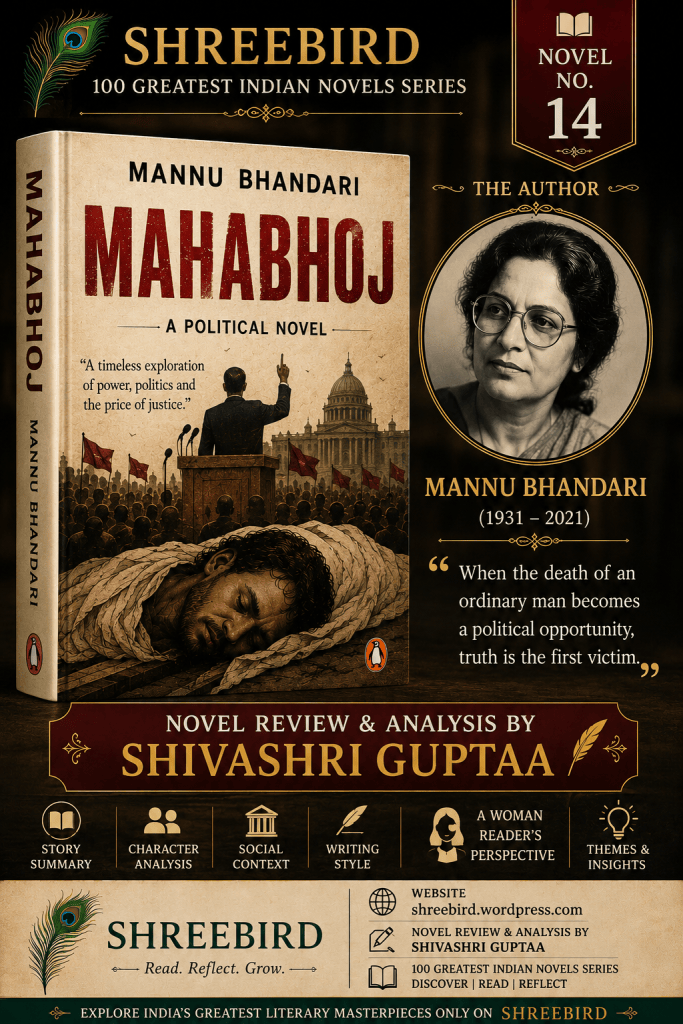
Mahabhoj
✨ Tagline
“When power becomes greater than truth, justice is always the first casualty.”
🌿 SHREEBIRD Opening Reflection
Democracy…
We often call it the most beautiful form of governance.
A system where every citizen has an equal voice.
A nation where justice is meant to belong to everyone.
But does reality always reflect that ideal?
Does every poor person receive justice?
Is every innocent voice truly heard?
Or do some lives exist only as election slogans,
newspaper headlines,
and political speeches?
Mahabhoj confronts us with these uncomfortable questions.
It is not merely a political novel.
It is a profound examination of democracy itself.
It is a mirror held up to power, administration, and society.
It tells the story of a world where a person’s death can become more valuable to politicians than the life that person actually lived.
Perhaps that is why Mahabhoj remains just as relevant today as it was when it was first published.
✍️ About the Author
Mannu Bhandari: The Powerful Voice of Human Relationships and Social Reality
Mannu Bhandari is regarded as one of the most influential women writers in modern Hindi literature.
Born in 1931 in Madhya Pradesh, she became one of the leading figures of the Nayi Kahani (New Story) Movement.
Her writings beautifully explore changing Indian society,
the identity of women,
middle-class life,
political contradictions,
and the emotional complexities of human relationships.
Her language is simple,
yet her ideas are remarkably profound.
Rather than imposing opinions,
she encourages readers to question everything around them.
While Aapka Bunty gave voice to the emotional world of a child caught in a broken family,
Mahabhoj boldly exposes the uncomfortable realities of democracy,
politics,
bureaucracy,
media,
and social justice.
Today, it is widely regarded as one of the finest political and social novels ever written in Hindi literature.
📖 The Story in a Nutshell
The story begins—
with a death.
But this is not merely the story of one man’s death.
It is the story of a system where the death of a poor citizen becomes a political opportunity.
At the center of the novel is—
Bisesar (Bisu).
A young Dalit man.
Poor.
Ordinary.
Yet courageous enough to raise his voice against injustice.
His mysterious death devastates his family.
For them,
it is an unbearable personal tragedy.
For politicians,
it quickly becomes an election issue.
The opposition blames the ruling government.
The government struggles to protect its image.
Officials prepare reports.
Journalists chase headlines.
Television debates begin.
And slowly,
Bisu is transformed—
from a human being
into a political symbol.
Everyone talks about him.
Yet very few truly care about the life he lived.
This is the deepest irony of Mahabhoj.
Through this powerful narrative,
Mannu Bhandari reminds us that sometimes justice is not killed inside a courtroom—
it dies long before,
on the stage of politics itself.
And from that moment onward,
the novel unfolds into a gripping exploration of power,
caste,
bureaucracy,
media,
political ambition,
and the fragile condition of democracy.
🎭 Meet the Characters
👤 Bisesar (Bisu)
Bisu is the heart of the novel.
Ironically, although he appears very little in the narrative, the entire story revolves around him.
He is a poor Dalit youth.
Honest.
Hardworking.
Fearless enough to stand against injustice.
His death is not presented as the tragedy of a single individual.
Instead, it becomes a symbol of countless marginalized people whose voices are silenced by power and politics.
In many ways, Bisu represents every ordinary citizen who is forgotten once the political speeches are over.
👤 Bisu’s Family
Broken by grief.
Helpless.
Waiting for justice.
They know nothing about political strategies or media debates.
They only know that they have lost someone they deeply loved.
As political leaders begin using Bisu’s death for their own agendas, the family’s personal sorrow slowly turns into a public spectacle.
This emotional conflict is one of the novel’s most heartbreaking aspects.
👤 The Political Leaders
The novel presents several politicians, but Mannu Bhandari wisely avoids creating a single villain.
Instead, she exposes an entire political system driven by ambition.
For many leaders, justice is not the priority.
Protecting power is.
Every statement carries political calculation.
Every expression of sympathy hides electoral interests.
Through these characters, the novel reveals how human suffering is often converted into political capital.
👤 The Opposition
The opposition is not portrayed as completely innocent either.
Rather than focusing solely on justice, many opposition leaders also view Bisu’s death as an opportunity to weaken the ruling party.
This balanced portrayal is one of the greatest strengths of Mahabhoj.
The novel criticizes the entire political culture instead of targeting a single ideology.
👤 The Administration and Police
The administration represents the machinery of the state.
Ideally, it should protect truth and justice.
Yet under political pressure, reports begin to change.
Statements are manipulated.
Facts become blurred.
Gradually, justice disappears beneath official paperwork and bureaucracy.
Mannu Bhandari brilliantly illustrates how institutions can lose their independence when power begins to interfere.
👤 The Media
The media plays a complex and fascinating role in the novel.
At times, it exposes uncomfortable truths.
At other moments, it unintentionally becomes part of the political spectacle.
Rather than presenting journalism as entirely heroic or entirely corrupt, the novel acknowledges both its strength and its limitations.
This balanced perspective makes Mahabhoj remarkably realistic.
🕰️ The World Behind the Novel
Mahabhoj was published in 1979, during a period when India was still reflecting on the political turbulence that followed the Emergency.
Questions about democracy,
political accountability,
corruption,
bureaucracy,
caste politics,
and civil rights dominated public discourse.
Instead of documenting a single historical event, Mannu Bhandari created a timeless political narrative.
The circumstances may belong to one particular era,
but the questions raised by the novel continue to resonate across generations.
That is why Mahabhoj still feels remarkably contemporary.
🎨 What Makes This Novel Special?
✨ A Powerful Portrait of Democracy
Rather than glorifying democracy, the novel examines its contradictions.
It reminds readers that democratic institutions are meaningful only when they truly serve ordinary citizens.
✨ Fearless Political Commentary
The novel does not attack one political party.
Instead, it exposes the deeper culture of power, manipulation, and opportunism that can exist across political systems.
Its courage lies in questioning the structure itself.
✨ No Single Villain
One of the novel’s greatest achievements is that it refuses to simplify reality.
No single character is responsible for the tragedy.
The system itself becomes the central antagonist.
This makes the story far more believable and impactful.
✨ A Profound Question of Social Justice
Throughout the novel, one uncomfortable question echoes repeatedly—
Does the life of a poor and marginalized citizen carry the same value as the life of someone powerful?
The novel never offers an easy answer.
Instead, it invites readers to confront this question themselves.
✨ The Relationship Between Media and Power
Mahabhoj presents journalism as both a guardian of democracy and, at times, a participant in political drama.
This layered portrayal adds remarkable depth to the narrative.
✨ Timeless Relevance
Governments change.
Technology evolves.
News spreads faster than ever.
Yet the struggle between power,
truth,
justice,
public opinion,
and political ambition remains strikingly similar.
That is why Mahabhoj continues to speak to readers across generations and remains one of the most relevant political novels in Hindi literature.
🎭 Understanding Mahabhoj
While reading Mahabhoj, one question keeps returning to the reader’s mind—
Who is the real villain of this novel?
Is it the politicians?
The police?
The bureaucracy?
The media?
Or is it the entire system?
This is where Mannu Bhandari’s brilliance truly shines.
She refuses to reduce the story to a battle between good and evil.
Instead, she reveals how injustice often emerges when an entire system becomes insensitive to human suffering.
Bisu’s death is no longer treated as the tragedy of a young man.
It becomes a political issue.
An election campaign.
A newspaper headline.
A television debate.
A public spectacle.
Everyone speaks in his name.
Yet very few pause to remember the human being behind the headlines.
That is the sharpest irony of Mahabhoj.
The novel quietly asks—
What happens when a person’s identity is replaced by political usefulness?
And perhaps that is the question that lingers long after the final page.
✍️ Language & Writing Style
One of the greatest strengths of Mahabhoj is Mannu Bhandari’s writing style.
Her language is simple,
direct,
and remarkably accessible.
There are no unnecessary literary flourishes.
No complicated vocabulary designed to impress.
Instead, every sentence serves the story.
What makes her writing extraordinary is its quiet intensity.
She raises profound political and moral questions without becoming preachy.
The novel moves naturally between political speeches,
journalistic reporting,
bureaucratic language,
and the everyday conversations of ordinary villagers.
This variety gives the narrative authenticity and emotional depth.
Another remarkable feature is her subtle use of irony.
Readers often find themselves smiling at the sharp satire,
only to realize a moment later that the situation is deeply tragic.
That delicate balance between realism and satire is one of the defining qualities of Mannu Bhandari’s literary voice.
💭 If This Novel Were Written Today…
If Mahabhoj were written today,
the story would probably unfold in the age of smartphones and social media.
Within minutes of Bisu’s death,
videos would go viral.
Television channels would run endless debates.
Social media platforms would explode with hashtags like—
#JusticeForBisu
Political parties would hold press conferences.
Influencers would upload analysis videos.
Fact-checkers would challenge misinformation.
WhatsApp groups would circulate half-truths and rumors.
News would travel faster than ever before.
Yet one haunting question would still remain—
Would Bisu actually receive justice?
Technology may have transformed communication,
but it has not eliminated the struggle between truth,
power,
public opinion,
and political interests.
That is why Mahabhoj feels even more relevant in today’s digital age.
🌍 Why Everyone Should Read Mahabhoj
This is not a novel meant only for students of literature.
It is a book for every thoughtful citizen.
Especially for readers who want to understand—
• The true meaning of democracy.
• The relationship between politics and society.
• The role of journalism in shaping public opinion.
• The challenges of social justice and equality.
• How literature can question systems instead of merely telling stories.
Reading Mahabhoj is not simply an intellectual experience.
It is an invitation to reflect on the responsibilities of both governments and citizens.
💡 SHREEBIRD Reading Tip
Don’t read Mahabhoj only as a political novel.
Read it as the story of an ordinary human being.
Every time a leader delivers a passionate speech,
ask yourself—
Where is Bisu in all these words?
Every time someone promises justice,
pause and ask—
Are they truly speaking for the victim, or merely for political gain?
When you read the novel with these questions in mind,
Mahabhoj transforms from a political narrative into a timeless exploration of democracy,
power,
justice,
and humanity.
And that is precisely what makes it one of the greatest novels in modern Hindi literature.
♀️ A Woman Reader’s Perspective
Now, let me share my own thoughts.
As a woman reader, Mahabhoj was not simply a political novel for me.
It was a deeply human story.
It reminded me that behind every newspaper headline,
every election speech,
and every political debate,
there is always a real person whose life has been forever changed.
While reading the novel, I never felt that Mannu Bhandari was trying to blame one political party or one individual.
Instead, she courageously questions an entire system that sometimes forgets the people it is supposed to protect.
What impressed me the most was the author’s sensitivity.
She never allows politics to overshadow humanity.
As a woman, I also noticed how the weakest sections of society—
the poor,
the marginalized,
women,
and powerless families—
often become the first victims when power begins to dominate justice.
The novel quietly reminds us that democracy is not measured only by elections,
but by the dignity and security of its most vulnerable citizens.
In today’s language, I would simply say—
“Mahabhoj is not against politics; it is against the loss of humanity in politics.”
And perhaps that is why the novel continues to feel so powerful even decades after it was written.
🦚 SHREEBIRD Reflection
After finishing Mahabhoj,
I realized that democracy is much more than voting once every few years.
A healthy democracy exists only when truth matters,
justice is accessible,
and every citizen’s life has equal value.
The tragedy of Bisu is not just his death.
The greater tragedy is how easily human suffering can be transformed into political strategy.
That is the question Mannu Bhandari leaves with every reader.
Are we becoming more sensitive—
or simply better at discussing tragedy without changing anything?
Perhaps literature cannot change governments overnight.
But it can certainly change the conscience of its readers.
And that is exactly what Mahabhoj achieves.
⭐ SHREEBIRD Verdict
Story ⭐⭐⭐⭐⭐
Writing Style ⭐⭐⭐⭐⭐
Political Insight ⭐⭐⭐⭐⭐
Social Relevance ⭐⭐⭐⭐⭐
Character Development ⭐⭐⭐⭐☆
Emotional Impact ⭐⭐⭐⭐⭐
Overall Rating ⭐⭐⭐⭐⭐
🌸 Final Thought
“The greatest failure of a democracy is not when people stop voting—it is when people stop caring about the lives behind the headlines.”
That is the timeless message of Mahabhoj.
It is more than a political novel.
It is a powerful reflection on democracy,
justice,
human dignity,
and moral responsibility.
Every generation will find something meaningful within its pages.
And every thoughtful reader will finish the novel with more questions than answers.
Perhaps that is the true mark of a literary masterpiece.
🦚 SHREEBIRD
📚 100 Greatest Indian Novels Series
✍️ Novel Review & Analysis by: SHIVASHRI GUPTAA
🌐 Website: shreebird.wordpress.com
📖 Loved this review? Explore more timeless classics on SHREEBIRD.
Our 100 Greatest Indian Novels Series brings together India’s finest literary masterpieces with:
✨ Story Summaries
✨ Character Analysis
✨ Historical & Social Context
✨ Literary Style & Themes
✨ A Woman Reader’s Perspective
✨ SHREEBIRD Reflection
✨ Honest Ratings & Final Thoughts
From Godaan and Gunahon Ka Devta to Raag Darbari, Nadi Ke Dweep, Jhootha Sach, Tamas, Mahabhoj, and many more—each review is crafted to help readers understand not just the story, but the ideas that make these novels timeless.
📚 Visit SHREEBIRD for more insightful book reviews, literary reflections, and India’s greatest classics.
🦚 Read. Reflect. Grow.


टिप्पणी करे