A Question That Made Me Rethink the Past, the Present, and the Future.
“History cannot be changed. But sometimes, imagining a different history helps us build a better future.”
— ShreeBird Original
Imagine this.
One morning, you wake up with a power no human has ever possessed.
Not the power to predict the future.
Not the power to become invisible.
Not even the power to travel through time.
But something far greater…
You are given the chance to erase just one moment from the entire history of mankind.
Only one.
No second chance.
No undo button.
No changing your decision later.
So…
What would you erase?
Would it be World War II?
The Holocaust?
Slavery?
The invention of nuclear weapons?
Colonialism?
The assassination of a great leader?
Or something else entirely?
When I asked myself this question, dozens of answers came to my mind.
But after hours of reflection, I realized my answer had never really changed.
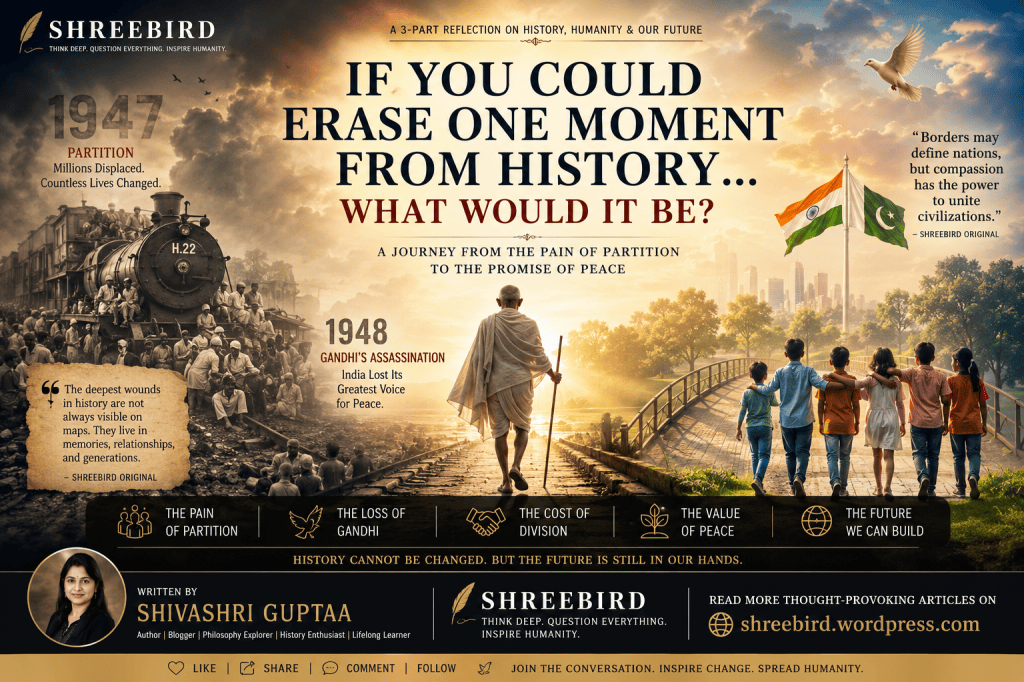
If I could erase one chapter from history, I would erase the Partition of India in 1947 and the assassination of Mahatma Gandhi in 1948.
Not because history should be forgotten.
But because these two events changed the lives of millions of ordinary people who never chose violence.
When a Line on a Map Changed Millions of Lives
The Partition was not merely the division of land.
It was the division of memories.
Families.
Friendships.
Neighbourhoods.
Cultures.
Dreams.
And hearts.
People who had celebrated festivals together suddenly found themselves citizens of different countries.
Children left behind the homes where they had taken their first steps.
Parents abandoned everything they had built over generations.
Some carried only a small suitcase.
Others carried nothing except hope.
Many never reached their destination.
Historians estimate that around 14 to 18 million people were displaced, making it one of the largest human migrations in recorded history. During the violence that followed, hundreds of thousands to over a million people lost their lives.
But numbers tell only half the story.
The real tragedy lives in the memories passed down through generations.
Stories of grandparents who never saw their childhood homes again.
Stories of brothers separated forever.
Stories of friendships that disappeared because a border appeared.
History remembers dates.
Families remember pain.
Then India Lost Its Greatest Voice for Peace
As if the wounds of Partition were not enough…
Just a few months later, on 30 January 1948, India lost Mahatma Gandhi.
A man who believed that hatred could never build a nation.
A leader who proved that courage is not always found on a battlefield.
Sometimes…
The greatest courage is choosing peace when the world demands revenge.
Gandhi dreamed of an India where people of different faiths, languages, and cultures could live together with dignity.
His assassination was not just the loss of a national leader.
It was the loss of one of humanity’s strongest voices for non-violence.
I often wonder…
What if Gandhi had lived longer?
Would he have helped heal some of the wounds left by Partition?
Would he have inspired a generation to choose dialogue over division?
No one knows.
History never answers “what if.”
A Question That Still Stays With Me
Sometimes I close my eyes and imagine a different timeline.
One where families never had to leave their homes overnight.
Where neighbours remained neighbours.
Where children inherited stories of friendship instead of separation.
Where Mahatma Gandhi continued reminding the world that humanity must always come before hatred.
Perhaps that world was never possible.
Perhaps it was.
We will never know.
But asking these questions has taught me one important lesson:
The greatest tragedies in history are not remembered because borders changed.
They are remembered because human lives changed forever.
“A nation is not built only by the land it owns, but by the lives it protects and the humanity it preserves.”
— ShreeBird Original
🌿 Reflection Before You Continue…
If you had the power to erase just one moment from history…
What would it be?
Hold on to your answer.
Because in the next part, we’ll explore a deeper question:
What has the world continued to lose because of the Partition—even after nearly eight decades?
Sometimes, the biggest cost of history is not what happened yesterday…
It’s what continues to happen today.
If you could erase one trend from history, what would it be?
The Cost of Division and the Value of Peace
When History Ends, Its Consequences Don’t.
“The deepest wounds in history are not always visible on maps. They live in memories, relationships, and generations.”
— ShreeBird Original
When we study the Partition of India, we often focus on 1947.
A date.
A political decision.
A line drawn across a map.
But history didn’t stop there.
Its consequences didn’t either.
The Partition officially ended decades ago.
Yet for millions of people, its echoes can still be heard in family stories, old photographs, abandoned homes, and memories passed from one generation to the next.
Many grandparents still remember the village where they were born.
The friends they left behind.
The homes they never saw again.
For them, Partition is not just a chapter in a history book.
It is a part of their identity.
When Neighbours Became Rivals
India and Pakistan share far more than a border.
We share centuries of history.
Ancient civilizations.
Languages.
Poetry.
Music.
Food.
Traditions.
Festivals.
And countless cultural roots.
Yet after Partition, two neighbouring nations gradually became defined by distrust, recurring tensions, and conflict.
Since Independence, India and Pakistan have experienced multiple wars and periods of military confrontation. Beyond these conflicts, decades of mistrust have influenced diplomacy, trade, travel, and the lives of ordinary people on both sides of the border.
The greatest burden of conflict is rarely carried by politicians.
It is carried by ordinary families.
By soldiers standing at the border.
By children growing up hearing stories of fear instead of friendship.
By people who simply dream of living peaceful lives.
The Price of Conflict Is More Than War
Whenever two nations remain locked in long-term hostility, the cost is measured in far more than military expenses.
It is measured in opportunities that never came to life.
Sometimes I wonder…
What if South Asia had spent more decades building together than preparing for conflict?
Imagine a future where lasting peace created even greater opportunities to invest in:
🏫 Better schools.
🏥 Modern hospitals.
🔬 Scientific research.
🚀 Space technology.
🤖 Artificial Intelligence.
🌱 Sustainable agriculture.
⚡ Clean energy.
🛣️ Infrastructure.
💼 Entrepreneurship.
📚 Quality education for every child.
No one can say with certainty that history would have unfolded exactly this way.
History is too complex for simple answers.
But one truth is difficult to ignore.
Every society benefits when peace creates more room for human development.
A peaceful environment allows governments, businesses, scientists, teachers, doctors, and innovators to focus more energy on building the future.
That is one of the greatest values of peace.
The Opportunity Cost We Rarely Discuss
Economists often talk about something called Opportunity Cost.
It means…
Every choice we make also means giving up another possibility.
The same idea applies to history.
Whenever nations spend decades managing conflict, some opportunities for collaboration, trade, education, and innovation may also be delayed.
Imagine if more young minds across South Asia had the chance to collaborate in science…
Imagine if universities exchanged ideas more freely…
Imagine if innovation crossed borders as easily as music and literature once did.
Perhaps the region would have discovered even more extraordinary solutions to global challenges.
We cannot know for certain.
But it is a possibility worth reflecting upon.
Because peace does not only prevent destruction.
Peace creates possibilities.
What Gandhi Tried to Teach the World
Mahatma Gandhi never claimed that peace was easy.
He knew it demanded courage.
Patience.
Sacrifice.
And immense self-control.
But he also believed something timeless.
“The weak can never forgive. Forgiveness is the attribute of the strong.”
— Mahatma Gandhi
Many people remember Gandhi because India became independent.
I remember him because he believed that winning people’s hearts was greater than defeating their bodies.
That lesson feels just as relevant today as it did in 1947.
Perhaps every generation has two choices.
To inherit old hatred…
Or to create new hope.
History Gives Us Lessons, Not Instructions
When I think about the Partition today, I do not ask,
“Who was right?”
History is rarely that simple.
Instead, I ask a different question.
“What can humanity learn from one of the greatest human tragedies of the twentieth century?”
For me, the answer is simple.
Hatred divides faster than love unites.
Violence spreads faster than trust.
But only compassion has the power to heal wounds that politics cannot.
Imagine a South Asia where children know each other through books, sports, science, and culture…
Instead of headlines about tension and conflict.
Would that future be worth striving for?
In the final part, we move beyond history and ask the most important question of all:
Can humanity build the future that Gandhi dreamed of… beyond borders?
Beyond Borders: The Future Gandhi Dreamed Of
The Greatest Tribute to History Is Not Remembering It—It’s Learning From It.
“The world has enough walls. What it needs now are more bridges.”
— ShreeBird Original
As I reached the end of this reflection, I realized something profound.
Perhaps this blog was never just about the Partition.
It was never just about Mahatma Gandhi’s assassination.
It was never just about India and Pakistan.
It was about a much bigger question…
What kind of world do we want to leave for the next generation?
History has already made its choices.
We cannot stop the trains that left in 1947.
We cannot reunite every family that was separated.
We cannot bring back every innocent life that was lost.
And we certainly cannot bring Mahatma Gandhi back.
But perhaps history never expected us to change the past.
It expected us to learn from it.
Every generation inherits two things.
The first is the mistakes of the past.
The second is the opportunity to build a better future.
The question is not…
“Why did history divide us?”
The real question is…
“Will we continue carrying those divisions, or will we finally choose to build bridges beyond borders?”
Sometimes I imagine an alternative South Asia.
A South Asia where borders exist, but hatred doesn’t.
Where India and Pakistan compete in science, innovation, sports, literature, and economic progress instead of living through recurring tensions.
Where universities produce Nobel Prize winners.
Where entrepreneurs build companies that transform the world.
Where scientists work together to solve climate change, healthcare challenges, and food security.
Where every child—whether born in Delhi, Lahore, Karachi, Kolkata, Dhaka, or Srinagar—is remembered not for the border they live behind, but for the dreams they carry within them.
Imagine if lasting peace created even greater opportunities to invest in…
🏫 Better schools.
🏥 Better hospitals.
🔬 Scientific research.
🚀 Space exploration.
🤖 Artificial Intelligence.
🌱 Sustainable agriculture.
⚡ Clean energy.
📚 World-class education.
💼 Employment and entrepreneurship.
💙 Human empowerment.
No one can say with certainty that history would have unfolded exactly this way.
History is far too complex for simple answers.
But one truth remains timeless.
Peace doesn’t just prevent wars.
Peace creates possibilities.
That is why Mahatma Gandhi’s life still matters.
He taught the world that true strength is not measured by the number of enemies a nation defeats.
True strength is measured by the number of lives it uplifts.
His dream was not merely an independent India.
His dream was a civilization where compassion would always be stronger than hatred…
Dialogue would always be stronger than violence…
And humanity would always be greater than every border ever drawn on a map.
Perhaps that dream still remains unfinished.
Perhaps…
It is now our responsibility to continue it.
Because the future will never ask us,
“Which religion did you belong to?”
“Which nation did you support?”
“Which side did you choose?”
Instead, history may ask only one question…
“What did you do to make humanity better?”
“Borders may define nations, but compassion has the power to unite civilizations.”
— ShreeBird Original
🌍 One Final Question…
If history gave you one chance…
Just one.
Would you erase a tragedy?
Or would you keep history exactly as it is and simply promise never to repeat its mistakes?
There is no right answer.
Only honest reflection.
Perhaps the purpose of history is not to make us proud.
Perhaps its greatest purpose is to make us wiser.
Because every generation writes the next chapter.
The question is…
What kind of chapter will we leave behind?
💭 Join the Conversation
I would love to know your perspective.
If you could erase ONE moment from human history…
What would it be—and why?
👇 Share your thoughts in the comments before reading anyone else’s answer.
Let’s create a conversation based on curiosity, empathy, and respect.
Because meaningful discussions build a better future.
📚 Recommended Books & Resources
If this article inspired you to think more deeply about history, peace, and humanity, these books are worth exploring:
By purchasing through these links, you support SHREEBIRD at no extra cost to you. Your support helps us continue creating free, thoughtful, and research-based content for readers around the world. Thank you! ❤️
❤️ Become a Part of the SHREEBIRD Community
If this article made you think differently…
⭐ Share it with your friends and family.
💬 Leave a thoughtful comment.
📖 Follow SHREEBIRD for weekly blogs on History, Philosophy, Psychology, Spirituality, Self-Growth, and Books.
🔖 Bookmark this article so you can revisit it whenever you need a reminder that peace begins with understanding.
Every share spreads an idea.
Every idea has the power to change a life.
✍️ About the Writer
SHIVASHRI GUPTAA
Author | Blogger | Philosophy Explorer | History Enthusiast | Lifelong Learner
I believe history is not just about remembering the past—it’s about creating a wiser future. Through SHREEBIRD, I write about history, philosophy, psychology, spirituality, books, and timeless ideas that inspire meaningful conversations and lifelong learning.
📚 Read More Articles: Explore thought-provoking blogs, book reviews, life lessons, and daily reflections on SHREEBIRD.
🤝 Let’s Connect Through Ideas: Your comments, suggestions, and perspectives make this community richer. Don’t hesitate to join the conversation.
☕ Support SHREEBIRD: If you enjoy our content, consider purchasing books through our recommended affiliate links. It helps support independent writing at no additional cost to you.
🌿 Thank You for Reading
“History gave us borders.
Humanity can still build bridges.”
See you in the next ShreeBird story.
Until then… keep thinking deeply, questioning fearlessly, and choosing humanity over hatred.


टिप्पणी करे