When a Question Paper Leaks, It Isn’t Just an Examination That Is Compromised—A Nation’s Trust Is Wounded
Will India’s Student Movement Make History… or Learn from History?
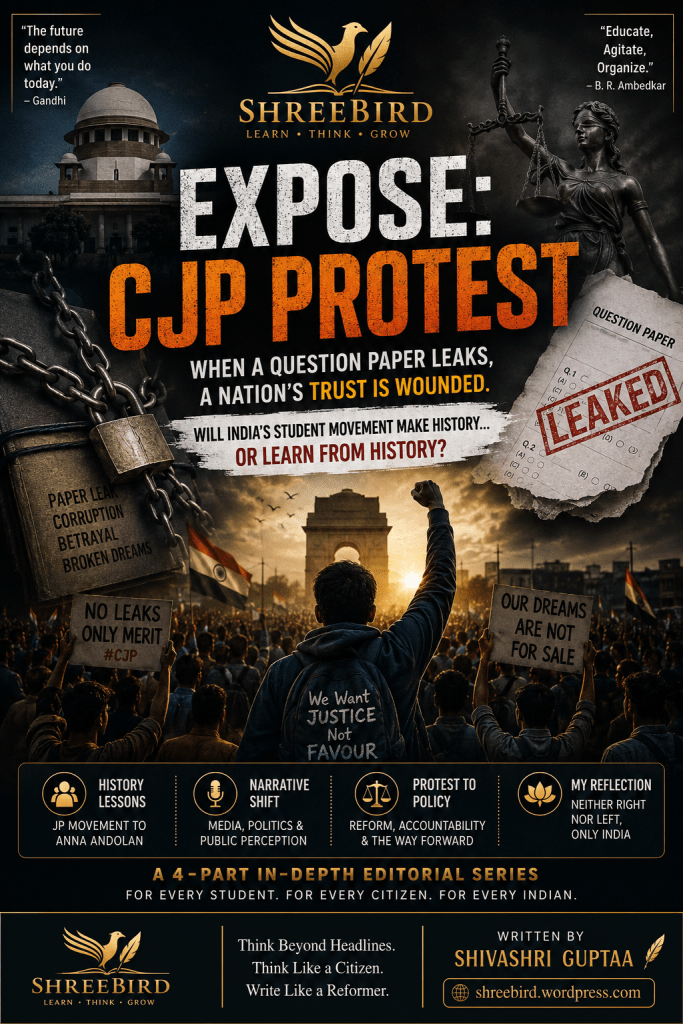
SHREEBIRD Signature Editorial |
“Education is the most powerful weapon which you can use to change the world.”
— Nelson Mandela
“Educate, Agitate, Organize.”
— Dr. B. R. Ambedkar
“The future depends on what you do today.”
— Mahatma Gandhi
“Injustice anywhere is a threat to justice everywhere.”
— Martin Luther King Jr.
5 May 2024… A Date That Shook Millions of Dreams
NEET-UG.
One of India’s most prestigious and competitive medical entrance examinations.
Millions of students walked out of their examination centres carrying hope.
A farmer’s son.
A daily wage worker’s daughter.
A first-generation learner.
A mother waiting outside a temple.
A father silently calculating the years of sacrifice behind this single examination.
For many families, this wasn’t merely a test.
It was the doorway to a better life.
But within days…
The headlines changed.
“Alleged Paper Leak.”
“Investigation Begins.”
“Arrests Made.”
“CBI Probe.”
“Supreme Court Hearings.”
Suddenly, the national conversation shifted.
The biggest question was no longer—
“How difficult was the examination?”
Instead, millions of students began asking—
“If the question paper can be sold before the examination begins… what is the value of honest hard work?”
That day, India did not merely witness an examination controversy.
It witnessed a crisis of public trust.
This Editorial Is Not About One Political Party
It is not written in favour of any government.
Nor is it written against any opposition.
It is not an attempt to defend or condemn any particular organisation.
This editorial is about something much larger.
It is about the future of millions of Indian students.
It is about merit.
It is about accountability.
It is about democracy.
Because when an examination system begins losing credibility…
A nation begins losing confidence in its own institutions.
A Paper Leak Is Never Just a Crime
It attacks society at five different levels.
1. It Betrays the Student
Years of discipline…
Sleepless nights…
Missed festivals…
Lost friendships…
All become meaningless when dishonesty receives an unfair advantage.
2. It Betrays the Family
Behind every successful candidate stands an invisible story.
A father who mortgaged his land.
A mother who sold her jewellery.
A sister who sacrificed her own education.
A family that believed education could change its destiny.
Paper leaks don’t merely steal marks.
They steal hope.
3. It Attacks Merit
A competitive examination is built upon one sacred principle—
Equal Opportunity.
The moment the question paper reaches dishonest hands before the examination…
Competition loses its fairness.
And when merit loses…
Institutions eventually lose their excellence.
4. It Damages the Economy
Every cancelled examination means—
Millions of productive hours wasted.
Thousands of crores invested by families and institutions.
Delayed recruitment.
Delayed public services.
A delayed future.
5. It Weakens Democracy
Democracy is not sustained only through elections.
It survives because citizens believe that institutions are fair.
The day people stop believing that hard work matters…
Democracy begins losing one of its strongest foundations.
“When hard work starts losing against manipulation, a nation doesn’t merely lose an examination—it begins losing its moral confidence.”
— SHREEBIRD
History Speaks Before It Repeats
Every generation witnesses a defining public movement.
Some movements reshape nations.
Others disappear as temporary headlines.
The difference is never the size of the crowd.
The difference is the clarity of purpose.
1917 — Champaran Satyagraha
A local injustice became a national awakening.
One movement transformed the relationship between citizens and power.
1942 — Quit India Movement
A single call—
“Do or Die.”
An entire nation united around one objective.
1974 — The JP Movement
Students questioned the system.
A youth-led movement eventually transformed Indian politics.
Jayaprakash Narayan famously reminded India—
“Total Revolution means not merely changing governments, but transforming society itself.”
2011 — The Anna Movement
What began as an anti-corruption campaign soon became a nationwide demand for accountability.
Regardless of differing political opinions…
It demonstrated one powerful democratic lesson—
Citizens can influence public policy.
What Can India Learn from the World?
India is not the only democracy where young people have taken to the streets.
Every nation offers a different lesson.
🇧🇩 Bangladesh — When Student Anger Became a National Political Crisis
Student protests initially emerged around concerns related to the government job quota system.
Over time, wider political dissatisfaction became intertwined with the movement.
Violence, instability and intense political confrontation followed.
Lesson
When multiple political agendas begin merging into a student movement…
Its influence may grow.
But so do the risks.
🇱🇰 Sri Lanka — When Economic Collapse Reached the Streets
The protests in Sri Lanka were not about examinations.
They were about inflation.
Fuel shortages.
Food insecurity.
Economic collapse.
Public frustration eventually transformed into a nationwide political movement.
Lesson
When governments fail to preserve public trust during prolonged crises…
Economic problems often become political crises.
🇳🇵 Nepal — Student Politics and Democratic Challenges
Student organisations in Nepal have historically played an important role in educational reforms and democratic debates.
However, on several occasions, violence, vandalism and clashes overshadowed legitimate concerns.
Lesson
Violence rarely strengthens a movement.
It often weakens its moral legitimacy.
🇭🇰 Hong Kong — When One Bill Became a Global Movement
A proposed extradition bill eventually evolved into a broader debate on civil liberties and political rights.
Sometimes…
A single policy becomes a symbol of something much larger.
Lesson
Public trust is often more powerful than political slogans.
Why Is India’s Democratic Tradition Different?
India’s greatest strength lies in its constitutional framework.
We possess—
✔ A written Constitution.
✔ An independent judiciary.
✔ Electoral democracy.
✔ Peaceful protest as a constitutional right.
Mahatma Gandhi demonstrated that—
“Non-violence is not the weapon of the weak; it is the greatest moral force available to humanity.”
Dr. B. R. Ambedkar repeatedly reminded citizens to pursue change through constitutional methods.
That remains India’s greatest democratic strength.
A protest should ultimately seek—
Institutional reform.
Not institutional destruction.
Why Did the CJP Protest Become Nationally Significant?
Because the debate was never only about one examination.
It was about trust.
It was about merit.
It was about accountability.
It was about the future of millions of young Indians.
Yet history also offers one important warning.
Every major public movement eventually reaches a decisive moment.
Not when governments respond.
But when the movement itself must decide—
Can it remain focused on its original purpose?
As public attention grows…
Political attention follows.
Media attention follows.
Ideological debates follow.
And then a difficult question emerges—
“Does the original cause remain at the centre of the movement?”
That question defines every great movement in history.
And it is precisely the question we shall explore in the next chapter.
🌿 SHREEBIRD THINK BOX
“Every movement fights two battles—one against the system, and another to protect its own purpose.”
“Young people are not political assets; they are a nation’s greatest possibility.”
“Democracy is strengthened not by louder slogans, but by stronger institutions.”
“A fair examination does more than select candidates—it protects the future of a nation.”
“Think Beyond Headlines. Think Like a Citizen. Write Like a Reformer.”
When the Protest Grew… Did the Cause Shrink?
Narrative, Politics & The Battle for Public Perception
“Facts are sacred, comment is free.”
— C. P. Scott
“The price of apathy towards public affairs is to be ruled by evil men.”
— Plato
“Every movement faces two battles—one against the system, another against losing its own purpose.”
— SHREEBIRD
Every Protest Reaches a Turning Point
No movement begins with confusion.
It begins with clarity.
One demand.
One purpose.
One emotion.
One voice.
But…
As a movement grows…
The stage becomes larger.
More cameras arrive.
More organisations appear.
Political parties become interested.
Social media algorithms amplify selected moments.
Ideological groups enter the conversation.
And gradually…
The battle is no longer fought only on the streets.
It is fought inside people’s minds.
That battle is called—
Narrative.
What Is a Narrative?
A narrative is not simply a story.
It is the framework through which society understands an event.
The same protest can be described in completely different ways.
One person may call it—
“A students’ movement demanding justice.”
Another may describe it as—
“A failure of governance.”
Someone else may argue—
“Political groups are trying to shape public opinion.”
The event remains the same.
The interpretation changes.
That is the power of narrative.
Agenda Setting Theory
Media scholars Maxwell McCombs and Donald Shaw proposed one of the most influential ideas in political communication—
“The media may not be successful in telling people what to think, but it is stunningly successful in telling people what to think about.”
This theory does not claim that media controls public opinion.
Instead, it explains that the issues receiving the most attention often become the issues people discuss the most.
That is why every major protest eventually becomes a contest over public attention.
When Does a Protest Become Larger Than Its Original Cause?
History offers an interesting pattern.
Many movements begin with one issue.
Later…
Several other concerns, organisations and political viewpoints begin joining the same platform.
Sometimes this broadens public participation.
Sometimes it also creates confusion.
The important democratic question is not—
“Who joined the protest?”
The more important question is—
“Did the original issue remain at the centre?”
The Debate Around the CJP Protest
As the CJP protest attracted wider national attention, different interpretations also emerged.
Supporters viewed it primarily as a movement demanding accountability, examination reforms and justice for students.
Critics argued that, over time, the protest platform appeared to include broader political messaging beyond the original examination-related concerns.
Several videos circulated on social media showing slogans and speeches that many observers felt were unrelated to paper leaks or examination reforms.
Others responded that in large public demonstrations, diverse participants often express different opinions, and isolated incidents should not automatically define the entire movement.
These contrasting perspectives became part of the larger public debate.
Politics and Public Movements
Can politics remain completely absent from a mass movement?
Probably not.
Political parties naturally respond to issues that generate large public attention.
Civil society organisations participate.
Activists participate.
Citizens participate.
The challenge is not their presence alone.
The challenge is whether—
Politics begins serving the movement…
or
The movement begins serving politics.
History shows both possibilities.
When Identity Politics Enters a Student Movement
Student movements are usually strongest when their objective remains simple and universally understood.
For example—
Fair examinations.
Transparent recruitment.
Institutional accountability.
However, if debates unrelated to those objectives begin dominating public discussion—whether ideological, religious or partisan—the original cause can lose visibility.
During the public debate around the CJP protest, some commentators also raised concerns about slogans and statements relating to religious or political issues that they believed distracted from the central demand for examination reforms.
Others disagreed with that assessment and argued that such incidents did not represent every participant.
Regardless of where one stands, one principle remains important:
A movement achieves its greatest impact when its central purpose remains unmistakably clear.
History Has Seen This Before
The JP Movement (1974)
It began with student concerns.
Eventually, it evolved into a nationwide political movement.
The Anna Movement (2011)
It began with anti-corruption.
Later, different political developments emerged from that broader public mobilisation.
The Arab Spring
The initial demand was political reform.
Different countries witnessed very different outcomes.
Some experienced democratic transitions.
Others experienced prolonged instability.
Hong Kong
A legislative proposal gradually transformed into a much broader debate over civil liberties and governance.
The Lesson
Movements grow.
Narratives grow faster.
If leadership fails to protect the original objective…
Public attention may shift elsewhere.
The Social Media Revolution
Twenty years ago…
History was written in newspapers.
Today…
History is first written by algorithms.
A twenty-second video clip.
A single slogan.
One emotional photograph.
One trending hashtag.
These can shape public perception before verified facts become widely available.
But viral content is not always complete context.
A responsible citizen should ask—
- Who recorded this?
- Is the video complete?
- What happened before and after?
- Does one clip represent an entire movement?
Critical thinking has become a democratic responsibility.
The Difference Between Noise and Influence
Noise attracts attention.
Purpose creates change.
Crowds create headlines.
Ideas create history.
That is why every successful democratic movement eventually asks itself one difficult question—
“Are we still fighting for the people who inspired this movement in the first place?”
If the answer becomes uncertain…
The movement begins losing its moral advantage.
A Reflection
Whether one supports the protest…
Criticises it…
Or remains undecided…
One principle should unite everyone.
Students deserve—
Fair examinations.
Transparent recruitment.
Institutional accountability.
Everything else is secondary.
Because once the central issue disappears…
The people for whom the movement began also begin disappearing from the national conversation.
“When the message becomes blurred, even the loudest movement begins losing its voice.”
— SHREEBIRD
🌿 SHREEBIRD THINK BOX
“Every movement is remembered not for its loudest slogan, but for its lasting impact.”
“Politics is inevitable in democracy; losing focus is not.”
“Peaceful protest gives legitimacy. Clear purpose gives power.”
“Merit must remain above ideology, and students must remain above politics.”
“Think Beyond Headlines. Think Like a Citizen. Write Like a Reformer.”
From Protest to Policy: Has India Really Learned?
Accountability Is Not the End of the Story—Reform Is
“The ultimate measure of a democracy is not how loudly people protest, but how sincerely institutions respond.”
— SHREEBIRD
“Justice delayed is justice denied.”
— William E. Gladstone
“A nation’s future is decided not by the number of examinations it conducts, but by the fairness with which it conducts them.”
— SHREEBIRD
When the Slogans Fade… What Remains?
Every protest eventually reaches a silent moment.
The crowds go home.
Television debates move to another issue.
Social media begins chasing a new trend.
Political speeches stop.
Hashtags disappear.
But one question remains—
Did anything actually change?
Because history does not remember protests simply because they were large.
History remembers protests because they changed institutions.
The Real Victory Is Never the Protest
The real victory is—
A better law.
A stronger institution.
A transparent system.
A safer future.
A protest can force people to listen.
Only policy can solve the problem.
That is why every democratic movement must eventually move—
From Emotion…
To Institution.
From Anger…
To Reform.
Did the Government Respond?
Public concern over examination integrity eventually led to administrative action and renewed discussion on strengthening India’s examination system.
Questions of accountability reached the highest levels of government.
There were announcements regarding institutional reforms, stricter safeguards and stronger legal mechanisms aimed at preventing future examination malpractice.
These developments demonstrate an important democratic principle—
Public pressure can influence governance.
However…
Announcements are only the beginning.
Implementation is the real examination.
“Policies create hope. Implementation creates trust.”
— SHREEBIRD
Is Removing One Minister Enough?
In every democracy…
Whenever a major administrative failure occurs…
Citizens demand accountability.
Sometimes resignations become symbols of responsibility.
Symbols matter.
But symbols alone cannot solve systemic problems.
Replacing one individual without repairing the institution merely postpones the crisis.
History repeatedly teaches us—
Systems outlive governments.
Institutions outlive individuals.
Therefore—
The ultimate objective should never be merely changing faces.
It should be changing systems.
The Bigger Enemy Is Not One Individual
The greatest threat to fair examinations is not a single minister…
Nor a single official…
Nor one political party.
The real threat is an organised ecosystem of corruption.
Paper leak networks often involve multiple actors—
Criminal syndicates.
Insiders.
Technology misuse.
Financial incentives.
Weak institutional monitoring.
Political influence in some cases.
Unless this ecosystem is dismantled…
Paper leaks may continue under different governments.
That is why reforms must focus on systems rather than personalities.
Five Reforms India Cannot Ignore
1. National Examination Security Architecture
Every stage—
Question paper creation.
Encryption.
Transportation.
Storage.
Digital monitoring.
Evaluation.
Should follow internationally benchmarked security protocols.
2. Fast-Track Judicial Process
Justice delayed destroys deterrence.
Cases involving examination fraud should be investigated quickly and, where appropriate, resolved through expedited judicial processes consistent with the law.
A delayed verdict sends the wrong message.
A timely verdict restores confidence.
3. Strong Legal Consequences
Individuals found guilty through due legal process should face strict penalties under applicable law.
Organised examination fraud should become a high-risk crime—
Not a high-profit business.
4. Whistleblower Protection
Many honest officials witness wrongdoing.
Very few feel safe reporting it.
A strong democracy protects those who expose corruption.
Silence protects criminals.
Transparency protects institutions.
5. Technology With Accountability
Artificial Intelligence.
Blockchain-based audit systems.
Advanced digital surveillance.
Real-time anomaly detection.
Technology can significantly strengthen examination security.
But technology without accountability simply creates more sophisticated failures.
What Can India Learn From Other Nations?
🇸🇬 Singapore
Strict institutional discipline.
Rapid administrative response.
Minimal tolerance for examination malpractice.
🇯🇵 Japan
Public trust is treated as a national asset.
Integrity is taught long before examinations begin.
🇫🇮 Finland
Transparency is deeply integrated into educational governance.
Institutional credibility becomes the strongest security mechanism.
India’s Opportunity
India should not copy another country’s system.
India must build its own model—
Technology + Transparency + Accountability + Public Trust.
The Role of Citizens
Governments alone cannot protect merit.
Citizens also carry responsibility.
Parents must reject shortcuts.
Students must reject cheating.
Institutions must reject complacency.
Media must prioritise verified facts over sensationalism.
Political parties must avoid turning every educational issue into permanent ideological warfare.
A nation’s educational credibility is everyone’s responsibility.
The Difference Between Protest and Reform
A protest asks—
“Who is responsible?”
A reform asks—
“How do we ensure this never happens again?”
The first question creates accountability.
The second creates history.
Imagine India Ten Years From Now
Imagine an India where—
Every examination is digitally secured.
Every recruitment process is transparent.
Every guilty network is dismantled.
Every deserving student believes—
“My future depends on my preparation, not someone’s corruption.”
That India is worth fighting for.
Was the Protest Successful?
The answer cannot be given today.
Not by politicians.
Not by television debates.
Not by social media.
History will decide.
If future generations witness—
✔ Fewer paper leaks.
✔ Stronger institutions.
✔ Faster justice.
✔ Greater transparency.
✔ Restored public trust.
Then history may remember this period as the beginning of meaningful reform.
Otherwise…
It will become another chapter of unfinished promises.
🌿 SHREEBIRD THINK BOX
“A protest may shake a government. Only reform strengthens a nation.”
“Accountability is democracy’s beginning, not its destination.”
“Merit is not merely an educational principle; it is a constitutional promise.”
“Every fair examination protects not only careers—but the credibility of the Republic itself.”
My Reflection: Neither Right. Nor Left. Only India.
What This Protest Taught Me About Democracy, Accountability and Nation Building
“Patriotism means to stand by the country. It does not mean to stand by the President or any other public official.”
— Theodore Roosevelt
“The nation is greater than every political party, and the Constitution is greater than every ideology.”
— SHREEBIRD
“The purpose of democracy is not to create permanent enemies, but permanent accountability.”
— SHREEBIRD
Now Let Me Tell You What I Personally Think…
After analysing history…
Global protests…
Political narratives…
Media influence…
Public perception…
Government response…
And institutional reforms…
Only one question remains.
What do I, as an ordinary Indian citizen, actually believe?
My answer is simple.
I am neither Right.
Nor Left.
I consider myself a Centrist.
I do not measure events by asking—
“Which party benefited?”
I ask—
“Did India benefit?”
Because for me…
The nation is always bigger than politics.
The Biggest Issue Was Never CJP
It was never about one organisation.
It was never about one opposition party.
It was never about one government.
The biggest issue was—
The integrity of India’s examination system.
When question papers leak…
Students lose years.
Parents lose savings.
Society loses trust.
The nation loses talent.
No political victory can compensate for that loss.
Was The Protest Necessary?
Yes.
Peaceful public protest is one of the strongest democratic rights guaranteed by the Constitution.
If millions of students believe their future has been compromised…
They have every right to demand answers.
A democracy where citizens cannot question authority…
Soon stops behaving like a democracy.
So asking questions was legitimate.
Demanding accountability was necessary.
Seeking institutional reform was justified.
Where Did I Begin To Feel Concerned?
As the movement expanded…
Public debate also expanded.
Media narratives multiplied.
Political participation increased.
Several ideological voices became visible.
On social media, numerous videos circulated showing slogans and speeches that many observers believed had little connection with examination reforms.
Some critics argued that religious, ideological and broader political issues were beginning to overshadow the original student concerns.
Others rejected this interpretation and maintained that isolated incidents should not define an entire movement.
Whether one agrees or disagrees with either side…
One lesson remains important—
Every student movement must protect its central purpose above everything else.
When unrelated debates become more visible than the original issue…
The very students for whom the movement began risk becoming invisible.
Religion Should Never Become A Distraction
India is home to every major faith.
That diversity is one of our greatest strengths.
Therefore…
If any protest platform witnesses slogans or statements that insult any religion, community or faith…
It weakens the moral legitimacy of the movement.
Likewise…
If any political or ideological group attempts to convert a student movement into a platform for its own long-term agenda…
Public trust naturally becomes divided.
The objective should always remain clear.
Students.
Merit.
Fair Examinations.
Nothing else should become more important.
My View On The Government’s Response
One positive outcome of this national debate was that examination reforms became a matter of serious public discussion.
Administrative accountability was demanded.
Institutional reforms entered the national conversation.
Discussions around stronger legal safeguards also gained momentum.
That is how democracy is supposed to work.
Citizens ask difficult questions.
Institutions respond.
But…
A promise is not the destination.
Implementation is.
History remembers results…
Not press conferences.
The Responsibility Of The Opposition
Opposition parties play an essential role in every democracy.
Questioning the government is their constitutional responsibility.
However…
Opposition also carries another responsibility.
To ensure that genuine public concerns are not reduced to short-term political opportunities.
Every democratic movement deserves constructive leadership.
Not merely political visibility.
The Responsibility Of Citizens
Citizens also have duties.
We should not believe every viral clip.
We should verify facts.
We should distinguish between criticism and misinformation.
We should reject violence.
We should reject hatred.
We should reject attempts to divide students on ideological or religious lines.
Because truth is rarely found in the loudest slogan.
It is found through evidence.
The India I Dream Of
I dream of an India where—
A student’s rank depends only on preparation.
Not corruption.
Not influence.
Not leaked question papers.
I dream of an India where—
Governments are not afraid of criticism.
Oppositions are not afraid of responsibility.
Media is not afraid of facts.
Citizens are not afraid of asking questions.
And institutions are not afraid of transparency.
That is the India worth building.
The Final Question
Ten years from today…
People may not remember—
Which party organised the protest.
Who stood on the stage.
Which hashtag trended.
Which television debate went viral.
History remembers something else.
It remembers—
Did the nation become better because of this moment?
If India’s examination system becomes stronger…
If public trust returns…
If future students compete without fear…
Then this period will be remembered as the beginning of meaningful reform.
If not…
It will remain another unfinished chapter in India’s democratic journey.
My Final Reflection
I do not support a government simply because it is in power.
I do not support an opposition simply because it opposes.
I support—
Truth over propaganda.
Merit over manipulation.
Institutions over personalities.
The Constitution over political convenience.
India over ideology.
Because…
A true patriot does not ask whether the government won or the opposition won.
A true patriot asks whether India won.
And that…
Is the only question that should matter.
🌿 Final Words
“Democracy is strongest when governments listen, oppositions act responsibly, institutions remain independent, and citizens continue asking honest questions.”
“A fair examination is not merely an educational process—it is a promise that every child, regardless of background, will receive an equal opportunity.”
“The future of India will not be written by those who shout the loudest. It will be written by those who build the strongest institutions.”
🌿 SHREEBIRD | Learn • Think • Grow
Ideas Above Ideologies. Merit Above Politics. Nation Above Noise.
If this editorial made you think…
Don’t simply share it.
Discuss it. Debate it. Challenge it. Improve it.
Because democracy grows stronger…
Every time citizens think before they choose.
✍️ About the Author
SHIVASHRI GUPTAA
Political & Social Essayist | UPSC–CGPSC Aspirant | Blogger | Research Enthusiast
“Writing not to influence political camps, but to encourage informed citizenship.”
🌐 Connect with SHREEBIRD
Website: https://shreebird.wordpress.com
Email: shreebirdofficial@gmail.com
📚 Recommended Reading
Governance & Democracy
- The Constitution of India https://www.amazon.in/dp/9358560746/ref=cm_sw_r_as_gl_apa_gl_i_dl_YHKT6V3WZFEM6778PC72?linkCode=ml1&tag=shreebird1904-21&linkId=2dc81ffd07f5fe1219a6b46ea71cc2c9
- India After Gandhi — Ramachandra Guha https://www.amazon.in/dp/9361131257/ref=cm_sw_r_as_gl_apa_gl_i_G4JCDBD48YN0DCRNPXCW?linkCode=ml1&tag=shreebird1904-21&linkId=31f4dbb4e2c26c94197dffcabc1b8e89
- Why Nations Fail — Daron Acemoglu & James A. Robinson https://www.amazon.in/dp/1846684307/ref=cm_sw_r_as_gl_apa_gl_i_SS19204NM71FRDM6QM7Y?linkCode=ml1&tag=shreebird1904-21&linkId=a85e81df0d86a8b74cf329e57520f5fc
Leadership & Personal Growth
- Atomic Habits — James Clear https://www.amazon.in/dp/1847941834/ref=cm_sw_r_as_gl_apa_gl_i_3J0MRQ22EM8MM80QT2BF?linkCode=ml1&tag=shreebird1904-21&linkId=8ec15c4cf0122c3e88c3f44e880556b9
- The 48 Laws of Power — Robert Greenehttps://www.amazon.in/dp/1861972784/ref=cm_sw_r_as_gl_apa_gl_i_9RKSEXPGG753ZYQSY0JG?linkCode=ml1&tag=shreebird1904-21&linkId=773abaab1c01367b473af44e94cd0b53
- Bhagavad Gita (Hindi & English)https://www.amazon.in/dp/B0D8BMZFSW/ref=cm_sw_r_as_gl_apa_gl_i_M6Q2YFAYMJXDHMNG1Y8D?linkCode=ml1&tag=shreebird1904-21&linkId=99250bc3e10bc5fc4cf2aa17cfd9e689
UPSC / CGPSC
- Indian Polity — M. Laxmikant
- Ethics, Integrity & Aptitude resources
- Answer Writing Practice Notebooks
Affiliate Disclosure
Some of the resources mentioned above may contain affiliate links. If you purchase through them, SHREEBIRD may earn a small commission at no additional cost to you. Your support helps us continue creating independent, research-based educational content.
© 2026 SHREEBIRD
“Think Beyond Headlines. Think Like a Citizen. Write Like a Reformer.”
Written by: SHIVASHRI GUPTAA
website-shreebird.wordpress.com


टिप्पणी करे