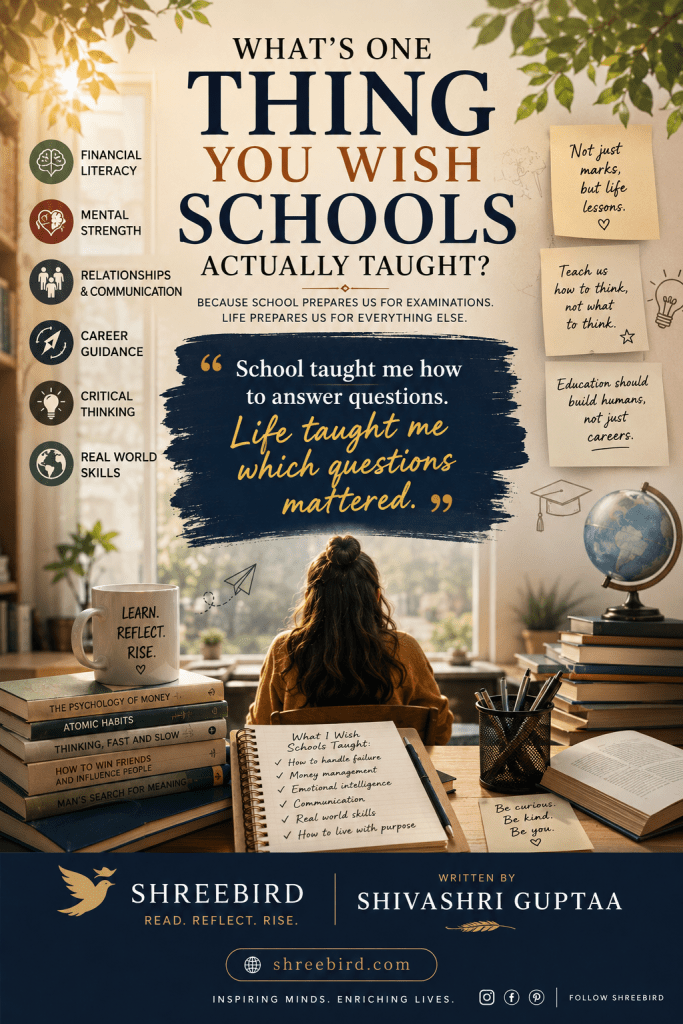
Because school prepares us for examinations. Life prepares us for everything else.
“Education is not preparation for life; education is life itself.” — John Dewey
Let me ask you something.
If you could walk into your old classroom tomorrow and add one subject to the timetable—
what would it be?
Money?
Mental strength?
How to handle rejection?
How to choose the right career?
How to communicate?
How to love without losing yourself?
How to leave when something is hurting you?
How to deal with failure?
How to think critically?
How to use technology without becoming dependent on it?
Or perhaps something as simple as:
How to actually live.
Because there is a strange contradiction in education.
We spend years learning how to calculate the area of a triangle.
We memorise dates.
We solve equations.
We learn chemical formulas.
We write examinations.
We collect marks.
And then one day—
school ends.
And suddenly life asks:
“How will you manage your money?”
“How will you choose a career?”
“How will you know whom to trust?”
“What will you do when you fail?”
“How will you handle loneliness?”
“How will you recognise manipulation?”
“How will you disagree without becoming cruel?”
“How will you use AI without allowing it to think for you?”
And we realise:
Nobody gave us the syllabus.
📚 We Were Taught Answers. We Were Rarely Taught Questions.
School often rewards the student who knows the correct answer.
But adulthood often rewards the person who knows which question to ask.
At school:
2 + 2 = 4.
In life:
Should I take this job?
Should I marry this person?
Should I invest this money?
Should I leave this city?
Should I start again?
Should I trust this information?
Should I follow the crowd?
There is no answer sheet.
There is no teacher standing outside the examination hall.
There is no bell announcing:
“Time’s up.”
You are simply expected to decide.
And sometimes the decision changes your entire life.
Perhaps the most important subject schools could teach is decision-making.
💰 1. I Wish Schools Taught Us How Money Actually Works
Imagine being 18.
You know algebra.
You know trigonometry.
You can write an essay on the French Revolution.
But you don’t understand:
interest,
inflation,
taxes,
insurance,
loans,
credit scores,
investing,
emergency funds,
compounding,
budgeting,
or financial scams.
And then the world gives you a salary.
Suddenly, you are expected to manage money you were never taught to understand.
This is not a small gap.
Financial decisions can shape decades of a person’s life.
Imagine two young people earning the same salary.
One understands budgeting, emergency savings and compound growth.
The other spends everything, takes expensive debt and begins investing only when retirement is approaching.
Their starting point was identical.
But their financial futures can become dramatically different.
Money is not everything.
But not understanding money can quietly affect almost everything.
Schools don’t need to turn children into stock-market experts.
They need to teach them:
How to read a bank statement.
How interest works.
Why debt can become dangerous.
Why saving matters.
How scams work.
What insurance actually does.
What taxes mean.
How compound interest works.
Because financial literacy isn’t about becoming rich.
It is about becoming less vulnerable.
🧠 2. I Wish Schools Taught Us How to Think, Not Just What to Think
This has become even more important in the age of AI.
In April 2026, CBSE introduced a new Computational Thinking and Artificial Intelligence curriculum for Classes 3–8, designed to develop AI-ready learners through computational thinking.
That’s an important shift.
But here’s the bigger question:
If AI can give students answers, what exactly should schools teach?
Perhaps the answer is:
How to question the answer.
AI can generate a convincing paragraph.
That doesn’t make the paragraph true.
AI can summarise an argument.
That doesn’t mean the argument is correct.
AI can produce an image.
That doesn’t mean the image represents reality.
AI can recommend something.
That doesn’t mean the recommendation is wise.
The future student therefore needs more than digital skills.
They need:
critical thinking, curiosity, media literacy, ethics and judgment.
UNESCO’s 2026 education discussions have similarly emphasised combining digital and AI literacy with creativity, critical thinking, empathy and other human-centred capabilities.
Because the most valuable human skill in an AI world may not be:
“Can you produce an answer?”
It may be:
“Can you recognise a bad answer?”
🤖 The AI Classroom Is Coming. But the Human Classroom Must Stay.
Imagine a student who can ask AI to write every essay.
Solve every problem.
Generate every presentation.
Summarise every book.
Write every email.
Create every idea.
They may become extremely efficient.
But efficiency is not the same as wisdom.
A calculator didn’t make mathematics useless.
The internet didn’t make knowledge useless.
And AI shouldn’t make thinking useless.
The role of education should evolve.
Not:
Human vs AI.
But:
Human thinking + responsible technology.
UNESCO has explicitly stressed human agency, critical thinking and ethics in education during the generative-AI era.
That may become one of the defining educational challenges of our generation.
💔 3. I Wish Schools Taught Us How to Handle Failure
This might be the most important one.
Because school often teaches us to fear mistakes.
Wrong answer?
Marks deducted.
Low score?
Parents worried.
Failed exam?
You feel like you’ve failed yourself.
But real life doesn’t work like an examination.
People fail businesses.
Fail interviews.
Fail relationships.
Fail exams.
Fail investments.
Fail plans.
Fail expectations.
And sometimes—
they fail spectacularly.
But failure isn’t always the opposite of success.
Sometimes:
Failure is information.
It tells you:
This approach didn’t work.
This career isn’t right.
This person wasn’t right for you.
This preparation wasn’t enough.
This business model needs changing.
This dream needs a different route.
Imagine if schools taught students to say:
“I failed at this.”
instead of:
“I am a failure.”
That tiny difference can change an entire life.
🏀 Look at Michael Jordan
Michael Jordan is often remembered as one of the greatest basketball players in history.
But the mythology around greatness sometimes hides something important:
Greatness contains enormous amounts of failure.
The lesson isn’t that every rejection guarantees success.
It is that failure doesn’t automatically determine your final identity.
A student who gets 55% isn’t necessarily less intelligent.
A person who fails one competitive examination isn’t necessarily incapable.
Someone rejected from a job isn’t necessarily unemployable.
Someone whose business collapses isn’t necessarily a bad entrepreneur.
A result is an event.
It should not become your identity.
Schools could teach this explicitly.
Because students don’t just need knowledge.
They need emotional recovery skills.
❤️ 4. I Wish Schools Taught Us Relationships
We learn biology.
But not always:
How to communicate.
We learn grammar.
But not always:
How to apologise.
We learn history.
But not always:
How to understand another person’s perspective.
We learn mathematics.
But not always:
How to recognise an unhealthy relationship.
We learn chemistry.
But not always:
How to set a boundary.
Yet relationships will influence almost every part of our adult lives.
Friendships.
Marriage.
Family.
Work.
Leadership.
Parenting.
Teamwork.
Even our relationship with ourselves.
What if schools taught:
Active listening.
Conflict resolution.
Consent and boundaries.
Emotional regulation.
Healthy communication.
Respectful disagreement.
Recognising manipulation.
How to apologise without defending yourself.
How to say no without guilt.
These aren’t “soft” skills.
They are life infrastructure.
🗣️ 5. I Wish Schools Taught Us How to Communicate
You can be brilliant and still struggle if you cannot communicate your ideas.
You can be talented and still be misunderstood.
You can be right and still lose an argument because you don’t know how to express yourself.
Communication isn’t just public speaking.
It is knowing:
When to speak.
When to listen.
How to disagree.
How to ask for help.
How to negotiate.
How to write clearly.
How to tell someone difficult news.
How to speak to someone who thinks differently from you.
A classroom could teach this through debates, presentations, group projects and real-world situations.
Not merely:
“Give a five-minute speech because it is worth 10 marks.”
But:
“Learn how to make your voice useful.”
🧭 6. I Wish Schools Taught Us How to Choose a Career
One of the strangest questions we ask teenagers is:
“What do you want to become?”
As if a 15-year-old is supposed to know.
At 15, many children don’t even know themselves.
Yet we expect them to choose a stream.
Then a degree.
Then a career.
Then somehow stick with it.
Meanwhile, the world itself keeps changing.
AI is changing jobs.
Remote work is changing workplaces.
Entrepreneurship is changing career paths.
The creator economy is creating new professions.
Technology is transforming old ones.
In May 2026, the Indian government also discussed revamping AI curricula with stronger practical exposure, industry integration and faculty development—another sign that education is being pushed closer to changing workplace realities.
So perhaps career education shouldn’t be:
“Choose Science, Commerce or Arts.”
It should be:
“Understand yourself, understand the world, then choose.”
Students should learn:
What are my strengths?
What kind of problems do I enjoy solving?
What lifestyle do I want?
What skills are valuable?
What careers actually exist?
What does a profession look like beyond its glamorous title?
What happens if my first choice doesn’t work?
A career is not a one-time answer.
It is a series of decisions.
🌱 7. I Wish Schools Taught Us How to Live With Ourselves
This might be the most underrated subject of all.
Self-awareness.
Knowing what you feel.
Knowing why you feel it.
Understanding your strengths.
Accepting your weaknesses.
Recognising comparison.
Understanding your triggers.
Knowing when you need rest.
Knowing when you need help.
Knowing the difference between loneliness and solitude.
Learning that being alone is not the same as being unwanted.
Learning that asking for help is not weakness.
Imagine a school where one period every week was simply:
“Understanding Yourself.”
No exam.
No marks.
Just reflection.
What made you happy this week?
What frightened you?
What did you avoid?
What did you learn about yourself?
What do you want to change?
Perhaps some of the most important education happens when nobody is giving you information.
When you are learning how to understand yourself.
🌍 8. I Wish Schools Taught Us How the Real World Works
What is inflation?
Why does the price of something rise?
How does a government budget work?
What is a contract?
What does “interest rate” mean?
What happens when you sign something you haven’t read?
How does the news influence public opinion?
How do algorithms decide what you see?
How can misinformation spread?
What is a scam?
What does privacy mean online?
How does a company make money?
What is intellectual property?
What is a basic legal right?
These are not just adult topics.
They are citizenship skills.
A well-educated person should not merely know facts.
They should understand the systems surrounding them.
📱 9. I Wish Schools Taught Digital Citizenship
A teenager today can have access to more information before breakfast than previous generations encountered in months.
But information isn’t automatically knowledge.
And access isn’t automatically wisdom.
Students need to understand:
Digital footprints.
Privacy.
Deepfakes.
Cyberbullying.
Misinformation.
Online manipulation.
Algorithmic recommendation.
AI-generated content.
Responsible sharing.
UNESCO’s recent work on digital citizenship and AI education has emphasised understanding how algorithms work and the ethical, social and educational challenges they create—not simply learning to operate the technology.
That’s crucial.
Because the next generation doesn’t merely need to be good users of technology.
They need to be good citizens inside technological systems.
🌳 10. I Wish Schools Taught Us How to Care for the Planet
We can memorise the definition of climate change.
But what if students actually learned to live with the planet?
Grow food.
Compost.
Understand water.
Measure household waste.
Plant trees and care for them.
Understand local biodiversity.
Learn where electricity comes from.
Understand food miles.
Visit wetlands.
Study rivers.
Learn how cities manage waste.
Imagine a school where students didn’t just read about sustainability.
They practiced it.
Because education should not merely describe the world.
It should teach us how to take responsibility for it.
🧑🍳 And Maybe Schools Should Teach One More Thing: Basic Life Skills
Imagine graduating at 18 knowing:
How to cook five healthy meals.
How to sew a button.
How to read a bill.
How to make a budget.
How to perform basic first aid.
How to write a professional email.
How to speak in an interview.
How to use public transport.
How to identify a scam.
How to make a simple CV.
How to maintain basic hygiene.
How to understand a rental agreement.
How to handle an emergency.
How to live independently.
These things may never appear in a board examination.
But they appear repeatedly in life.
Perhaps we should stop asking only, “What did the student score?”
And start asking:
“Can this student navigate the world?”
🎓 The Education System Is Already Beginning to Change
This isn’t merely a philosophical dream.
Education itself is changing.
India’s NEP 2020 has been pushing toward more holistic, multidisciplinary and technology-enabled education, and AI is now becoming part of that transition. In 2026, CBSE formally launched its Computational Thinking and AI curriculum for Classes 3–8 for the 2026–27 academic session.
Globally, the conversation is moving in a similar direction.
UNESCO’s 2026 work around youth skills has emphasised that AI and digital literacy need to sit alongside creativity, critical thinking and empathy.
That is an important signal.
Because the future doesn’t simply need people who know more.
It needs people who can think better.
And perhaps—
feel better,
communicate better,
adapt better,
decide better,
and live more responsibly.
🧠 What If the School of the Future Looked Different?
Imagine a timetable like this:
Monday: Mathematics Tuesday: Science Wednesday: Financial Literacy Thursday: Communication & Relationships Friday: Critical Thinking & Media Literacy Saturday: Life Skills, Creativity & Community Projects
And every semester:
One real-world problem.
Students must solve it.
Maybe:
How can our school reduce food waste?
How can we save water?
How can we create a budget for a family?
How can we detect fake information?
How can we design an accessible public space?
How can we help an elderly person use digital services?
Now education becomes different.
Because students aren’t merely asking:
“Will this come in the exam?”
They’re asking:
“Where can I use this in life?”
💬 Nelson Mandela’s Question
Nelson Mandela famously said:
“Education is the most powerful weapon which you can use to change the world.”
But perhaps today we need to expand the meaning of education.
Education shouldn’t only help a person earn a living.
It should help them:
build a life,
understand a society,
question injustice,
handle uncertainty,
care for others,
protect themselves,
and
become the kind of person they would want to live with.
🕯️ The Most Important Lesson May Be Learning How to Learn
There is one reason all of this matters even more now.
The world is changing faster than syllabi can be rewritten.
Today’s technical skill may become tomorrow’s outdated skill.
Today’s popular career may look different ten years from now.
AI will change some jobs.
New jobs will appear.
Old assumptions will disappear.
So perhaps the ultimate subject isn’t:
“Learn everything.”
That is impossible.
It is:
“Learn how to keep learning.”
Teach a child curiosity.
Teach them how to verify.
Teach them how to experiment.
Teach them how to fail.
Teach them how to ask better questions.
Teach them how to change their mind when evidence changes.
Then the child can keep learning long after the final school bell.
🌿 The SHREEBIRD Question
If I could add only one subject to every school in the world, I wouldn’t call it:
Financial Literacy.
Mental Health.
Career Planning.
Life Skills.
Critical Thinking.
Or Emotional Intelligence.
I would call it:
“The Art of Being Human.”
Because inside that one subject, we could teach:
How to think.
How to feel.
How to decide.
How to communicate.
How to fail.
How to love.
How to earn.
How to spend.
How to disagree.
How to adapt.
How to care.
How to begin again.
And perhaps most importantly—
how to remain human in a world becoming increasingly intelligent.
❤️ A Final Thought
Maybe the greatest problem with education isn’t that schools teach the wrong things.
It is that they sometimes teach only one kind of intelligence.
The intelligence that produces marks.
But life requires many kinds of intelligence.
Financial intelligence.
Emotional intelligence.
Social intelligence.
Moral intelligence.
Digital intelligence.
Practical intelligence.
Creative intelligence.
And the intelligence to look at your own life and ask:
“Is this really the life I want to build?”
Because someday, every student will leave the classroom.
The uniform will be folded away.
The textbooks will gather dust.
The examination results will become old documents.
And the real examination will begin.
No invigilator.
No question paper.
No model answer.
Just life.
And perhaps the best education is the one that prepares you for that moment.
“School taught me how to answer questions. Life taught me which questions mattered.”
Maybe that’s what schools should actually teach.
💭 Now It’s Your Turn
If you could walk into your old school tomorrow and add ONE compulsory subject—
What would you teach?
Money?
Relationships?
Failure?
Critical thinking?
Cooking?
Career planning?
Mental strength?
Digital literacy?
Self-awareness?
Or something completely different?
Tell us your one subject.
Because perhaps the education system of tomorrow begins with the question we ask today.
📖 The Psychology of Money — Morgan Housel Because understanding money is a life skill, not just a financial skill. → Read the book → https://link.amazon/B0fsKGA5W
📖 Atomic Habits — James Clear Because the person you become is shaped by what you repeatedly do. → Read the book →https://link.amazon/B02b5IcK6
📖 Thinking, Fast and Slow — Daniel Kahneman For anyone who wants to understand how the human mind makes decisions. → Explore the book → https://link.amazon/B07FAwy5e
📖 How to Win Friends and Influence People — Dale Carnegie Because communication and relationships are part of every education. → Read the book → https://link.amazon/B02ZrSBs8
📖 Man’s Search for Meaning — Viktor E. Frankl For the lessons about meaning, resilience and the human spirit that no textbook can fully teach. → Read the book → https://link.amazon/B0ejzcoRn
🌱 A NOTE FROM SHREEBIRD
At SHREEBIRD, we believe learning doesn’t stop when school ends.
Sometimes the most important lessons come from:
A failed attempt.
A difficult relationship.
A journey.
A book.
A conversation.
A mistake.
A quiet morning.
Or a question we were finally brave enough to ask ourselves.
Affiliate Disclosure: Some links on SHREEBIRD may be affiliate links. If you purchase through these links, SHREEBIRD may earn a small commission at no additional cost to you. We recommend books and resources because we believe they may genuinely add value to our readers.
🎓 ONE LAST QUESTION BEFORE YOU LEAVE
If school had taught you one lesson about life that you know today, what would you wish you had learned earlier?
Maybe your answer is exactly the lesson another student needs to hear.


टिप्पणी करे