Three Impossible Dinners, Three Extraordinary Minds

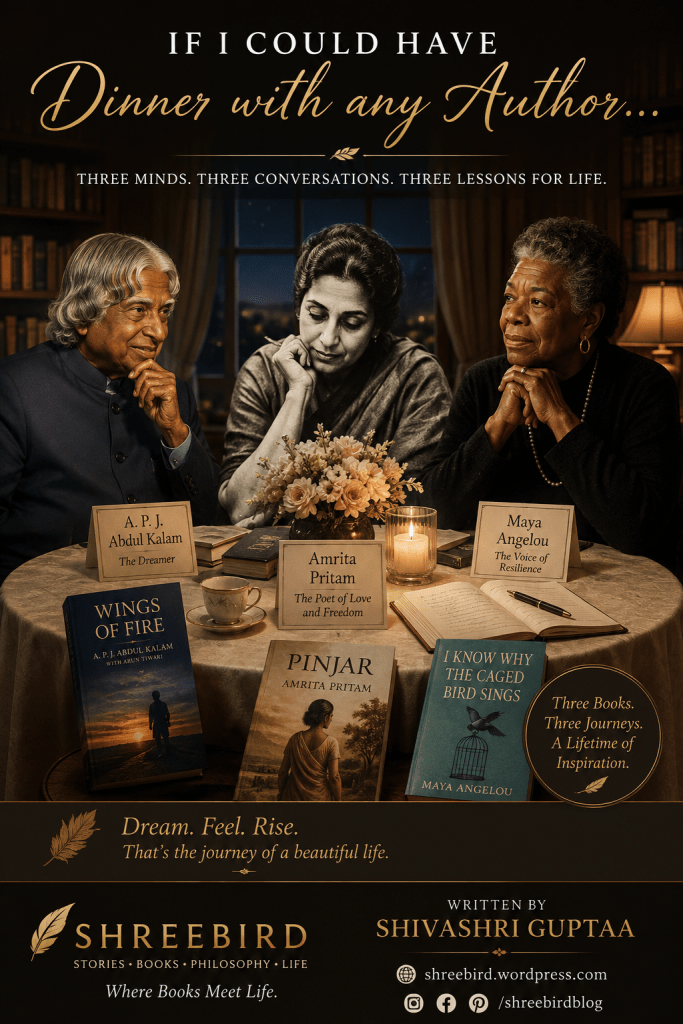
What if you could sit across the table from any author—living or dead—and ask them everything you’ve ever wanted to know?
There are questions that sound simple until you actually try to answer them.
“Which author would you love to have dinner with?”
My answer isn’t one name.
It is three.
Because if I had three impossible dinner invitations, I would choose three people who represent three completely different dimensions of life:
Dr. A.P.J. Abdul Kalam — for dreams.
Amrita Pritam — for love, freedom and the courage to be yourself.
Maya Angelou — for resilience and the art of rising after life breaks you.
Three writers.
Three lives.
Three conversations.
And perhaps, three lessons I would carry home forever.
🍽️ DINNER ONE
Dr. A.P.J. Abdul Kalam — The Dinner About Dreams
Imagine sitting across from Dr. A.P.J. Abdul Kalam.
The former President of India.
The aerospace scientist.
The man lovingly remembered as the People’s President.
But I wouldn’t begin by asking him about missiles, science or the presidency.
I’d ask him something much simpler:
“Sir, how do you keep dreaming when your circumstances are telling you to be realistic?”
Because Kalam’s own journey is a reminder that extraordinary lives don’t always begin in extraordinary circumstances.
Born in Rameswaram in 1931, he went on to become a renowned aerospace scientist, play a major role in India’s space and defence programmes, and later serve as India’s 11th President. His life became synonymous with scientific ambition, education and inspiring young people. His autobiography Wings of Fire, written with Arun Tiwari, traces that journey from childhood and early struggles to his scientific career.
And that’s precisely why I’d want to meet him.
Not because he became successful.
But because he dreamed before success was visible.
🌌 What Would I Ask Kalam?
I’d probably have a notebook with me.
Not because I wanted an autograph.
Because I’d be terrified of forgetting anything he said.
I’d ask:
“What do you do when you work hard and still fail?”
I’d ask:
“How do you know whether to keep pursuing a dream or let it go?”
I’d ask:
“Why do young people lose their dreams as they grow older?”
And finally:
“What is the difference between having ambition and having a meaningful life?”
I imagine Kalam would take that question seriously.
Because his vision of education was never merely about collecting degrees.
He consistently spoke to young people about imagination, scientific thinking, responsibility and national development.
His book Wings of Fire itself is much more than a conventional autobiography. The official President of India archive describes it as an autobiography of Kalam with Arun Tiwari, built around his life, ideas and experiences.
📚 SHREEBIRD BOOK RECOMMENDATION
Wings of Fire — A.P.J. Abdul Kalam with Arun Tiwari
If you want to understand Kalam beyond inspirational quotes circulating on social media, read the autobiography.
It takes you into his childhood, education, professional struggles, scientific journey and evolving philosophy.
The book was originally published by Universities Press in 1999.
SHREEBIRD Affiliate Pick:
📖 Wings of Fire — An Autobiography
👉 Buy through SHREEBIRD: [Insert your Amazon Associates affiliate link here]
Affiliate disclosure: SHREEBIRD may earn a small commission if you purchase through this link, at no additional cost to you.
🌹 DINNER TWO
Amrita Pritam — The Dinner Date I Would Never Want to End
And then comes the dinner I would probably be most emotionally curious about.
Amrita Pritam.
If Kalam is the person I’d invite for a conversation about dreams, Amrita Pritam is the woman I’d invite for a conversation about love, loneliness, identity and freedom.
And yes—
I would call this a dinner date.
Not because I want to turn a literary icon into a romantic fantasy.
But because her writing makes you feel as though she understood something about the human heart that most of us spend our entire lives trying to articulate.
Amrita Pritam was one of the major literary voices of modern Punjabi literature, known as a poet, novelist and essayist. Her writing crossed languages and explored love, womanhood, displacement, Partition and the complicated interior lives of people.
And she didn’t write like someone asking permission.
She wrote like someone who had already decided:
“My life belongs to me.”
That’s what I would want to discuss with her.
☕ What Would I Ask Amrita?
Honestly?
I wouldn’t start with:
“How did you become a writer?”
I’d ask:
“Amrita ji, what does it mean to love someone without losing yourself?”
Because that question feels almost timeless.
We often confuse love with possession.
We confuse sacrifice with devotion.
We confuse loneliness with the absence of another person.
And we sometimes spend years trying to be loved while forgetting to ask:
“Do I still recognise myself?”
Amrita Pritam’s life and writing invite exactly these uncomfortable questions.
And that’s why I think this dinner would be different from the Kalam dinner.
With Kalam, I’d arrive with questions about the future.
With Amrita, I’d probably end up talking about the past.
About people who left.
People who stayed.
People we loved.
People we couldn’t love.
And the strange ways memory refuses to disappear.
🕊️ I’d Ask Her About Freedom
One question would definitely be:
“Did freedom ever feel lonely?”
Because we romanticise freedom.
We say:
Be independent.
Follow your heart.
Choose yourself.
But nobody talks enough about the loneliness that can accompany choosing your own path.
Sometimes freedom means disappointing people.
Sometimes it means being misunderstood.
Sometimes it means walking away from the life everyone else thinks you should live.
And sometimes it means sitting alone with the consequences of your choices.
That’s a conversation I’d want to have with Amrita Pritam.
Not as a fan.
But as a woman asking another woman:
“Was the price of becoming yourself ever too high?”
📖 And Then We’d Talk About Pinjar
Of all the books I could recommend by Amrita Pritam, Pinjar would be my first choice for SHREEBIRD readers.
Pinjar was originally written in Punjabi and is set against the backdrop of Partition. Its central character, Puro, becomes caught in the violence, displacement and social cruelty surrounding Partition, particularly the suffering experienced by women. Penguin’s description highlights the novel’s exploration of Partition, women’s suffering, human rights, religious divisions and the possibility of forgiveness and rebuilding one’s future.
The title itself is powerful.
Pinjar means “skeleton.”
And that becomes more than a physical image.
It becomes a metaphor for what happens when society strips a human being of identity, choice, dignity and belonging.
Puro isn’t merely a character.
She becomes a question:
What remains of a person when the world takes away everything they thought they were?
That’s why Pinjar isn’t simply a Partition novel.
It is a novel about:
Identity.
Women.
Violence.
Belonging.
Forgiveness.
Survival.
And the complicated possibility of beginning again.
📚 SHREEBIRD BOOK RECOMMENDATION
Pinjar — Amrita Pritam
If you’ve never read Amrita Pritam, this is an extraordinary place to begin.
Penguin Random House India’s current edition is 160 pages and was published in 2019.
SHREEBIRD Affiliate Pick:
📖 Pinjar — Amrita Pritam
👉 Buy through SHREEBIRD: [Insert your Amazon Associates affiliate link here]
Affiliate disclosure: If you purchase through this affiliate link, SHREEBIRD may earn a small commission at no extra cost to you.
🌙 And Before the Dinner Ended…
I think I’d ask Amrita one last question.
Not about literature.
Not about fame.
Not about love.
I’d ask:
“If you could go back and meet the younger Amrita, what would you tell her?”
That answer would probably stay with me longer than anything else.
Because every woman has a younger version of herself somewhere inside.
The girl who had dreams.
The girl who believed.
The girl who loved without knowing how complicated love could become.
The girl who thought adulthood would finally make everything understandable.
And perhaps growing up is partly learning how to protect that girl without allowing her innocence to control your life.
🕯️ DINNER THREE
Maya Angelou — The Dinner About Rising Again
And then there’s Maya Angelou.
If Kalam represents dreaming and Amrita represents feeling, Maya Angelou represents rising.
She was a poet, memoirist, performer, playwright, civil-rights activist and one of the most influential literary voices of modern America.
Her life was remarkably varied. Before becoming internationally celebrated as a writer, she worked in numerous fields and was deeply involved in civil-rights activism. She eventually wrote more than 30 books and became known worldwide for her autobiographical writing and poetry.
And then there is I Know Why the Caged Bird Sings.
Her first memoir.
A book about childhood, racism, poverty, trauma, identity and the power of literature.
Penguin Random House describes it as Angelou’s debut memoir and a modern American classic; it became the first volume of her seven-part autobiographical series.
🐦 What Would I Ask Maya Angelou?
I’d ask:
“How do you remain soft after life has given you reasons to become hard?”
Because that might be one of the hardest things in life.
Pain can make us cruel.
Failure can make us cynical.
Betrayal can make us distrustful.
But there are people who experience enormous pain and somehow refuse to let it destroy their capacity for love.
That’s the kind of person I would want to understand.
I’d ask her:
“How do you forgive without pretending the hurt didn’t happen?”
“How do you rebuild yourself after losing a part of who you were?”
And finally:
“How do you rise without becoming bitter?”
Her memoir is powerful precisely because it does not erase suffering. It places difficult experiences alongside literature, self-discovery and the development of an enduring sense of self.
📚 SHREEBIRD BOOK RECOMMENDATION
I Know Why the Caged Bird Sings — Maya Angelou
This is the book I’d recommend if you want to understand Angelou’s voice rather than simply read her famous quotes.
It’s painful.
It’s beautiful.
It’s uncomfortable.
And ultimately, it is deeply human.
The book was first published in 1969 and became the opening volume of her seven autobiographical works.
SHREEBIRD Affiliate Pick:
📖 I Know Why the Caged Bird Sings — Maya Angelou
👉 Buy through SHREEBIRD: [Insert your Amazon Associates affiliate link here]
Affiliate disclosure: SHREEBIRD may earn a small commission from qualifying purchases made through this link, at no additional cost to you.
✨ THREE AUTHORS. THREE QUESTIONS.
If I think about these three dinners together, something beautiful happens.
I realise I wouldn’t actually be meeting three authors.
I’d be meeting three philosophies of life.
🌟 Kalam would ask me:
“What is your dream?”
And I’d have to answer honestly.
🌹 Amrita would ask:
“What do you love—and have you lost yourself in that love?”
And I’d probably need more time.
🕊️ Maya would ask:
“After everything you’ve been through, will you still rise?”
And I’d hope my answer would be:
Yes.
📚 THREE BOOKS I’D TAKE HOME
If this impossible dinner actually happened, I’d want three books sitting on my table afterwards.
1. Wings of Fire
A.P.J. Abdul Kalam with Arun Tiwari
Lesson: Dream beyond your circumstances.
Explore Wings of Fire via the President of India’s archivehttps://link.amazon/B0gUXtp1k
2. Pinjar
Amrita Pritam
Lesson: Identity and dignity can survive even when history tries to take them away.
Explore Pinjar at Penguin Random House Indiahttps://link.amazon/B0ajWI0E8
3. I Know Why the Caged Bird Sings
Maya Angelou
Lesson: Your past can shape your story without having the final word over your future.
Explore I Know Why the Caged Bird Sings at Penguin Random Househttps://link.amazon/B0c0iGD4o
💭 If I Had to Choose Only ONE…
This is where the question becomes difficult.
If someone forced me to cancel two reservations and keep only one—
I’d probably choose Amrita Pritam.
Because Kalam’s ideas can be explored through his books.
Maya’s wisdom can be heard through her poetry and memoirs.
But with Amrita, I imagine the conversation itself would become a piece of literature.
I’d want to sit across from her.
Order something warm.
Listen to the pauses between her sentences.
Ask about love.
Ask about freedom.
Ask about loneliness.
Ask about writing.
Ask about the women she saw.
Ask about the people she lost.
Ask what it means to live a life that belongs completely to yourself.
And then, perhaps, I’d say:
“Amrita ji, tell me something you have never written.”
And then I’d shut up.
Because sometimes the greatest privilege isn’t being the person who speaks.
It’s being the person someone finally feels safe enough to tell.
🌿 WHAT THESE THREE AUTHORS TEACH ME
Perhaps this is why these three people belong together in my imaginary dining room.
Kalam teaches me to look upward.
Toward dreams.
Toward possibility.
Toward a future that doesn’t yet exist.
Amrita teaches me to look inward.
Toward love.
Toward identity.
Toward the complicated truth of being human.
Maya teaches me to look forward.
Even after pain.
Even after failure.
Even after life has taken something from me.
And perhaps that is the complete journey:
Dream. Feel. Rise.
🐦 THE SHREEBIRD QUESTION
Now I want to turn the dinner table toward you.
Forget the usual celebrity answers.
Forget the authors you’re supposed to choose.
Imagine the impossible invitation arrives tonight.
Three chairs.
Three authors.
One dinner.
Who would you invite?
And more importantly—
What is the ONE question you would ask them?
Because perhaps the author we want to meet tells us something about the person we are becoming.
Maybe you choose Kalam because you need courage to dream.
Maybe Amrita because you’re trying to understand love.
Maybe Maya because you’re learning how to rise.
Or maybe you choose someone completely different.
Tell me your author.
I’d love to know what conversation is waiting inside your imagination.
📚 SHREEBIRD READING SHELF
For the Dreamer
Wings of Fire — A.P.J. Abdul Kalam with Arun Tiwari
For the Heart
Pinjar — Amrita Pritam
For the Survivor
I Know Why the Caged Bird Sings — Maya Angelou
🛒 SHREEBIRD AFFILIATE BOOK PICKS
A.P.J. Abdul Kalam: Wings of Fire
👉 https://link.amazon/B023ZG5Hr
Amrita Pritam: Pinjar
👉 https://link.amazon/B01j9AyRU
Maya Angelou: I Know Why the Caged Bird Sings
👉 https://link.amazon/B063815zF
Disclosure: Some links in this article may be affiliate links. If you purchase through them, SHREEBIRD may receive a small commission at no additional cost to you. These commissions help support the creation of future articles.
🐦 SHREEBIRD
Stories • Books • Philosophy • Life
Written by:
SHIVASHRI GUPTAA
SHREEBIRD — Where Books Meet Life.
🌐 Website: shreebird.wordpress.com
📚 Read. Think. Feel. Grow.
Because sometimes the right book doesn’t give you an answer.
It gives you a better question.
© SHREEBIRD | SHIVASHRI GUPTAA
All rights reserved.
SHREEBIRD — Read deeply. Live consciously.


टिप्पणी करे