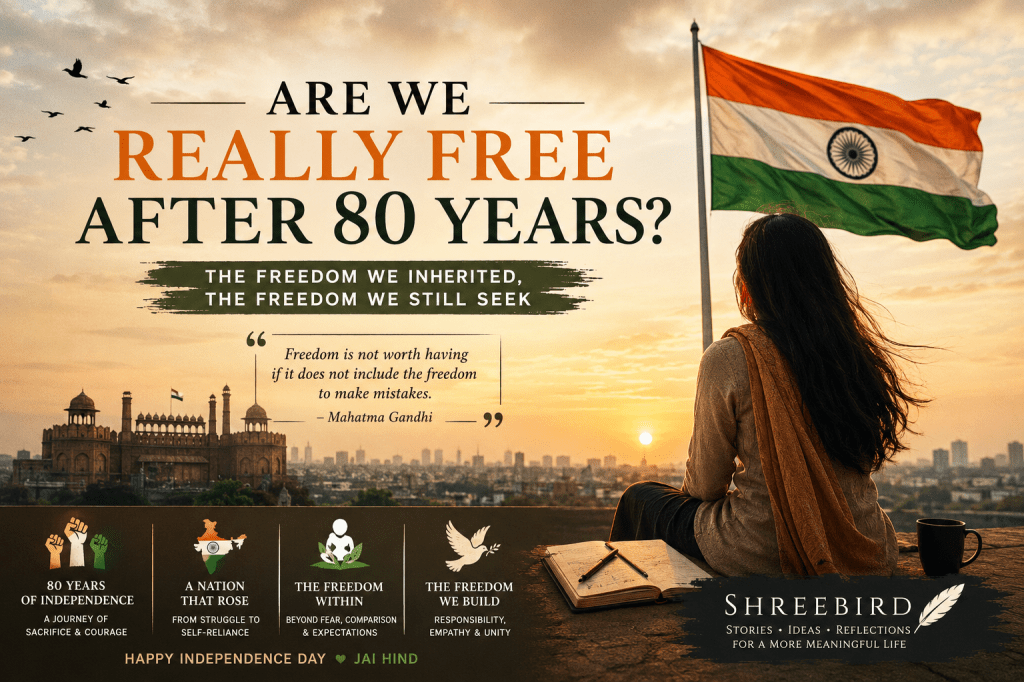
The Freedom We Inherited, The Freedom We Still Seek
“Freedom is not worth having if it does not include the freedom to make mistakes.” — Mahatma Gandhi
Every year, on August 15, India wakes up wrapped in the colours of the tricolour.
Flags rise from rooftops.
Schools echo with patriotic songs.
The national anthem plays.
Children dress as freedom fighters.
We remember Gandhi, Bhagat Singh, Subhas Chandra Bose, Sardar Patel, Rani Lakshmibai, Sarojini Naidu and countless others whose names may never appear in our textbooks—but whose sacrifices made our freedom possible.
And yet, perhaps on India’s 80th Independence Day, we should pause for a moment and ask a slightly uncomfortable question:
Are we really free?
Not politically.
India is a sovereign nation.
Not constitutionally.
We have fundamental rights.
Not historically.
The British left.
But what about the freedom that exists inside an individual?
Are we free from fear?
Are we free from social expectations?
Are women free to define their own lives?
Are young people free from the pressure to succeed according to someone else’s timeline?
Are we financially free?
Are we mentally free?
Are we free from comparison?
Are we free from the need to constantly prove our worth?
Because perhaps a nation can become politically independent while its people continue to carry invisible chains.
🇮🇳 80 YEARS OF FREEDOM — AND A NEW QUESTION
On August 15, 2026, India celebrated its 80th Independence Day—a milestone that naturally invites us to look backward and forward at the same time. Recent coverage of the celebrations has framed India’s journey not simply as a remembrance of 1947, but as a conversation about what the country should become by 2047.
The symbolism was powerful.
A country that once fought for the right to govern itself was now discussing:
Artificial intelligence
Semiconductor manufacturing
Youth skills
Women’s participation
Entrepreneurship
Digital transformation
Defence
Energy security
Economic self-reliance
A developed India by 2047
The vocabulary of freedom has changed.
In 1947, freedom meant:
Get the British out.
In 2026, freedom may increasingly mean:
Build a country where every individual has the ability and dignity to shape their own future.
And that is a much harder freedom to achieve.
🌿 FREEDOM HAS MANY LAYERS
We often think freedom means only one thing:
Political independence.
But human beings experience freedom at many levels.
Political Freedom
The freedom of a nation to govern itself.
Economic Freedom
The ability to earn, save, invest and make choices without being trapped by financial insecurity.
Social Freedom
The freedom to question outdated expectations.
Intellectual Freedom
The freedom to think differently.
Emotional Freedom
The freedom to leave relationships, situations and identities that no longer allow us to grow.
Digital Freedom
The ability to navigate an increasingly connected world without becoming controlled by algorithms, misinformation or digital addiction.
Spiritual Freedom
Perhaps the deepest one—
the freedom to know who you are beyond society’s labels.
And suddenly, Independence Day becomes more personal.
It is no longer just about the country.
It becomes about the citizen.
🕊️ THE FREEDOM FIGHTERS FOUGHT FOR SOMETHING BIGGER THAN A FLAG
Imagine India in 1947.
People had lived under colonial rule for generations.
The freedom movement was not simply about changing the flag.
It was about dignity.
Self-respect.
Self-determination.
The right to decide our own future.
Mahatma Gandhi’s idea of Swaraj was deeper than merely replacing British rulers with Indian rulers.
It involved self-rule.
And perhaps that idea remains surprisingly relevant.
Because what is the point of political Swaraj if we have no self-rule over our own minds?
If an algorithm determines what we watch…
If society determines whom we should marry…
If relatives determine what career we should choose…
If social media determines what success should look like…
If comparison determines whether we feel worthy…
Then perhaps we should ask:
How much of our life are we actually choosing?
📱 THE NEW COLONISATION MAY NOT LOOK LIKE COLONISATION
The modern world does not need chains to influence us.
Sometimes it only needs a screen.
We open Instagram for five minutes.
An hour disappears.
We see someone’s vacation.
We see someone’s wedding.
Someone else’s promotion.
Someone else’s new house.
Someone else’s body transformation.
Someone else’s relationship.
Someone else’s success.
And suddenly—
our own life feels smaller.
Nobody forced us to compare.
Nobody ordered us to feel inadequate.
Yet somehow, we surrendered our peace.
That is why freedom in the digital age requires a new kind of literacy.
Not merely knowing how to use technology.
But knowing when technology is using us.
💰 CAN YOU BE FREE WITHOUT FINANCIAL FREEDOM?
This is one of the most practical questions of modern freedom.
Imagine having a dream—
but no savings.
Imagine wanting to leave a toxic workplace—
but being unable to survive without the salary.
Imagine wanting to study—
but being afraid of the cost.
Imagine wanting to start a business—
but being trapped by debt.
Money is not everything.
But financial insecurity can limit choices.
That is why economic progress matters.
Recent discussions around India’s journey at 80 have increasingly focused not only on growth but on financial inclusion, wealth creation and broader participation in the economy.
True freedom is not merely:
“I earn money.”
It is also:
“I have enough financial stability to make meaningful choices.”
👩🏻 FREEDOM FOR WOMEN: FROM PERMISSION TO CHOICE
Perhaps one of the clearest ways to measure a society’s freedom is to ask:
How much freedom does a woman have to choose her own life?
Can she decide whether she wants to marry?
Whether she wants children?
What career she wants?
Where she wants to live?
Whether she wants to travel alone?
Whether she wants to start a business?
Whether she wants to return to work after motherhood?
Whether she wants to say no?
These are not small questions.
They are questions of agency.
The 2026 Independence Day conversation itself included renewed attention to women’s political representation, with the Prime Minister backing greater representation for women and discussing women’s participation in India’s development.
But representation is only one part of freedom.
The deeper transformation happens when a girl grows up believing:
“My life belongs to me.”
🎓 WHAT ABOUT THE FREEDOM OF YOUNG PEOPLE?
Today’s young Indians have opportunities that previous generations could hardly imagine.
The internet has democratised information.
Digital payments have changed everyday commerce.
Online education has expanded access.
AI is changing learning and work.
And on Independence Day 2026, the government announced plans to provide AI training to one crore young people, alongside free online coaching for competitive examinations.
On the surface, this is about technology and employment.
But underneath lies a deeper idea:
Freedom means having the skills to participate in your country’s future.
A young person who can learn, adapt and create has more choices.
And choices are the foundation of freedom.
🤖 THE AI QUESTION: WILL TECHNOLOGY MAKE US FREER?
AI could become one of the greatest tools of empowerment in modern India.
A student in a small town can ask questions that once required an expensive tutor.
A creator can produce content with fewer resources.
A small business can automate repetitive work.
A researcher can analyse information faster.
A person who once struggled with English can use technology as a language-learning companion.
But technology can also create new forms of dependence.
If we allow AI to think for us—
we may become less independent.
If algorithms tell us what to believe—
we may become less intellectually free.
If social media decides what makes us happy—
we may become emotionally dependent.
So perhaps the freedom question of the AI age is not:
“Can machines think?”
It is:
“Can humans continue to think independently while using machines?”
🧠 THE FREEDOM TO THINK DIFFERENTLY
One of the most underrated freedoms is the freedom to have an unpopular opinion.
Not every disagreement is disrespect.
Not every different opinion is rebellion.
Not every unconventional life is a failure.
Sometimes freedom means saying:
“I don’t want the life everyone expects me to want.”
Maybe you don’t want a conventional career.
Maybe you want to travel.
Maybe you want to stay single.
Maybe you want to marry late.
Maybe you want to start over at 35.
Maybe you want to leave a prestigious career.
Maybe you want a simple life instead of a luxurious one.
Maybe your definition of success is peace.
A free society should have room for different dreams.
Because uniformity is not freedom.
🪞 THE INVISIBLE PRISON OF SOCIAL EXPECTATIONS
There are prisons with walls.
And there are prisons without them.
The second kind can be harder to recognise.
“People will laugh.”
“What will relatives say?”
“You are already too old.”
“This career is not respectable.”
“Everyone else is ahead.”
“You should settle down.”
“You should earn more.”
“You should look different.”
“You should behave differently.”
“You should be more successful.”
And slowly, without anyone forcing us—
we begin living according to an imaginary audience.
Perhaps one of the greatest acts of personal freedom is learning to say:
“This is my life. I will live it responsibly, but I will not live it entirely for other people’s approval.”
🌊 A SIMPLE EXAMPLE
Imagine two people.
Person A earns a lot.
Has a beautiful house.
Drives an expensive car.
Has thousands of followers.
But wakes up every morning terrified of losing everything.
Person B earns less.
Lives simply.
Has fewer possessions.
But has time for family, books, nature, health and meaningful work.
Who is more successful?
We cannot answer without knowing their values.
Because freedom is not the same as abundance.
Sometimes freedom is having less—
but owning your time.
🌱 FROM “FREEDOM FROM” TO “FREEDOM TO”
Perhaps this is the next chapter of India’s freedom story.
Our ancestors fought for:
Freedom FROM
colonial rule.
The next generation must build:
Freedom TO
learn.
Create.
Question.
Innovate.
Travel.
Dream.
Earn.
Participate.
Lead.
Choose.
And contribute.
That shift is important.
Because freedom is not only the removal of chains.
Freedom is the presence of possibilities.
🇮🇳 INDIA AT 80: A COUNTRY STILL BECOMING
There is a temptation on Independence Day to tell only a success story.
We celebrate economic growth.
Technology.
Infrastructure.
Space achievements.
Digital transformation.
Entrepreneurship.
Global influence.
And rightly so.
But patriotism does not require pretending that every problem has disappeared.
A mature love for one’s country can hold two thoughts at the same time:
“Look how far we have come.”
And—
“Look how much further we still need to go.”
That is not pessimism.
That is responsibility.
Recent commentary around India’s 80th Independence Day has similarly framed the moment as a combination of pride in the journey and responsibility for the nation-building still ahead.
🌏 FREEDOM ALSO MEANS RESPONSIBILITY
We often talk about our rights.
But freedom without responsibility can become selfishness.
The freedom to drive does not mean the freedom to endanger others.
The freedom to build does not mean the freedom to destroy nature.
The freedom to earn does not mean the freedom to exploit.
The freedom to speak does not mean freedom from consequences.
The freedom to consume does not mean freedom to waste endlessly.
Perhaps the mature version of freedom is:
“I am free—but my freedom exists alongside your dignity.”
That is where citizenship begins.
🌳 WHAT KIND OF INDIA DO WE WANT BY 2047?
India’s 80th Independence Day has naturally turned attention toward 2047, when the country will mark a century of independence. The national conversation is increasingly framed around the idea of a developed India by then.
But imagine asking a child in 2026:
“What kind of India do you want to live in at 100?”
Perhaps she would say:
I want clean rivers.
I want safe streets.
I want excellent schools.
I want honest institutions.
I want opportunities regardless of where I was born.
I want women to feel safe.
I want young people to find meaningful work.
I want villages to have world-class connectivity.
I want technology without losing humanity.
I want development without destroying nature.
I want diversity without hatred.
I want freedom without fear.
That is a much more beautiful definition of a developed nation.
🕯️ THE FREEDOM WE STILL OWE OURSELVES
Our ancestors gave us political freedom.
Now perhaps we have to give ourselves something else.
Freedom from:
Fear.
Ignorance.
Prejudice.
Addiction.
Constant comparison.
Financial helplessness.
Social conditioning.
Intellectual laziness.
The need for external validation.
And perhaps most importantly—
the fear of becoming who we truly want to become.
Because sometimes the biggest prison is not the world.
It is the version of ourselves we are afraid to outgrow.
❤️ WHAT DOES FREEDOM MEAN TO YOU?
Maybe freedom is waking up and knowing your life has direction.
Maybe it is being able to say no.
Maybe it is earning enough to choose.
Maybe it is having the courage to leave.
Maybe it is having the courage to stay.
Maybe it is travelling alone.
Maybe it is choosing your own career.
Maybe it is sitting peacefully with your parents.
Maybe it is writing a book.
Maybe it is starting over.
Maybe it is simply being able to sleep at night without pretending to be someone you are not.
Freedom doesn’t have one definition.
Freedom is personal.
And perhaps that is why the question deserves to be asked again and again.
✨ SO, ARE WE REALLY FREE?
After 80 years, the answer cannot simply be yes or no.
We are freer in countless ways than the generations before us.
But freedom is not a destination.
It is a continuous project.
Every generation has to redefine it.
Every citizen has to protect it.
Every society has to expand it.
And every individual has to examine the invisible chains they carry.
The India of 1947 asked:
“When will we be free?”
The India of 2026 can ask a different question:
“What will we do with the freedom we inherited?”
That question is perhaps even more important.
🌅 THE NEXT 80 YEARS BEGIN WITH US
One day, in 2047, India will celebrate 100 years of independence.
The people celebrating then will look back at us.
They will inherit the choices we make today.
They will inherit our cities.
Our institutions.
Our environment.
Our technology.
Our culture.
Our ideas.
Our mistakes.
And our dreams.
What will we leave them?
A richer India?
A more technologically advanced India?
Yes.
But hopefully also—
a freer India.
An India where a child can dream without asking permission.
Where a woman can choose without fear.
Where a young person can build without being crushed by circumstances.
Where disagreement does not automatically become hatred.
Where progress does not require sacrificing humanity.
Where development includes dignity.
Where freedom comes with responsibility.
And where being Indian does not merely mean inheriting a history—
but participating in its next chapter.
🕊️ THE FINAL QUESTION
So this Independence Day, before we post the tricolour on Instagram…
before we forward patriotic messages…
before we sing Vande Mataram…
perhaps we should pause.
Look at our own life.
And ask:
Am I free?
Free to think?
Free to learn?
Free to choose?
Free to fail?
Free to begin again?
Free to disagree?
Free to become?
Free to live without constantly performing for the approval of others?
And then ask one more question—
What can I do to make someone else’s freedom a little greater?
Because perhaps that is the ultimate evolution of freedom.
Not:
“I am free.”
But—
“Because I am free, I will help others become freer too.”
🇮🇳 SHREEBIRD’S INDEPENDENCE DAY THOUGHT
“A nation is truly free not merely when it can govern itself, but when its people have the dignity, opportunity and courage to shape their own lives.”
India has completed 80 years of political independence.
Now comes the deeper journey—
the journey from freedom inherited to freedom lived.
And perhaps the most beautiful tribute we can offer those who fought for us is not simply to remember them once a year.
It is to use our freedom well.
**Think freely.
Live responsibly. Choose courageously. And leave the next generation a freer world.**
📚 SHREEBIRD BOOK CORNER
If this essay made you think about freedom, identity, society and the meaning of a meaningful life, these books are worth exploring.
🌿 The Power of Now — Eckhart Tolle
For understanding the freedom that comes from stepping out of constant mental noise and returning to the present.
 मैं चिड़िया बनना चाहती हूं ...
टिप्पणी करे