That is when manifestation begins turning into action.
11. 🕉️ Karma — The Indian Philosophy of Action
One of the most widely known verses from the Bhagavad Gita says:
“Karmanye vadhikaraste ma phaleshu kadachana.”
A commonly given meaning is:
You have a right to your actions, but not to the fruits of those actions.
This does not mean that you should not have goals.
Rather—
Have goals, but do not make your entire inner peace dependent on the outcome.
Preparing for an examination?
Study today.
Building a business?
Understand a problem today.
Improving your health?
Exercise today.
Building wealth?
Start practicing financial discipline today.
Tomorrow’s ocean is created from today’s drops.
12. 🏛️ Stoicism — Focus on What You Can Control
Stoicism emphasizes the distinction between what is within our control and what is not.
You cannot completely control—
How successful other people are.
What the market will do.
What people think about you.
Your past.
Other people’s decisions.
But you can work on—
Your effort.
Your learning.
Your habits.
Your response.
Your next decision.
Marcus Aurelius’ Meditations repeatedly explores questions of judgment, discipline, perspective and how one responds to circumstances.
Put your energy where your agency exists.
13. 💰 Is Wealth Simply a Difference in Hard Work?
No.
A person’s economic circumstances can be shaped by many factors.
But one important wealth-building mechanism is worth understanding:
Value Creation + Saving + Investment + Time + Compounding
Increasing income alone is not always enough.
If income increases but everything is spent—
wealth may not grow.
If you save but never understand how to put capital to productive use—
growth may remain limited.
And when disciplined financial behaviour continues over long periods—
compounding can become powerful.
14. 📈 Compounding — When Small Drops Become an Ocean
Imagine, purely as a mathematical illustration, that ₹1,00,000 earns a hypothetical 10% annual compounded return.
Approximately:
10 years → ₹2.59 lakh
20 years → ₹6.73 lakh
30 years → ₹17.45 lakh
This is only an illustration, not a guaranteed investment return.
But the lesson is powerful—
Time can transform a small beginning.
And compounding is not limited to money.
15. 🧠 Knowledge Compounds Too
You read one book today.
It gives you one idea.
That idea creates another question.
The question leads you to another book.
Then comes experience.
Then deeper understanding.
Eventually, the knowledge you accumulated begins helping you solve completely different problems.
After several years—
your mind is no longer the mind you started with.
That is intellectual compounding.
16. ❤️ Relationships Compound Too
A meaningful relationship is rarely built in one day.
Trust begins—
with one conversation.
Then consistency.
Then support.
Then shared experiences.
Then years.
And gradually—
trust compounds.
Reputation works similarly.
One good piece of work.
Then another.
Then another.
Eventually, people begin trusting your work.
Reputation becomes an asset.
17. 🪔 One Lamp Can Light Another
One beautiful quality of knowledge is that—
sharing it does not necessarily make it smaller.
A teacher can teach 30 students.
One of those students may eventually teach 100 more.
A book can reach thousands of minds.
One idea can create thousands of other ideas.
“One lamp can light another without losing its own light.”
This is one of the most beautiful forms of abundance:
Creation → Sharing → Multiplication.
18. 🌍 Wealth Is More Than Accumulation
One form of wealth is—
what you accumulate.
But another form is—
what you create.
A teacher creates knowledge.
A doctor creates health.
An architect creates useful spaces.
An engineer creates solutions.
An entrepreneur can create products and employment.
A writer creates ideas.
Therefore, the deeper question of wealth is not only—
“How much can I accumulate?”
It is also—
“How much value can I create?”
19. 🌱 The Highest Form of Abundance — Contribution
If your success benefits only you—
that is still a form of wealth.
But if your success also creates—
employment,
education,
mentorship,
inspiration,
opportunity,
then the impact of your wealth moves beyond you.
That is flow.
Something came to you.
It grew within you.
And then it moved toward someone else.
20. 🙏 Gratitude — Seeing What Already Exists
Gratitude does not mean—
“I don’t want anything more.”
It means—
“I recognize what I already have, while continuing to work for what I want to build.”
You can be grateful—
and ambitious.
You can be content—
and growth-oriented.
Gratitude and ambition do not have to be opposites.
21. ⚖️ Without Understanding “Enough,” “More” Never Ends
Suppose you want ₹1 lakh.
You achieve it.
Then ₹10 lakh.
Then ₹1 crore.
Then ₹10 crore.
Then comparison begins again.
And the mind says—
“More.”
Therefore, abundance cannot simply mean endless accumulation.
Abundance also requires an understanding of “enough.”
Ask yourself—
“Why do I want more?”
For security?
For freedom?
For family?
For experiences?
For status?
For comparison?
The answer can reveal a lot.
22. 💎 Wealth Has Many Forms
True richness is not limited to a bank balance.
Financial Wealth
Money and assets.
Intellectual Wealth
Knowledge and understanding.
Emotional Wealth
Emotional balance and resilience.
Relational Wealth
Trust and meaningful relationships.
Creative Wealth
The ability to create something new.
Time Wealth
Greater control over your time.
Spiritual Wealth
Meaning, peace and inner clarity.
Someone may have enormous financial wealth—
but very little time.
Someone else may have plenty of time—
but no sense of purpose.
Therefore—
“More money is not automatically more life.”
23. 🌊 A River Does Not Exist Only to Reach the Ocean
Along its journey, a river—
supports agriculture,
sustains ecosystems,
provides water,
supports communities,
and gives life to countless forms of nature.
Its value is not only in its destination.
Its journey has value too.
The same is true of life.
Your success is not valuable only on the day you achieve your final goal.
The journey matters too.
What did you learn?
Whom did you help?
Whom did you inspire?
Whose path became easier because you walked yours?
24. 🧩 One Generation’s Discipline Can Become the Next Generation’s Freedom
Progress within families can happen gradually.
One generation survives.
The next creates stability.
The next gains education.
The next creates wealth.
And another generation may inherit more choices.
But inheritance should not be limited to money.
Financial literacy is an inheritance.
Discipline is an inheritance.
Education is an inheritance.
Values are an inheritance.
Sometimes one of the greatest things a family can pass forward is—
the knowledge of how to create, protect and grow wealth.
25. 🌿 Do Not Measure Your River Against Someone Else’s
Someone’s river may already be larger.
That’s okay.
Their starting line may have been different.
Someone may have started at 22.
Someone else at 32.
Someone else at 42.
There is no universal timeline for life.
So the question is not—
“How far behind am I?”
Ask instead—
“How far have I moved from where I was yesterday?”
26. 🧭 Direction > Speed
One person may be running very fast—
but in the wrong direction.
Another may be walking slowly—
but toward the right destination.
Therefore, before speed—
Choose your direction.
Ask yourself:
What ocean am I trying to reach?
Is this really my goal?
Why do I want it?
What can my one drop be today?
27. 🌊 From a Drop to the Ocean — The Complete Journey
A drop—
↓
A stream—
↓
Many streams—
↓
A river—
↓
Rocks and turns—
↓
Greater flow—
↓
The ocean—
↓
Clouds—
↓
Rain—
↓
Another drop.
Which means—
Flow never truly ends.
It only changes its form.
Life is similar.
What you learn—
can be taught to someone else.
The wealth you create—
can make another person’s future more secure.
The experience you gain—
can save someone else from a mistake.
The love you receive—
can be passed forward.
This is the deeper meaning of abundance.
🪷 THE SHREEBIRD PHILOSOPHY
“Scarcity asks: How little do I have? Abundance asks: How much can I create with what I have?”
“Manifestation gives direction. Karma is the journey. Compounding is the power of time. Gratitude is the beauty of the present. Contribution is the expansion of abundance.”
And perhaps the most important question of life is not—
“How much do I have?”
But—
“What am I creating with what I have?”
🌊 The Final Thought — Let Your Drop Flow
Do not become disappointed by your drop simply because someone else has an ocean.
You do not need to become an ocean today.
You only need to—
learn one skill.
Build one habit.
Read one book.
Start one saving habit.
Recognize one opportunity.
Learn from one failure.
Build one meaningful relationship.
Take one small step.
And then—
another.
Then another.
Then another.
Because—
“Great success is often not the result of one giant decision, but of a long series of small, consistent decisions.”
Remember—
Every tree was once a seed.
Every book was once an idea.
Every expert was once a beginner.
Every great journey once began with a first step.
And—
Every river was once a drop.
So do not underestimate your beginning.
If your direction is clear,
if your flow continues,
if you keep learning,
if you keep adapting,
and if you keep taking action—
then time can connect your small drops.
And perhaps one day—
when you look back at your life,
you will realize that—
the “one drop” you once thought was too small
became your entire river.
And your river—
became someone else’s path to the ocean.
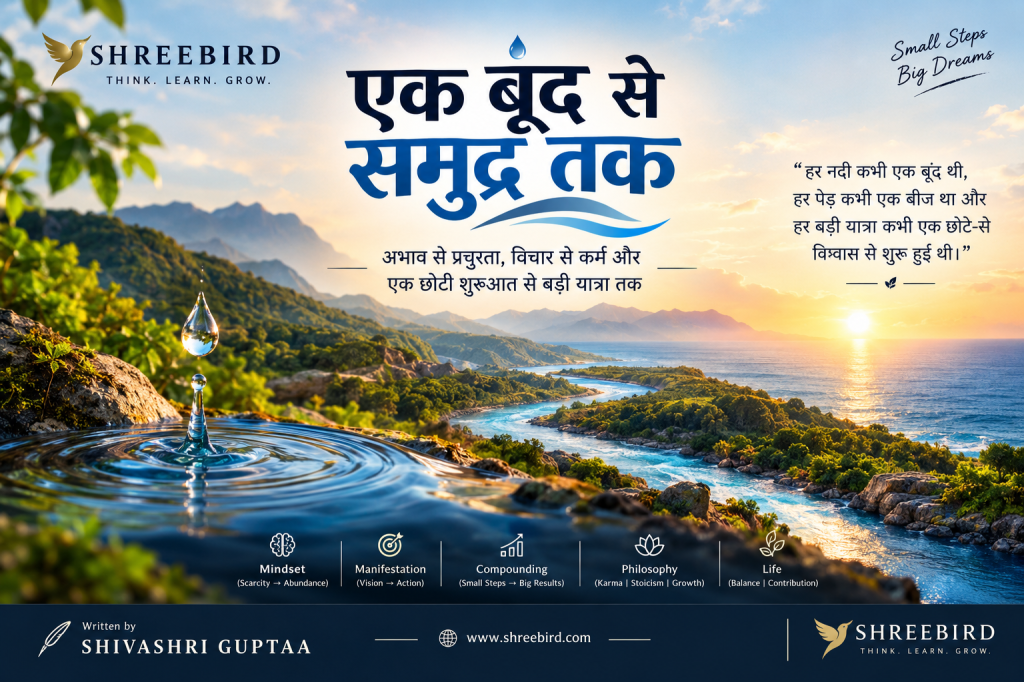
🌊 FROM A DROP TO THE OCEAN
“Never underestimate your beginning. An ocean is never the beginning— it is the result of countless drops coming together.”
✦ SHREEBIRD ✦
Written by: SHIVASHRI GUPTAA
Content Creator | Educator | Blog Writer
UPSC • CGPSC • Ethics • Indian Philosophy • GrowthGyan


टिप्पणी करे