An Exploration of Love, Freedom, Compatibility, Sacrifice, and the Courage to Create a World of One’s Own
Some questions appear simple, yet they hold entire universes within them.
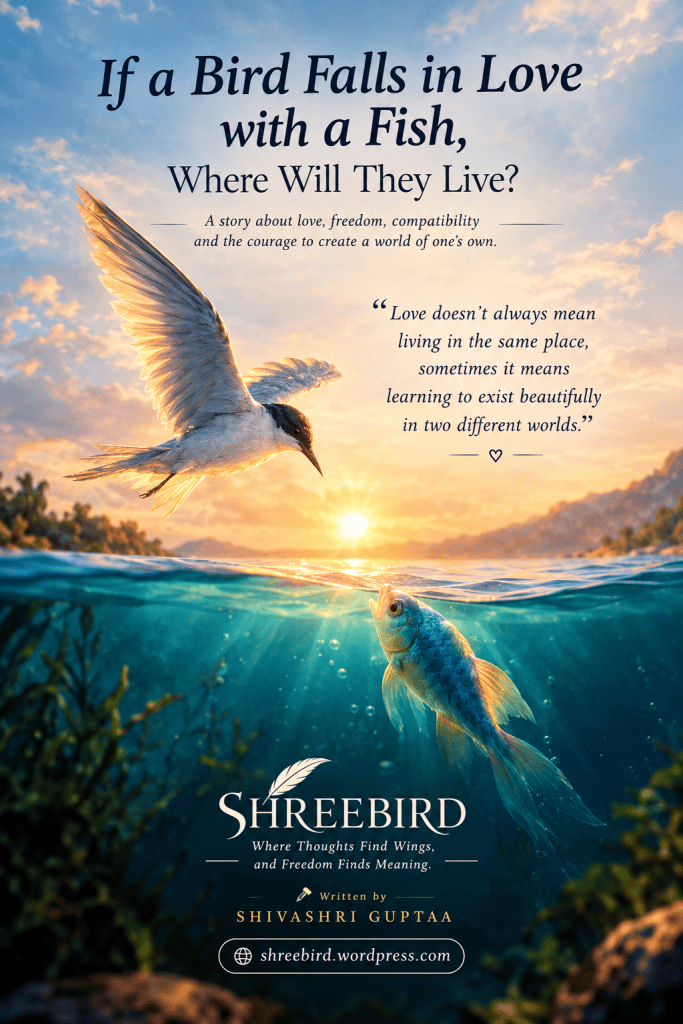
“If a bird falls in love with a fish, where will they live?”
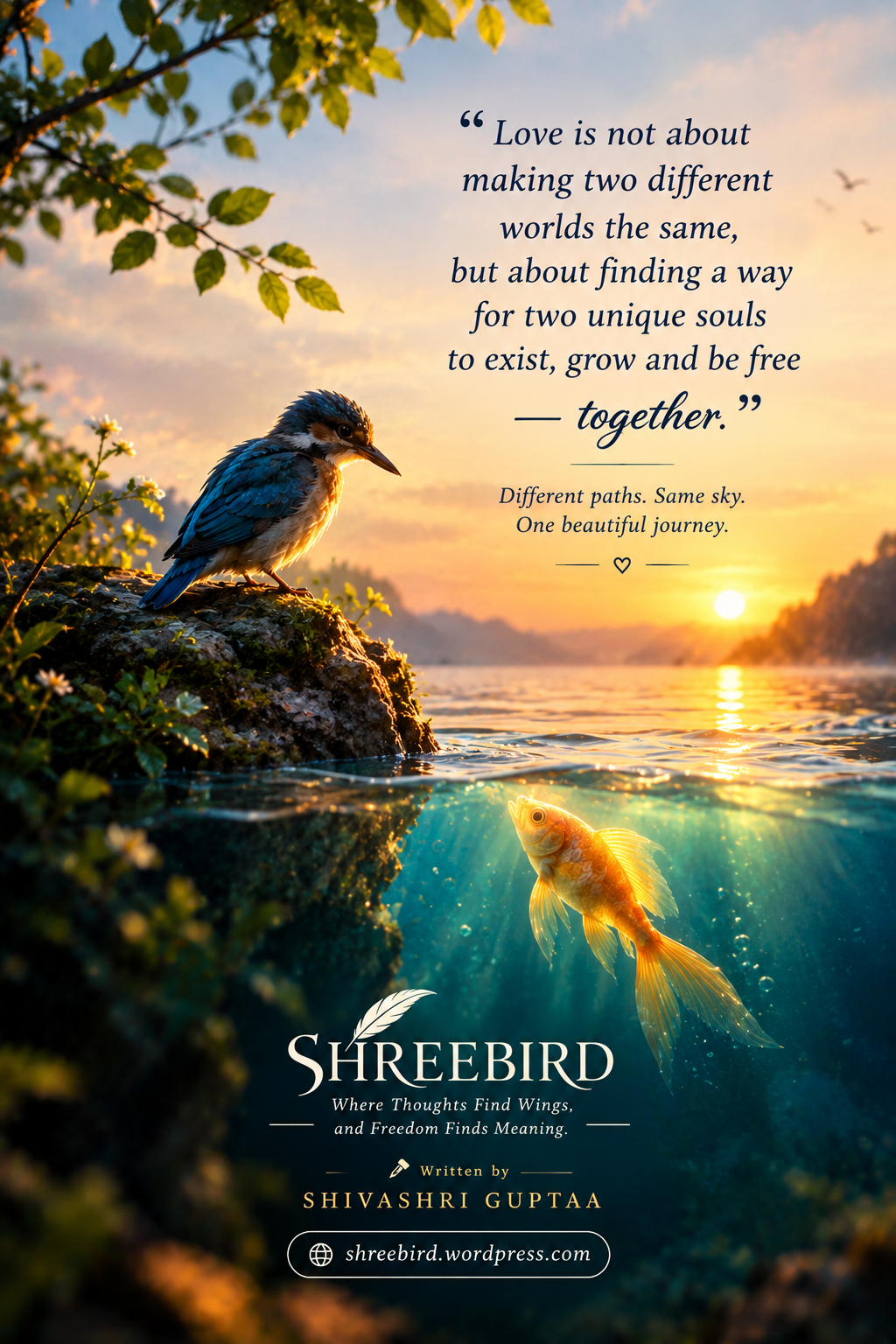
The bird belongs to the sky. Its wings are designed for flight, its eyes are accustomed to distant horizons, and its heart finds freedom in the endless blue above. The fish belongs to the water. Its fins are made for swimming, its body is shaped by the currents, and its existence depends upon the very element in which the bird cannot survive.
And yet, imagine that one day, somewhere between the blue of the sky and the blue of the sea, they fall in love.
What happens then?
Does the bird abandon the sky? Does the fish leave the water? Does one sacrifice its nature to preserve the relationship? Or do they discover that love is not merely about finding someone to live with, but about understanding the world in which the other must live?
Perhaps this is not just a story about a bird and a fish. Perhaps it is the story of every human being who has ever loved someone different from themselves.
1. When Two Different Worlds Fall in Love
Love Begins Where Differences Meet
We often say that opposites attract. The quiet person falls for the talkative one. The dreamer falls for the practical thinker. Someone who loves travelling falls in love with someone who finds peace at home. Two people raised in different cultures, speaking different languages, or carrying different ambitions discover a connection they cannot easily explain.
At first, these differences feel magical.
The person who loves adventure introduces stability into their partner’s life. The person who prefers routine learns to embrace spontaneity. One teaches the other to dream; the other teaches them how to turn dreams into reality.
Differences can become opportunities for growth.
But there is an important distinction between being different from someone and being fundamentally incompatible with the life that person needs to live.
A bird may admire the ocean, but admiration cannot give it gills. A fish may love the sky, but love alone cannot make it breathe in the air.
Human relationships are more flexible than this metaphor. People can learn, adapt, compromise, and build new habits. Yet some differences involve deeply held values, fundamental life goals, personal boundaries, or non-negotiable responsibilities.
Love may bring two people together, but it does not automatically answer how they should build a life together.
The Difference Between Loving Someone and Changing Someone
One of the most beautiful illusions of love is the belief that if we love someone enough, they will eventually become the person we need them to be.
We tell ourselves:
“They will change after marriage.”
“They will understand me someday.”
“Once I sacrifice enough, they will finally appreciate me.”
“After a few more years, we will want the same things.”
Sometimes people do grow together. A patient conversation can change a perspective. Shared experiences can soften old prejudices. Emotional maturity can transform the way people treat each other.
But growth cannot be demanded as the price of being loved.
If the bird constantly asks the fish to climb a tree, the fish will eventually begin to believe that its inability to do so is a personal failure. If the fish insists that the bird must remain underwater, the bird may begin to resent the very wings that once made it beautiful.
The tragedy is not that they are different. The tragedy begins when they interpret those differences as defects.
A healthy relationship does not ask, “How can I make you more like me?”
It asks, “How can we understand each other without forcing either of us to disappear?”
This is where love becomes more than an emotion. It becomes a practice of respect, patience, honesty, and self-awareness.
When Sacrifice Becomes Self-Abandonment
Sacrifice is often celebrated as the highest expression of love. We admire people who make difficult choices for those they care about. Parents sacrifice for children. Partners support one another through illness, financial hardship, and uncertain times. Friends put aside their convenience to help one another.
Such sacrifices can be meaningful because they are freely chosen and rooted in mutual care.
But there is a difference between sacrificing something for love and sacrificing the very self that makes love possible.
Imagine a bird that gradually stops flying because its partner cannot follow it into the sky. It abandons its journeys, its instincts, and its natural way of being. At first, it may call this devotion. Years later, it may discover that it has forgotten how to fly.
Now imagine the fish trying to survive outside the water. It may do so for a moment, but eventually its body will pay the price.
Neither sacrifice creates a sustainable home.
In real life, this happens when a person abandons education, career ambitions, friendships, financial independence, or personal identity solely to preserve a relationship. Sometimes these decisions are freely made and mutually understood; at other times, they emerge from fear—fear of loneliness, rejection, social judgment, or losing the person they love.
The question is not whether we should ever compromise. Every lasting relationship requires compromise.
The question is:
Does this compromise help us build a life together, or does it slowly erase one of us?
Love should give us reasons to grow, not reasons to hate the person we are.
The World Outside the Relationship
A relationship does not exist in isolation. Families, cultures, financial realities, social expectations, geography, and career responsibilities all influence the choices available to two people.
Consider two people who love each other but belong to different religious or cultural backgrounds. Their affection may be genuine, yet questions about family acceptance, traditions, children, and daily life may require difficult conversations.
Or consider two people whose careers demand that they live in different cities. One may have an opportunity that cannot easily be postponed; the other may have responsibilities that cannot simply be abandoned.
Neither person is necessarily wrong.
The real challenge is to determine whether they can make decisions that respect both their relationship and their individual responsibilities.
Sometimes the solution is patience. Sometimes it is a long-distance arrangement. Sometimes it is a new plan that neither person had originally imagined. And sometimes, despite genuine love, their paths may not lead to the same destination.
Acknowledging this possibility is painful, but it is also an act of honesty.
Not every love story fails because the love was false. Some struggle because love alone cannot resolve every practical conflict.
That truth does not make love meaningless. It makes our choices more important.
A Question Worth Asking Ourselves
Perhaps the bird and the fish are not the only ones who need to answer this question.
Perhaps we should ask ourselves:
- Am I loving the person in front of me, or the person I hope they will become?
- Can I respect their needs without abandoning my own?
- Can we discuss difficult realities without treating every disagreement as a threat?
- Are we building a shared future, or merely postponing the questions that frighten us?
Because love is not simply the feeling that brings two hearts together.
It is also the wisdom to understand what keeping them together will require.
And sometimes, the most loving thing we can do is stop asking another person to survive in a world that was never meant for them.
When Love Meets Reality
Understanding, Compatibility, and the Limits of Sacrifice
Understanding Is More Important Than Agreement
We often imagine that a successful relationship is one in which two people agree on almost everything. They share the same interests, make similar decisions, and look at life through the same lens.
But perhaps a better relationship is not one without disagreements. It is one in which disagreement does not destroy respect.
Two people can have different political opinions and still listen to one another. They can follow different spiritual paths and still respect each other’s beliefs. They can have different personalities and still build a peaceful home.
The real test is not whether two people think alike. It is whether they can disagree without humiliating one another, express their needs without fear, and make decisions without one person always having to surrender.
The bird may love the ocean without believing that the ocean is the only beautiful place in the world. The fish may admire the sky without wishing to become a bird.
They do not have to become identical to appreciate one another.
Understanding does not require us to become the other person. It requires us to take their reality seriously.
This is especially important in relationships where one person is ambitious and the other prefers a quieter life, where one values independence and the other values constant togetherness, or where one wants children and the other does not.
Such differences cannot always be solved through affection alone. They need honest conversations, practical decisions, and sometimes the courage to acknowledge incompatibility.
Real-Life Lessons: When Two Different Worlds Meet
Human history offers many examples of people whose lives were shaped by unusual partnerships, shared ambitions, and difficult personal circumstances. These examples do not prove that love can overcome every obstacle, but they show how relationships can create possibilities when people respect one another’s individuality.
Marie and Pierre Curie: Love That Made Room for a Shared Purpose
Marie Curie and Pierre Curie shared a deep commitment to scientific research. Their partnership was built not merely on affection but also on intellectual respect and a common purpose.
Their work contributed enormously to the study of radioactivity, and Marie Curie went on to become the first woman to win a Nobel Prize.
Their story offers a useful lesson: a meaningful relationship need not require one person to shrink so that the other can shine. Two people can support one another while pursuing demanding intellectual and professional goals.
Of course, their lives also involved hardships, and no relationship should be reduced to an inspirational ideal. But their shared scientific work illustrates the possibilities that emerge when two individuals can value both their connection and their purpose.
The lesson for our bird and fish is simple: love becomes more powerful when it makes room for each partner’s gifts.
Stephen Hawking and Jane Hawking: Love Under Extraordinary Pressure
Stephen Hawking and Jane Hawking shared a marriage that unfolded under extraordinary circumstances, including Stephen’s diagnosis of motor neurone disease, family responsibilities, and the pressures of a highly demanding scientific life.
Their story, which Jane later described in her memoir Travelling to Infinity: My Life with Stephen, reveals both commitment and the enormous strain that can accompany long-term caregiving and changing personal circumstances.
It would be misleading to present their relationship as a simple fairy tale in which love solved everything. Their experiences were complex, and their marriage eventually ended.
Yet their lives remind us that relationships are lived in reality, not in romantic imagination. Love can coexist with responsibility, exhaustion, changing needs, and difficult decisions.
Sometimes two people care deeply about one another and still find that the life they are living has become difficult to sustain.
That does not erase the meaning of what they shared.
The Long-Distance Relationship: Love Between Two Cities
Consider a more ordinary example.
Two people fall in love while studying in the same city. They share evening walks, conversations over tea, birthdays, and the small rituals that gradually become part of their lives.
Then one receives a job in another city. The other must remain behind to prepare for an examination, care for a family member, or establish a career.
Suddenly, their relationship exists across train journeys, phone calls, missed festivals, and uncertain timelines.
Distance does not necessarily weaken love. Sometimes it deepens trust, patience, and communication.
But distance also reveals questions that proximity can hide:
- Are both people making an effort?
- Is there a realistic plan to live in the same place eventually?
- Can they support each other’s careers?
- Are they moving toward a shared future, or simply hoping that circumstances will change?
A relationship can survive distance when both people are willing to build a bridge. But the bridge cannot be built by one person alone.
Love may provide the motivation. Communication, effort, and realistic planning provide the structure.
Career and Family: The Invisible Conflict
Imagine a woman who has spent years preparing for a career that matters deeply to her. She falls in love with someone whose family expects her to give up her ambitions after marriage.
The partner may genuinely love her. The family may genuinely believe it is following tradition. Yet the woman is being asked to choose between an important part of her identity and the relationship she wants to preserve.
This is where love must meet fairness.
A compromise could involve discussing locations, work schedules, financial responsibilities, or shared household duties. Perhaps the couple can find a way to honour both careers and family relationships.
But if the only acceptable solution is that one person must surrender their future, the problem is no longer merely a difference in preferences. It is a question of equality.
A healthy partnership does not automatically place one person’s dreams above the other’s because of gender, tradition, income, or family pressure.
Both people deserve to be heard. Both lives matter.
And both must be willing to participate in building a solution.
Compatibility Is Not the Enemy of Love
Sometimes people believe that discussing compatibility makes love less romantic.
They fear that if they ask practical questions about money, marriage, children, location, lifestyle, or family expectations, they will somehow weaken the magic of the relationship.
But compatibility is not a cold calculation that replaces love. It is an attempt to understand whether love can flourish in the life two people are trying to build.
Imagine two people who love travelling. One dreams of exploring the world for years, while the other wants to settle near family and build a stable local life.
Neither dream is inherently superior. But unless they talk about their expectations, one may eventually feel trapped while the other feels abandoned.
The same is true of financial habits. One person may prioritise saving and security, while the other values experiences and spontaneous spending. They can learn from each other, but they need a shared approach to money.
The same is true of children, career choices, domestic responsibilities, and personal freedom.
Love tells us that someone matters to us. Compatibility helps us understand how to live together without repeatedly hurting each other over the same unresolved issues.
A relationship does not need perfect compatibility. It needs enough shared ground, mutual respect, and willingness to work through the differences that matter.
When Letting Go Is Also an Act of Love
We often celebrate the person who fights for love. We write songs about waiting, sacrifice, and never giving up.
But what about the courage to recognise when a relationship is harming both people?
Sometimes the bird and the fish may spend years trying to create a shared world. They may love each other sincerely. They may make sacrifices, seek compromises, and keep returning to the same difficult questions.
And eventually, they may realise that the life each needs cannot be built in the form they had imagined.
Letting go does not automatically mean that the relationship was meaningless. It may mean that the people involved have finally acknowledged a reality they could not change.
There is an important distinction between giving up at the first difficulty and recognising a fundamental incompatibility after honest effort.
The first may be avoidance. The second may be maturity.
We should not romanticise suffering by assuming that the more pain a relationship causes, the more profound the love must be.
Pain is not proof of destiny. Waiting is not always proof of devotion. And sacrifice is not always proof of virtue.
Sometimes love asks us to stay and work. Sometimes it asks us to change. Sometimes it asks us to leave with kindness.
The wisdom lies in learning which situation we are facing.
A Thought to Carry Forward
Perhaps the bird and the fish do not need to prove their love by suffering.
Perhaps they need to understand what their love can realistically become.
Because the purpose of a relationship is not simply to avoid losing another person. It is to create a life in which both people can continue to exist, grow, and feel respected.
And if they cannot create that life together, their love still deserves honesty rather than an endless promise that tomorrow will somehow solve everything.
Creating a World of Our Own
What Nature, Philosophy, and Freedom Teach Us About Love
Nature Does Not Ask Every Living Being to Become the Same
Nature is full of extraordinary differences.
A tree grows toward sunlight. A river moves toward lower ground. A bird migrates across continents. A fish moves through water that would be hostile to many creatures living beyond it.
Each has its own structure, needs, limitations, and way of surviving.
A fish does not fail because it cannot fly. A bird does not fail because it cannot breathe underwater.
Their abilities are shaped by their nature.
Human beings, of course, have a much greater capacity to adapt. We can learn languages, change careers, move between cultures, and build lives that our younger selves could never have imagined. But we also have emotional needs, personal boundaries, physical limitations, and values that cannot always be reconciled with another person’s expectations.
Nature offers a useful reminder: difference does not automatically mean deficiency.
We should not judge a person’s worth by their ability to fit into our preferred way of living.
A quiet person need not become loud to be confident. An ambitious woman need not become less ambitious to be lovable. A sensitive person need not become emotionally distant to appear strong. A person who values solitude need not feel guilty for needing time alone.
The goal is not to become everything for everyone.
The goal is to understand ourselves well enough to build relationships in which our differences can exist without becoming weapons.
The River, the Ocean, and the Space Between Them
Think of a river travelling toward the ocean.
Along the way, it passes through forests, villages, farms, mountains, and cities. It nourishes life, changes landscapes, and sometimes encounters obstacles that force it to alter its course.
Yet a river cannot reach the sea by pretending that every landscape is identical.
It moves according to the terrain. It adjusts to the land. It follows the possibilities available to it.
Relationships require a similar combination of direction and flexibility.
Two people need not follow identical paths every day. One may spend time pursuing a career while the other manages a different responsibility. One may need quiet when the other needs conversation. One may be ready for a major life decision before the other is.
The important question is whether their separate movements can coexist within a shared direction.
A healthy relationship does not require two people to merge into one indistinguishable identity. It allows two individuals to remain distinct while choosing to build something together.
This is the difference between unity and uniformity.
Unity means standing together without needing to become identical.
Uniformity means expecting everyone to behave, think, and feel the same way.
Love needs unity far more than uniformity.
What Philosophy Teaches Us About Loving Without Possessing
The idea that love should preserve individuality appears in many philosophical traditions.
In The Art of Loving, philosopher and social psychologist Erich Fromm explored love as an active practice involving care, responsibility, respect, and knowledge. In this view, love is not merely the desire to possess someone or receive affection from them. It also involves taking their individuality seriously.
This offers an important way to understand our bird and fish.
If the bird says, “I love you, so you must live exactly as I do,” it is asking for possession rather than understanding.
If the fish says, “I love you, so you must abandon the sky forever,” it is making the same demand in another form.
Love becomes more mature when it can say:
“I want to know who you are, even where you are different from me.”
“I want to support your growth without deciding every direction you must take.”
“I want to build a life with you, but I do not want the price of that life to be your disappearance.”
This does not mean that a relationship has no boundaries or obligations. Mutual respect also requires reliability, honesty, and accountability. Freedom is not an excuse to neglect a partner or avoid every difficult responsibility.
The challenge is to create a relationship in which commitment and individuality strengthen each other rather than constantly compete.
The Courage to Create a Third World
So, where will the bird and the fish live?
Perhaps the answer is not that one must surrender its world and enter the other’s.
Perhaps they must imagine a third possibility.
The bird can build its nest near the water. The fish can swim beneath the surface near the shore. They can meet at the boundary between their worlds, where the air touches the water and the sky reflects upon the sea.
They cannot share every experience. The bird cannot accompany the fish into the deepest ocean, and the fish cannot follow the bird through the clouds.
But they may still share moments of closeness, protect one another in ways they can, and respect the spaces where their lives must remain different.
In human relationships, this third world might mean finding a city where both partners can pursue their careers. It might mean creating a household that respects two different cultures. It might mean dividing responsibilities fairly, allowing time for individual interests, or finding a compromise that neither person had initially considered.
Creating a third world requires creativity, negotiation, and a willingness to move beyond the question of who must surrender.
But it also requires honesty.
Not every situation has a workable third option. Sometimes the distance between two lives is too great, or the compromises required would damage one or both people. In such cases, acknowledging the limits of a relationship may be kinder than forcing an impossible arrangement.
The point is not that every love story must survive.
The point is that every person in a love story deserves to be treated as a whole human being.
Love Should Expand Life, Not Make It Smaller
Ask yourself what love has done to your world.
Has it made you more compassionate? Have you become more willing to understand people whose experiences differ from yours? Has it given you the courage to face your weaknesses and the confidence to pursue your dreams?
Or have you gradually stopped expressing yourself? Have you abandoned friendships, neglected your ambitions, or learned to remain silent because disagreement might threaten the relationship?
These questions are not always easy to answer. Every relationship involves difficult periods, and temporary compromise is not the same as losing oneself.
But over time, love should allow both people to become more fully human.
A relationship may challenge us, stretch our assumptions, and ask us to change. Yet it should not require one person to live permanently in fear, shame, or self-denial.
Love is not a competition in which the person who sacrifices the most wins.
Nor is it a contract in which one person’s needs always take priority.
It is a shared responsibility to create a life that recognises the dignity of both individuals.
And sometimes, the most profound form of intimacy is not saying, “You are mine.”
It is saying, “You are your own person, and I choose to know you, respect you, and walk beside you.”
The Final Answer: Where Will They Live?
Perhaps the bird and the fish will live at the edge of the water.
Perhaps they will find a way to meet without demanding that either abandon its nature.
Perhaps they will create a new kind of relationship, one that honours their differences while exploring the possibilities available to them.
Or perhaps, after trying honestly, they will discover that they cannot build a shared home without causing each other harm.
There is no single answer that applies to every relationship.
But there is one question worth remembering:
Can we love each other without requiring one another to stop being who we are?
If the answer is yes, then perhaps there is a world they can build together.
If the answer is no, then perhaps the lesson is not to force the impossible, but to recognise that love and compatibility, though deeply connected, are not identical.
The bird was not born to hate the water. The fish was not born to envy the sky.
They can admire each other without treating their differences as failures.
And perhaps that is what mature love teaches us: we do not have to possess everything we admire, become everything we love, or sacrifice every part of ourselves to prove that our feelings are real.
We can love deeply and still respect reality.
We can compromise without disappearing.
We can choose another person without abandoning ourselves.
And we can recognise that a meaningful connection does not always require two people to inhabit the same world in exactly the same way.
Perhaps the most beautiful love is not the one in which two people become one.
Perhaps it is the one in which two whole individuals create enough space for each other to remain whole.
Because, in the end, love should not be measured only by how far we are willing to go for someone.
It should also be measured by how much freedom, dignity, understanding, and life we allow each other to retain along the way.
The bird needs the sky.
The fish needs the water.
And love, if it is to become a home, must learn to honour both.
Recommended Reading
- The Art of Loving — Erich Fromm
- The Second Sex — Simone de Beauvoir
- Man’s Search for Meaning — Viktor E. Frankl
- Where the Mind Is Without Fear — Rabindranath Tagore
Explore These Books
- The Art of Loving — https://www.amazon.in/dp/1855385058/ref=cm_sw_r_as_gl_apa_gl_i_dl_D5F0VW1DK4M5VMGAAMS9?linkCode=ml1&tag=shreebird1904-21&linkId=bbeb6c15ceda93bee1cebf67ebd76693
- The Second Sex — https://www.amazon.in/dp/1784870382/ref=cm_sw_r_as_gl_apa_gl_i_809N1FEN36HR00G15PY8?linkCode=ml1&tag=shreebird1904-21&linkId=b91a55376ee1640d0ad88c1159978cc8
- Man’s Search for Meaning — https://www.amazon.in/dp/B0H69GWNJV/ref=cm_sw_r_as_gl_apa_gl_i_2J934Q9ZMTJT6AFQNBFW?linkCode=ml1&tag=shreebird1904-21&linkId=079ebc96108847cd85f8d75bc1cc4d14
Affiliate disclosure: ShreeBird may earn a commission from qualifying purchases made through affiliate links, at no additional cost to the reader.
SHREEBIRD
Where Thoughts Find Wings, and Freedom Finds Meaning.
Written by: SHIVASHRI GUPTAA
Website: https://shreebird.wordpress.com


एक उत्तर दें