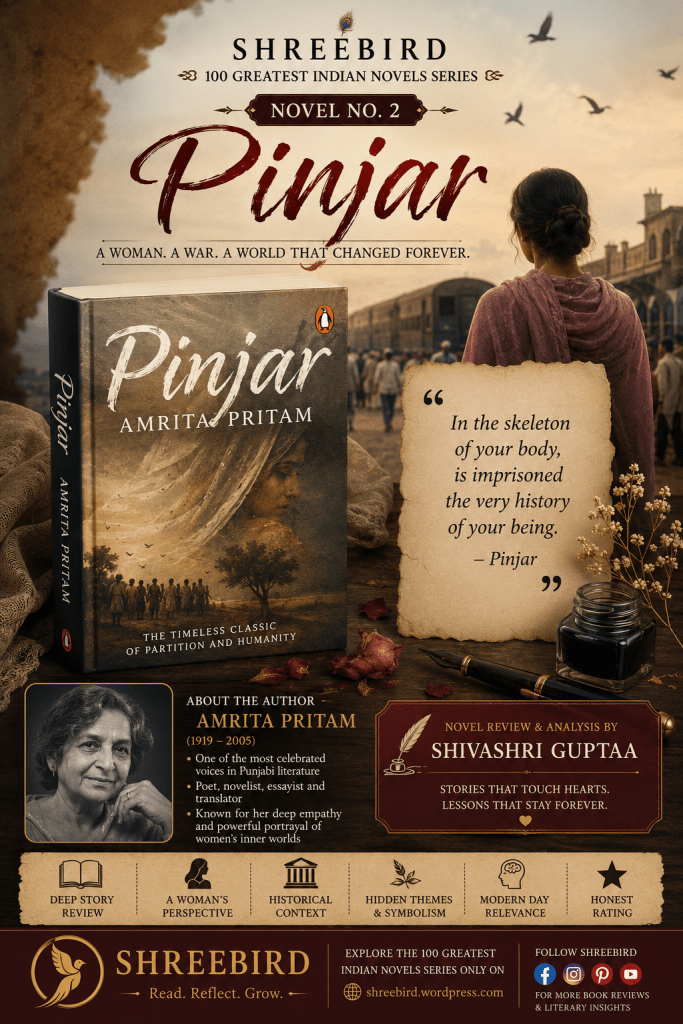
100 Greatest Indian Novels Series
📚 Novel No. 2
Pinjar
A Novel That Asks One Heartbreaking Question…
“What happens when a woman loses not just her home, but her identity?” https://link.amazon/B07DCnXlf
🌿 Before We Begin…
Close your eyes for a moment.
Imagine waking up one morning and discovering that your name,
your family,
your home,
your future,
and even your identity…
no longer belong to you.
Not because you made a mistake.
Not because you committed a crime.
But simply because history decided your fate.
Sounds unimaginable?
Yet this was the reality of millions during the Partition of India.
Among those countless unheard voices stands one unforgettable woman—
Puro.
And through her,
Amrita Pritam tells one of the most heartbreaking stories ever written in Indian literature.
💭 A Question for You…
Before reading this review, ask yourself one question—
If the entire world rejected you…
Would you still know who you really are?
Keep this question in your mind.
By the end of Pinjar,
your answer may no longer be the same.
✨ Why This Novel Is More Than a Partition Story
Many people describe Pinjar as a novel about the Partition of India.
They are only partly right.
Yes,
the Partition forms the background.
But the real story is not about borders.
It is about human beings.
It is about women whose lives were torn apart by decisions they never made.
It is about identity.
Memory.
Love.
Loss.
Forgiveness.
And survival.
This is not a novel that asks,
“Who won?”
It asks,
“What did humanity lose?”
That single question transforms Pinjar from a historical novel into a timeless human document.
✍️ About the Author
Amrita Pritam – The Voice of Women’s Pain and Freedom
Few writers have understood a woman’s inner world as deeply as Amrita Pritam.
Born in 1919 in Gujranwala (now in Pakistan),
she became one of the most celebrated poets and novelists of the Indian subcontinent.
She witnessed Partition with her own eyes.
She saw families disappear.
She saw people leave behind homes they had built over generations.
She saw women suffer in ways that history books rarely describe.
Those memories never left her.
Instead,
they became literature.
Literature that continues to move readers across the world.
Pinjar is perhaps her most powerful novel.
It does not shout.
It does not accuse.
It simply tells the truth.
And sometimes,
the truth is more painful than fiction.
Even today,
more than seventy years after its publication,
Pinjar remains one of the greatest feminist novels in Indian literature.
Not because it speaks loudly.
But because it speaks honestly.
📖 The Story in a Nutshell
At the center of the story is
Puro.
A young woman with ordinary dreams.
A loving family.
A future already planned.
She imagines marriage,
happiness,
and a peaceful life.
Like millions of young women,
she believes tomorrow will look much like today.
But history has different plans.
A single incident changes everything.
The life she once knew begins to disappear,
piece by piece.
The world that once called her “daughter”
starts questioning whether she still belongs.
The home she longs to return to no longer feels within reach.
And the woman she once was slowly begins to fade.
But Pinjar is not only the story of losing identity.
It is also the story of rebuilding it.
As the novel unfolds,
Puro begins a journey that is far greater than survival.
She begins searching for something every human being deserves—
A place to belong.
Without revealing the novel’s unforgettable turning points,
it is enough to say this—
Pinjar will not simply make you emotional.
It will make you uncomfortable.
It will force you to ask difficult questions.
Questions about humanity.
About religion.
About borders.
About women.
And perhaps the hardest question of all—
Can a person ever truly return home after losing everything that once defined them?
⏸️ Pause & Think
Before moving to the next part, ask yourself—
If your identity was taken away tomorrow…
What would remain?
Your name?
Your memories?
Your courage?
Or simply your humanity?
Keep that thought with you.
Because Pinjar is about to challenge every answer you have.
🎭 Meet the Characters
Some novels are remembered because of their plot.
Pinjar is remembered because of its people.
These are not fictional characters who exist only on paper.
They feel like real human beings—broken, conflicted, loving, frightened, and painfully imperfect.
Let’s meet them.
👤 Puro
Puro is the soul of Pinjar.
At first, she is simply a young woman dreaming of an ordinary life.
She wants a family.
She wants love.
She wants the future every young girl hopes for.
But destiny tears that future apart.
What follows is not merely her struggle for survival.
It is her search for identity.
As the novel progresses, Puro transforms in extraordinary ways.
She becomes stronger.
Wiser.
More compassionate.
She learns that sometimes the greatest courage is not fighting against the world—
It is refusing to let the world take away your humanity.
By the end of the novel, Puro is no longer just a character.
She becomes a symbol of resilience.
👤 Rashid
If there is one character readers continue debating decades after finishing the novel, it is Rashid.
Is he a villain?
A victim of circumstances?
A man seeking redemption?
Or all of these at once?
Amrita Pritam never gives easy answers.
That is what makes Rashid unforgettable.
He commits an act that changes Puro’s life forever.
Yet as the story unfolds, readers begin to witness another side of him—
A man burdened by guilt.
A man trapped between family honour, tradition, and his own conscience.
You may forgive him.
You may never forgive him.
But you will almost certainly keep thinking about him.
👤 Ramchand
Ramchand represents the life Puro was once meant to have.
He is not simply a lost fiancé.
He symbolizes lost possibilities.
Lost dreams.
And a future stolen before it could even begin.
Through him, the novel quietly reminds us that Partition did not only divide countries.
It also divided countless unfinished lives.
👤 Puro’s Family
One of the most heartbreaking aspects of Pinjar is not violence.
It is silence.
Puro’s family loves her.
Yet fear,
social pressure,
and the desire to protect family honour influence decisions that leave permanent emotional scars.
Their choices force readers to ask one painful question—
Can love exist without the courage to stand beside the person you love?
There is no simple answer.
And that is precisely why this novel remains unforgettable.
🕰️ The World Behind the Novel
To truly understand Pinjar, we must understand its historical setting.
The novel takes place during the Partition of India in 1947—
One of the largest and most painful human migrations in modern history.
Millions of people crossed newly created borders.
Thousands lost their homes.
Families were separated forever.
Communities that had lived together for generations suddenly became strangers.
But history often remembers numbers.
Amrita Pritam chose to remember people.
Especially women.
Many women experienced abduction,
forced marriages,
displacement,
and rejection by the very families they hoped would welcome them home.
These stories rarely appeared in official records.
Yet they became silent wounds carried across generations.
Pinjar gives those forgotten voices a place in literature.
That is why it is not only a novel.
It is also an act of remembrance.
🎨 What Makes Pinjar a Literary Masterpiece?
✨ It Humanizes History
History books tell us when Partition happened.
Pinjar tells us what it felt like.
It transforms historical events into deeply personal experiences.
✨ It Gives Women Their Voice
Many Partition narratives focus on politics and violence.
Amrita Pritam shifts the focus to women—
Their pain.
Their resilience.
Their identity.
Their dignity.
That perspective makes the novel revolutionary even today.
✨ There Are No Simple Heroes or Villains
One of the greatest strengths of Pinjar is its moral complexity.
People make terrible mistakes.
Some seek redemption.
Others remain trapped by fear.
The novel refuses to divide humanity into good and evil.
Instead, it explores the grey areas where real life exists.
✨ Compassion Over Hatred
Despite the violence surrounding its characters, Pinjar never becomes a novel of revenge.
Instead, it asks whether compassion can survive even after unimaginable suffering.
That question gives the novel its timeless emotional power.
💬 What Would You Do?
Now, imagine this for a moment.
Suppose you were Puro.
The people you trusted the most could no longer protect you.
The life you dreamed of had disappeared overnight.
And the world had begun treating you as if you no longer belonged anywhere.
What would you choose?
Would you spend your life searching for the past?
Or would you find the courage to build a new identity?
There is no correct answer.
That is exactly why Pinjar continues to move readers across generations.
It doesn’t test your knowledge.
It tests your humanity.
✍️ Language & Literary Style
One of the greatest strengths of Pinjar is not its story.
It is the way the story is told.
Amrita Pritam never relies on dramatic language to make readers cry.
She writes with extraordinary simplicity.
Quietly.
Honestly.
Every sentence feels effortless.
Yet every page carries the weight of countless untold lives.
Her words never force emotions upon the reader.
Instead, they allow emotions to grow naturally.
A single silence.
A single unanswered question.
A single farewell.
Often speaks louder than an entire chapter.
That is the magic of Amrita Pritam’s writing.
She understood that pain does not always scream.
Sometimes…
it whispers.
And those whispers remain with us forever.
🦴 Why Is the Novel Called Pinjar?
The title itself is one of the most powerful symbols in Indian literature.
“Pinjar” literally means “Skeleton.”
But the novel is not talking about a human skeleton alone.
It asks a far deeper question—
What remains of a person when everything else is taken away?
A name can be changed.
A home can be lost.
Relationships can disappear.
Borders can divide families.
History can erase identities.
But can anyone truly take away the human soul?
Puro slowly realizes that she is no longer fighting only for a home.
She is fighting to protect her humanity.
That is why Pinjar is such a powerful title.
It reminds us that without dignity,
compassion,
and identity,
a living person can slowly become nothing more than an empty shell.
🌸 Understanding Puro’s Transformation
When we first meet Puro,
she dreams like every ordinary young woman.
Her world feels safe.
Predictable.
Full of hope.
But tragedy changes her life in ways she never imagined.
The remarkable part of her journey is this—
She does not allow suffering to define her forever.
She changes.
Not because she wants to.
Because she has to.
Her pain gradually transforms into empathy.
Her fear becomes quiet strength.
Her loneliness becomes compassion for others who are also suffering.
By the end of the novel,
Puro is no longer searching only for herself.
She becomes a source of hope for others.
That transformation is what makes her one of the greatest female protagonists in Indian literature.
She does not become powerful because she defeats someone.
She becomes powerful because suffering never destroys her humanity.
🌍 If Pinjar Were Written Today…
If Pinjar were written in today’s world,
the setting would certainly change.
The borders might be different.
Technology would exist.
Social media would spread news within seconds.
Governments would issue statements.
Television channels would debate the incident.
Hashtags would trend across the internet.
But one painful question would still remain—
Would society truly understand a woman before judging her?
Even today,
many women who survive violence,
abduction,
war,
or social stigma are often forced to fight two battles.
One against tragedy.
Another against society’s judgment.
That is why Pinjar continues to feel painfully relevant.
Its setting belongs to 1947.
Its emotions belong to every century.
Perhaps today’s Puro would have more legal protection.
More public support.
More opportunities to rebuild her life.
Yet emotional acceptance,
family honour,
and social prejudice remain challenges in many parts of the world.
That is why this novel still speaks directly to modern readers.
💭 Pause & Reflect
Let me ask you one more question.
Imagine you are standing before Puro after the story ends.
She looks at you and asks only one thing—
“Who am I now?”
How would you answer?
Would you define her by what happened to her?
Or by the extraordinary courage with which she chose to live afterwards?
Perhaps the answer to that question reveals more about us…
than about Puro herself.
📚 Why Pinjar Still Matters
Great literature survives because it speaks to every generation in a different way.
Pinjar is no exception.
For some readers,
it is a Partition novel.
For others,
it is a feminist masterpiece.
For many,
it is one of the greatest stories ever written about identity and belonging.
But above all,
it is a reminder that history should never be remembered only through wars,
politics,
or borders.
History must also remember the ordinary people whose lives were changed forever.
Especially the women whose stories were often left untold.
That is why Pinjar is not merely a novel.
It is memory.
It is history.
It is humanity.
And that is why it continues to break hearts—and heal them—generation after generation.
♀️ A Woman’s Perspective
Reading Pinjar as a woman in the twenty-first century is an emotional experience that is difficult to put into words.
Many readers see this novel as a story about Partition.
I see it as a story about a woman whose identity was repeatedly decided by other people.
No one truly asks Puro what she wants.
Men make decisions.
Families make decisions.
Society passes judgment.
History changes her destiny.
But somewhere in all this noise…
Puro’s own voice is almost lost.
That is what hurt me the most.
As women, we are often told to adjust.
To sacrifice.
To protect family honour.
To accept circumstances.
But Pinjar quietly asks a different question—
Why is a woman’s dignity so often expected to carry the burden of society’s honour?
What happened to Puro was never her fault.
Yet she was expected to bear the consequences.
That painful reality has not completely disappeared even today.
Victims are still questioned.
Women are still judged.
Families still worry more about “What will people say?” than “How is she feeling?”
That is why Pinjar is not an old novel.
It is a mirror.
And unfortunately, parts of that mirror still reflect our society.
The most inspiring thing about Puro is not that she survives.
It is that she refuses to let hatred define her humanity.
She teaches us that strength is not always loud.
Sometimes strength is choosing compassion after life has given you every reason to become bitter.
To me, Puro is not just one of the greatest female characters in Indian literature.
She is one of the bravest.
💭 If I Could Change One Thing…
If I had the chance to rewrite one moment in Pinjar,
I would not change history.
I would change society.
I would want one person…
Just one…
To stand beside Puro without fear.
To tell her,
“You are not the one who should feel ashamed.”
Perhaps that single sentence could have changed an entire life.
And maybe that is the lesson this novel still teaches us today—
Sometimes one courageous voice is enough to break generations of silence.
📚 Who Should Read This Book?
This novel is for you if—
✔️ You enjoy emotionally powerful literary fiction.
✔️ You want to understand the human side of the Partition beyond history textbooks.
✔️ You appreciate strong female protagonists.
✔️ You love novels that stay with you long after the final page.
✔️ You believe books should make us think, not just entertain us.
⭐ Should You Buy This Book?
Without hesitation—Yes.
Not because it is famous.
Not because it is considered a classic.
But because every reader deserves to experience at least one book that changes the way they understand humanity.
Pinjar is one of those rare novels.
It will make you emotional.
It will make you uncomfortable.
It will challenge your beliefs.
And perhaps most importantly—
It will make you more compassionate.
Some books decorate your bookshelf.
Pinjar quietly transforms the person reading it.
That is why I believe every literature lover should own a copy.
🦚 SHREEBIRD Reflection
After finishing Pinjar, I did not remember the borders.
I remembered the people.
I remembered Puro.
Her silence.
Her courage.
Her broken dreams.
And her extraordinary humanity.
Amrita Pritam reminds us that history is not only written by leaders and governments.
It is also written in the lives of ordinary women whose names are often forgotten.
The greatest achievement of Pinjar is that it refuses to let us forget them.
Long after the final chapter, one realization remains—
A nation may recover from Partition.
Maps may be redrawn.
Cities may be rebuilt.
But some emotional wounds continue across generations.
That is why remembering stories like Pinjar is not only an act of reading.
It is an act of empathy.
⭐ SHREEBIRD Verdict
Story ⭐⭐⭐⭐⭐
Emotional Impact ⭐⭐⭐⭐⭐
Character Development ⭐⭐⭐⭐⭐
Historical Significance ⭐⭐⭐⭐⭐
Feminist Perspective ⭐⭐⭐⭐⭐
Literary Value ⭐⭐⭐⭐⭐
Re-read Value ⭐⭐⭐⭐⭐
Overall Rating ⭐⭐⭐⭐⭐
🌸 Final Thought
“A border can divide two nations, but it should never divide our humanity.”
That is the timeless heartbeat of Pinjar.
It is not merely a novel about the Partition of India.
It is about identity.
Belonging.
Womanhood.
Compassion.
Loss.
Hope.
And the remarkable strength of the human spirit.
Every generation reads Pinjar differently.
But every generation closes the book carrying the same feeling—
A little more empathy than before.
And perhaps…
that is the true purpose of great literature.
🦚 Thank You for Reading!
If this review made you pause, reflect, or question something within yourself, then it has already achieved its purpose.
But this is only one masterpiece.
Explore the complete “100 Greatest Indian Novels Series” on SHREEBIRD, where every review goes beyond the story to uncover the emotions, history, philosophy, psychology, and life lessons hidden within India’s greatest books.
✨ What you’ll discover on SHREEBIRD
📖 Spoiler-Free Story Reviews
🎭 Deep Character Analysis
🏛️ Historical & Social Context
💡 Hidden Themes & Symbolism
👩 A Woman’s Perspective
🌍 Modern-Day Relevance
⭐ Honest Ratings
🦚 SHREEBIRD Reflections
✍️ Novel Review & Literary Analysis by: SHIVASHRI GUPTAA
🌐 Website: shreebird.wordpress.com
💬 Before You Leave…
I’d love to hear your thoughts.
If you were Puro…
What decision would you have made?
And one more question—
Do you think society has truly changed, or are women still judged for circumstances beyond their control?
Share your thoughts in the comments.
Your perspective may become someone else’s reason to think differently.
❤️ If this review touched your heart, share it with a fellow book lover.
Because the greatest stories are meant to be passed from one reader to another.
🦚 SHREEBIRD — Read Beyond the Story. Reflect Beyond the Words. Grow Beyond Yourself.


टिप्पणी करे