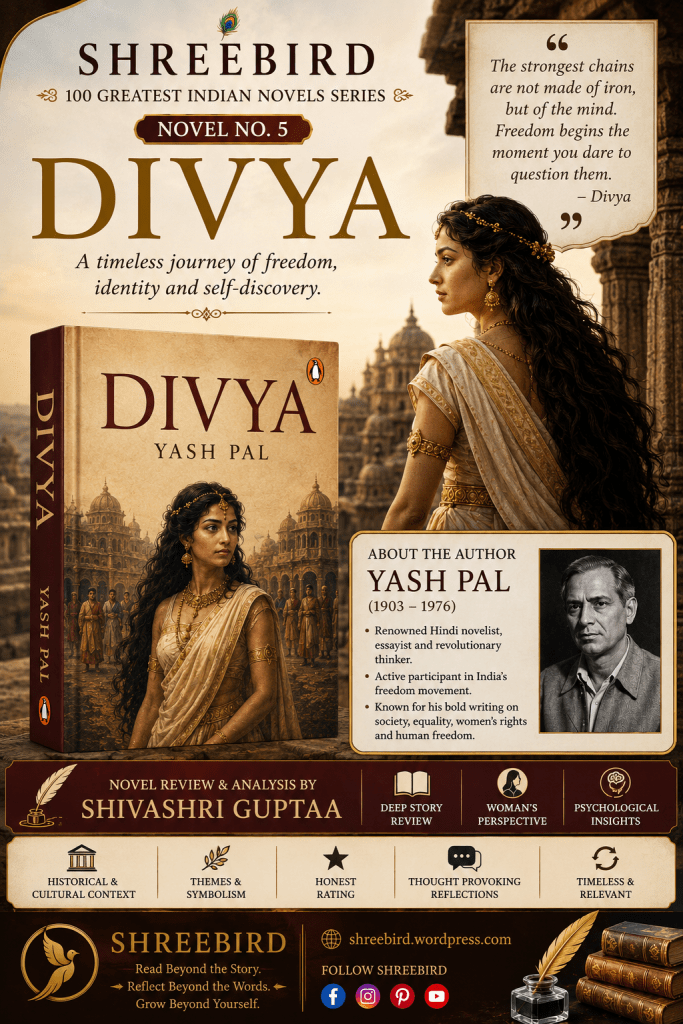
100 Greatest Indian Novels Series
📚 Novel No. 5
DIVYA https://link.amazon/B09RMGRwY
A Woman Who Refused to Let the World Define Her
✨ Tagline
“History remembers kings for building empires. Literature remembers women like Divya for building themselves.”
🌿 Before You Begin…
What does freedom truly mean?
Is it the freedom to travel?
The freedom to speak?
The freedom to choose whom you love?
Or…
is it something much deeper?
Imagine living in a world where your beauty is admired,
your intelligence is noticed,
your courage is respected…
yet your life still belongs to someone else.
Your destiny is decided by society.
Your relationships are controlled by power.
Your dreams are measured against tradition.
Would you still call yourself free?
That is where Divya begins.
Not with a battle.
Not with a revolution.
But with a woman searching for something that history has denied countless women—
The right to live life on her own terms.
💭 A Question Before We Begin…
Before reading this review, ask yourself one simple question—
If you had to choose between love, power, comfort, and freedom…
What would you choose?
It sounds like an easy question.
After reading Divya,
you may no longer think so.
✨ More Than a Historical Novel
Many readers believe Divya is simply a historical novel set in ancient India.
That is only the surface.
Beneath its historical setting lies one of the most powerful explorations of womanhood ever written in Hindi literature.
It is a novel about—
Identity.
Choice.
Power.
Love.
Social hierarchy.
Freedom.
And the eternal search for one’s true self.
The palaces.
The kingdoms.
The traditions.
The rituals.
These create the backdrop.
But the real battlefield exists inside the human heart.
That is what makes Divya timeless.
Although the story takes place centuries ago,
its questions still challenge modern readers.
✍️ About the Author
Yashpal – The Revolutionary Who Questioned Society
Few writers possessed the courage to challenge social traditions as boldly as Yashpal.
Born in 1903, he was not only a celebrated novelist but also a revolutionary thinker who actively participated in India’s freedom movement.
His experiences shaped his vision of society.
He believed literature should do more than entertain.
It should question injustice.
Challenge blind traditions.
And encourage readers to think independently.
Throughout his literary career, Yashpal explored themes such as equality,
class struggle,
women’s rights,
human freedom,
and social transformation.
His female characters are among the strongest in Hindi literature because they are never written merely as symbols of sacrifice.
They think.
They question.
They rebel.
They grow.
Published in the mid-twentieth century, Divya remains one of his most admired novels.
It combines history with philosophy,
romance with realism,
and personal struggle with larger social questions.
Even today,
Divya continues to inspire readers who believe that true freedom begins with the courage to choose one’s own path.
📖 The Story in a Nutshell
At the center of this remarkable novel is—
Divya.
A young woman whose beauty immediately attracts attention.
But Yashpal never allows readers to admire her only for her appearance.
Her greatest strength is her mind.
She questions.
She observes.
She refuses to accept injustice simply because it is old.
Life takes Divya through unexpected turns.
She experiences privilege.
She experiences suffering.
She witnesses love.
She encounters power.
She faces betrayal.
She discovers that every social class has its own invisible chains.
With every experience,
she begins to understand that freedom cannot be gifted by society.
It must be discovered within oneself.
Without revealing the novel’s unforgettable twists,
it is enough to say this—
Divya is not about becoming a queen.
It is about becoming one’s true self.
And that journey is far more difficult than conquering any kingdom.
⏸️ Pause & Think
Let me ask you something.
If the world offered you luxury…
But took away your freedom…
Would you accept it?
Or would you risk everything to live according to your own conscience?
Keep that question in your heart.
Because Divya will ask it again and again—until you discover your own answer.
🎭 Meet the Characters
Some novels are remembered because of their stories.
Divya is remembered because of its people.
Every important character represents an idea.
A belief.
A way of looking at life.
And that is what makes this novel far more than historical fiction.
Let’s meet the souls who give life to this masterpiece.
👑 Divya
Divya is one of the most fascinating female protagonists in Hindi literature.
She is graceful without being fragile.
Intelligent without being arrogant.
Compassionate without becoming weak.
Unlike many traditional heroines, Divya refuses to accept life exactly as society presents it.
She keeps asking questions.
Why should birth decide a person’s worth?
Why should women always obey?
Can love exist without freedom?
These questions slowly transform her from an ordinary young woman into an extraordinary human being.
What makes Divya unforgettable is not her beauty.
It is her courage to think differently.
She does not fight with swords.
She fights with her conscience.
And sometimes, that is the hardest battle of all.
⚔️ Prithusen
Prithusen is one of the novel’s most compelling male characters.
He is brave.
Ambitious.
Capable.
Yet, like every human being, he is also shaped by power, duty, and the expectations of society.
His relationship with Divya is never merely romantic.
It becomes a conversation between love and ambition.
Between desire and responsibility.
Through Prithusen, Yashpal reminds us that even strong men can become prisoners of the world they help create.
🏛️ The Society Around Them
In Divya, society itself feels like a character.
Kings.
Priests.
Merchants.
Warriors.
Servants.
Slaves.
Each group believes it understands truth.
Yet every group also carries prejudice.
Yashpal brilliantly shows how social systems influence personal choices.
Sometimes people do not make decisions freely.
They simply obey traditions that existed long before they were born.
That silent pressure shapes almost every relationship in the novel.
🏺 The World Behind Divya
Although Divya is set in ancient India, it is not written merely to recreate history.
Yashpal uses history as a mirror.
Through magnificent cities,
royal courts,
religious institutions,
and rigid social hierarchies,
he asks timeless questions about equality and freedom.
The novel explores a world where status often mattered more than character.
Birth determined opportunity.
Power determined justice.
And women were frequently expected to follow rules they had no role in creating.
Yet even within this world,
Yashpal plants the seed of rebellion—
Not through violence,
but through independent thought.
That is why Divya feels surprisingly modern.
The costumes belong to ancient India.
The questions belong to every century.
✨ What Makes Divya Extraordinary?
🌸 A Heroine Who Thinks
Divya is not waiting for someone to rescue her.
She observes.
Questions.
Learns.
Changes.
Her greatest strength is her ability to grow through experience.
That emotional evolution makes her one of the richest female characters in Indian literature.
⚖️ A Novel That Questions Power
Most historical novels celebrate kings and kingdoms.
Divya asks a different question—
Who pays the price for power?
The answer is often ordinary people.
Especially women.
Especially those with no voice.
❤️ Love Without Blind Idealism
Love exists throughout the novel.
But Yashpal never portrays love as a magical solution.
Relationships are shaped by ambition,
social expectations,
fear,
and personal choices.
That realism makes every emotional moment feel authentic.
🌍 Freedom Beyond Politics
When we hear the word “freedom,” we often think about nations.
Yashpal asks us to think about individuals.
Can someone be surrounded by luxury and still feel imprisoned?
Can someone lose everything yet remain inwardly free?
These questions give Divya its philosophical depth.
💬 What Would You Do?
Imagine this.
You are offered a life filled with comfort,
wealth,
and security.
But there is one condition.
You must stop questioning the rules.
You must simply obey.
Would you accept that life?
Or would you choose uncertainty in exchange for freedom?
Divya chooses to question.
Not because it is easy.
But because she believes that a comfortable prison is still a prison.
Now ask yourself—
What would you choose?
Because every generation faces this question in a different form.
And every generation must answer it for itself.
✍️ Language & Literary Style
One of the greatest achievements of Divya is that it transforms philosophy into an engaging story.
Many novels teach ideas.
Yashpal lets his characters live those ideas.
His writing is elegant without becoming difficult.
Thought-provoking without becoming preachy.
Historical without feeling distant.
Every conversation carries meaning.
Every decision reveals a conflict.
Every chapter quietly asks the reader another question about life.
Instead of telling us what is right or wrong, Yashpal invites us to think.
That is the hallmark of great literature.
You don’t finish Divya with a list of answers.
You finish it with better questions.
And perhaps that is even more valuable.
🌸 Beyond the Heroine: What Does Divya Represent?
At first glance, Divya appears to be the central character of a historical novel.
But as you read further, you realize—
She is much more than a person.
She represents every individual who refuses to let society define their worth.
Every woman who has ever questioned unfair traditions.
Every human being who has chosen dignity over comfort.
Divya is not searching for a palace.
She is searching for herself.
That is why readers from different generations continue to connect with her.
Her journey is deeply personal.
Yet somehow, it feels universal.
🔍 Hidden Symbolism in Divya
The beauty of this novel lies in its layers.
The palace is not merely a palace.
It symbolizes privilege.
Power.
And the illusion of security.
The roads Divya travels are not simply physical journeys.
They represent inner transformation.
Every relationship she forms teaches her something about freedom, identity, or human nature.
Even the changing circumstances of her life carry symbolic meaning.
Yashpal reminds us that life constantly strips away the identities society gives us until only our true self remains.
The real question is—
Who are we when all our titles disappear?
That is the heart of Divya.
🌍 If Divya Were Written Today…*
Imagine Divya living in 2026 instead of ancient India.
She might be a brilliant university student.
A journalist exposing injustice.
A lawyer defending the powerless.
A startup founder challenging stereotypes.
Or a young woman refusing to let society decide when she should marry, what career she should choose, or how she should live.
The setting would change.
The clothes would change.
Technology would change.
But the struggle would remain familiar.
Even today, many women are praised for being successful—
As long as they do not question expectations.
As long as they fit into society’s idea of the “ideal woman.”
The moment they choose differently, criticism often follows.
That is why Divya still feels astonishingly relevant.
Its historical setting belongs to the past.
Its emotional truth belongs to the present.
♀️ A Woman’s Perspective
As a modern woman, I did not admire Divya because she was fearless.
I admired her because she was human.
She doubts.
She suffers.
She makes mistakes.
She grows.
That is real strength.
Too often, women are expected to sacrifice their dreams in the name of family, tradition, or social approval.
Divya dares to ask—
What if a woman’s first responsibility is not to society… but to her own conscience?
This novel does not encourage rebellion for the sake of rebellion.
It encourages awareness.
Self-respect.
And the courage to make thoughtful choices.
For me, Divya is not a symbol of defiance.
She is a symbol of self-discovery.
She teaches us that freedom begins the moment we stop living according to someone else’s definition of happiness.
💭 Pause & Reflect
Before you continue to the final part, ask yourself one last question.
If society applauds your success…
But you no longer recognize the person in the mirror—
Have you truly succeeded?
Or is success meaningful only when it allows you to remain authentic?
That is the question Divya quietly leaves in every reader’s heart.
And perhaps…
that is why this novel continues to inspire generation after generation.
📚 Who Should Read This Book?
Divya is not a novel for readers looking only for fast-paced action or a conventional romance.
It is a book for those who enjoy asking difficult questions about life.
You should read Divya if—
✔️ You love historical fiction with philosophical depth.
✔️ You enjoy novels featuring powerful and intelligent women.
✔️ You are interested in Indian history, culture, and social thought.
✔️ You believe literature should challenge your thinking, not merely entertain you.
✔️ You appreciate stories that remain relevant decades after they were written.
This is not a book you finish in one sitting.
It is a book you pause,
underline,
reflect upon,
and return to years later.
⭐ Should You Buy This Book?
Absolutely.
Not because it is a classic.
Not because it appears on reading lists.
But because Divya asks questions that every thoughtful person should ask at least once.
What is freedom?
Can love exist without equality?
Who decides a person’s worth?
Is a comfortable life more valuable than an authentic one?
These are not ancient questions.
They are modern questions.
And that is why Divya deserves a place on every serious reader’s bookshelf.
Some novels entertain you for a weekend.
Divya stays with you for years.
🦚 SHREEBIRD Reflection
Every era creates its own definition of the “ideal woman.”
Sometimes she is expected to be silent.
Sometimes obedient.
Sometimes self-sacrificing.
Sometimes perfect.
But very few stories ask what the woman herself truly wants.
Divya does.
That is why this novel feels remarkably fresh even today.
Yashpal does not portray his heroine as flawless.
He portrays her as thoughtful.
Curious.
Emotionally resilient.
And brave enough to question a world that often mistakes obedience for virtue.
Perhaps that is the novel’s greatest achievement.
It reminds us that freedom is not simply the absence of chains.
It is the presence of choice.
The freedom to think.
To question.
To love.
To refuse.
To change.
And above all,
the freedom to become the person you were meant to be.
🌸 Five Lessons I Carried From Divya
📖 1. Freedom begins in the mind before it appears in the world.
📖 2. A person’s birth should never determine their destiny.
📖 3. Love cannot flourish where equality does not exist.
📖 4. Courage is often quieter than we imagine—it begins with asking one honest question.
📖 5. The greatest journey in life is not toward power, but toward self-discovery.
⭐ SHREEBIRD Verdict
Story ⭐⭐⭐⭐⭐
Historical Depth ⭐⭐⭐⭐⭐
Character Development ⭐⭐⭐⭐⭐
Philosophical Insight ⭐⭐⭐⭐⭐
Women’s Perspective ⭐⭐⭐⭐⭐
Literary Value ⭐⭐⭐⭐⭐
Re-read Value ⭐⭐⭐⭐⭐
Overall Rating: ⭐⭐⭐⭐⭐ (5/5)
🌿 Final Thought
“The strongest people are not those who conquer kingdoms. They are the ones who refuse to surrender their conscience.”
That, to me, is the soul of Divya.
It is more than a historical novel.
It is more than a story of love.
It is more than a journey through ancient India.
It is a timeless exploration of freedom,
identity,
dignity,
and the courage to live truthfully.
Every generation reads Divya differently.
Some discover a love story.
Some discover history.
Some discover philosophy.
But many readers discover something even more valuable—
A deeper understanding of themselves.
And that is the rare gift of great literature.
Books like Divya do not simply fill our shelves.
They quietly reshape our minds.
🦚 Thank You for Reading!
If this review made you stop, think, or see Divya from a new perspective, then this journey has already been worthwhile.
But this is only one stop in a much larger literary adventure.
Welcome to the SHREEBIRD – 100 Greatest Indian Novels Series, where every classic is explored beyond its plot.
We don’t just summarize books.
We uncover their hidden emotions, timeless ideas, historical context, psychological depth, and modern relevance.
✨ What You’ll Find on SHREEBIRD
📚 Spoiler-Free Reviews
🎭 Character Psychology
🏛️ Historical & Cultural Insights
💭 Hidden Themes & Symbolism
👩 A Woman’s Perspective
🌍 If This Novel Were Written Today…
⭐ Honest Verdicts
🦚 SHREEBIRD Reflections
✍️ Novel Review & Literary Analysis
SHIVASHRI GUPTAA
🌐 Website: shreebird.wordpress.com
💬 Before You Leave…
I’d love to hear your thoughts.
If you were Divya…
Would you choose love, power, security, or freedom?
Or do you believe true happiness is possible only when all four exist together?
Share your answer in the comments.
There are no right or wrong responses.
Because the greatest conversations begin where simple answers end.
❤️ If this review inspired you, share it with someone who believes books can change the way we see the world.
🦚 SHREEBIRD
Read Beyond the Story. Reflect Beyond the Words. Grow Beyond Yourself.


टिप्पणी करे