If history opened one door for you… would you enter the past, or would you finally understand the present?
“Those who cannot remember the past are condemned to repeat it.” — George Santayana
Imagine this.
You wake up tomorrow.
There is a strange machine standing in front of you.
No instructions.
No warning.
Just one sentence glowing on its screen:
“You may witness ONE moment in human history.”
Not change it.
Not interfere.
Not save anyone.
Just witness it.
You have one chance.
One destination.
One moment.
Where would you go?
Would you stand beside Cleopatra?
Watch the construction of the pyramids?
Walk through ancient Rome?
Meet Leonardo da Vinci?
Watch the first flight of the Wright brothers?
Stand beside Gandhi during the freedom movement?
Hear Martin Luther King Jr. speak?
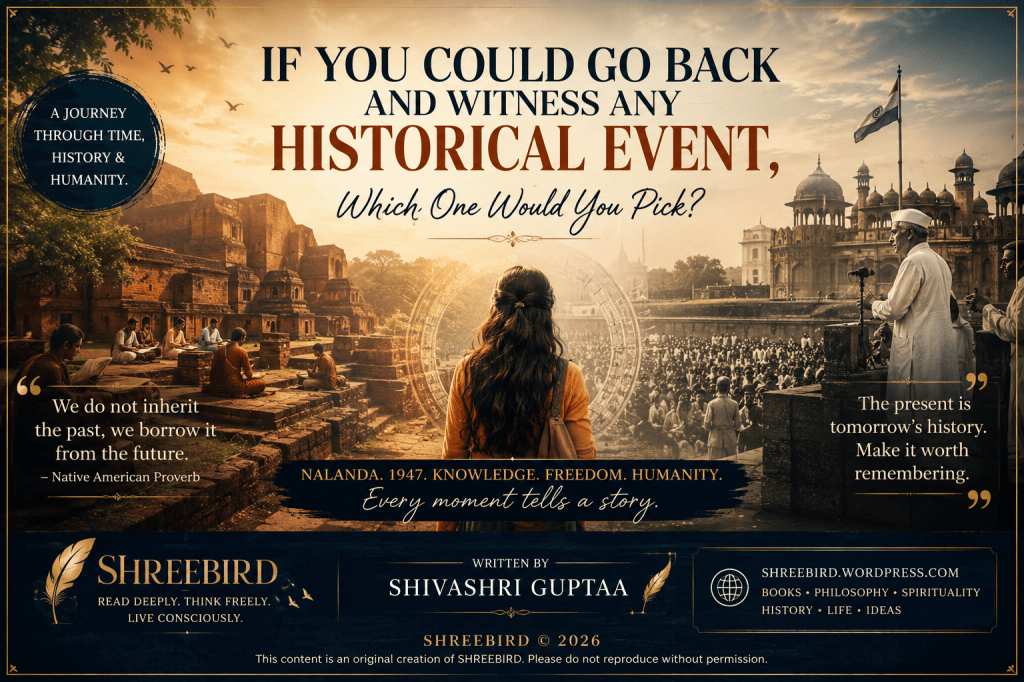
Or stand in Delhi at midnight on 14–15 August 1947, when India became independent?
There are thousands of possibilities.
But if I had only one ticket through time—
I would go to ancient Nalanda.
Not merely to see its ruins.
I would want to see Nalanda alive.
🌿 I Don’t Want To See A Monument. I Want To See A Civilization Thinking.
Today, we visit historical places through photographs.
We see broken walls.
Pillars.
Bricks.
Museums.
Archaeological remains.
But imagine seeing those same places when they were not ruins.
Imagine walking through Nalanda when students were actually living there.
When teachers were teaching.
When debates were happening.
When manuscripts were being written.
When travellers from distant parts of Asia arrived carrying questions.
UNESCO describes Nalanda Mahavihara as one of the earliest and longest-serving monastic-cum-scholastic institutions in the Indian subcontinent, with organized transmission of knowledge continuing for centuries. The surviving archaeological complex includes viharas, stupas, shrines and other structures that reveal the intellectual and monastic life of the institution.
And suddenly, history stops being a chapter.
It becomes a living world.
📖 Imagine Walking Into Nalanda
I imagine myself entering through its ancient complex early in the morning.
The sun has barely risen.
The courtyard is slowly becoming alive.
A student walks past carrying manuscripts.
Somewhere, a teacher is already discussing philosophy.
Another group is debating logic.
Someone is studying language.
Someone is questioning an old idea.
Someone is discovering a new one.
And perhaps, somewhere in that enormous intellectual world, a young student is sitting alone thinking:
“What is truth?”
I would sit beside him.
Not as a tourist.
Not as a historian.
Just as another human being who is curious.
And I would listen.
🧠 Because The Most Fascinating Thing About History Is Not What People Built.
It is what they believed.
We often admire ancient civilizations because of their monuments.
But monuments tell us what people could construct.
Ideas tell us what people could imagine.
And that’s why Nalanda fascinates me.
It represents something more powerful than architecture:
the human hunger for knowledge.
💭 Famous Quote #1 — Albert Einstein
“The important thing is not to stop questioning.”
That sentence could almost be the unofficial motto of a great centre of learning.
Because education isn’t about collecting answers.
It is about developing better questions.
Example 1: Socrates
More than two thousand years ago, Socrates became famous not because he claimed to possess every answer, but because he constantly questioned assumptions.
His method reminds us of something uncomfortable:
Sometimes intelligence begins with admitting, “I might be wrong.”
Imagine hearing that kind of philosophical debate in an ancient university.
That is the experience I would want.
🔥 But Then I Would Ask A Darker Question
What happens when knowledge disappears?
This is where my time-travel journey becomes less romantic.
Because Nalanda wasn’t immortal.
The institution eventually declined and was sacked and abandoned in the 13th century. UNESCO records the archaeological remains as spanning centuries of development and describes the site’s later sack and abandonment.
And this forces us to confront one of history’s most painful truths:
Human civilization can spend centuries creating knowledge—and lose it frighteningly quickly.
🔥 Example 2: The Library of Alexandria
The Library of Alexandria has become one of history’s most powerful symbols of lost knowledge.
But here’s the important lesson:
The popular story that one single dramatic fire destroyed the entire library in one moment is an oversimplification. Its decline was likely connected to multiple historical processes rather than one neat cinematic event.
And that’s actually more frightening.
Because civilizations rarely disappear in one dramatic scene.
They disappear gradually.
A manuscript stops being copied.
A language stops being taught.
A library loses funding.
A tradition becomes irrelevant.
A question stops being asked.
And eventually—
something that once seemed permanent becomes a memory.
📜 Famous Quote #2 — Jorge Luis Borges
“I have always imagined that Paradise will be a kind of library.”
Now imagine the opposite.
A library becoming ash.
Books that took generations to create disappearing in moments.
Ideas that existed nowhere else vanishing forever.
This is why libraries are not just buildings.
They are humanity’s external memory.
🕯️ And Perhaps I Would Ask One Scholar…
If I could speak to one scholar at Nalanda, I would ask:
“What knowledge are you most afraid humanity will lose?”
Maybe he would answer philosophy.
Maybe medicine.
Maybe astronomy.
Maybe mathematics.
Maybe spiritual knowledge.
Or perhaps something much simpler:
“The ability to think for ourselves.”
And that answer would follow me back to the 21st century.
📱 Because We Have More Information Than Any Civilization Before Us
Think about the irony.
An ancient scholar might spend months finding one manuscript.
We can access millions of books from a phone.
An ancient traveller might spend months crossing mountains to learn from another teacher.
We can listen to lectures from universities around the world while sitting in bed.
We have search engines.
Digital libraries.
AI.
Online courses.
Podcasts.
Archives.
Videos.
And yet—
Are we necessarily wiser?
That is the question history would ask us.
💡 Example 3: The Smartphone Paradox
A smartphone can contain more information than an ancient library could physically hold.
But information does not automatically create wisdom.
You can know 500 facts and still make one terrible decision.
You can read 100 books and still misunderstand yourself.
You can have unlimited access to knowledge and still lack judgment.
Information answers:
“What?”
Wisdom asks:
“So what?”
🌌 Famous Quote #3 — Carl Sagan
“Somewhere, something incredible is waiting to be known.”
That is perhaps the most beautiful reason to study history.
Because every civilization believed it understood the world—
until someone discovered that it didn’t.
🏛️ Now Let’s Change The Time Machine
Suppose I could choose a second event.
I would go to another moment in Indian history.
Midnight of 14–15 August 1947.
Imagine standing there.
The clock approaches midnight.
India is about to become independent.
Jawaharlal Nehru delivers his famous “Tryst with Destiny” speech to the Constituent Assembly. The official archival record dates the speech to the midnight session of 14–15 August 1947.
And then comes that unforgettable line:
“At the stroke of the midnight hour, when the world sleeps, India will awake to life and freedom.” — Jawaharlal Nehru
I wouldn’t want to watch it from the VIP gallery.
I would want to stand among ordinary Indians.
Because history belongs to them too.
🇮🇳 Example 4: Freedom Didn’t Feel The Same To Everyone
For some, 15 August 1947 meant celebration.
For others, it was inseparable from displacement, violence and the trauma of Partition.
Nehru’s own speech acknowledged that freedom arrived alongside immense sorrow and responsibility. The archival text describes independence not as an endpoint but as an opening of opportunity—and emphasizes the responsibility that comes with freedom.
That complexity matters.
Because history is rarely black and white.
The same date can contain both tears and celebrations.
A person can be free and grieving at the same time.
A nation can celebrate and mourn simultaneously.
A new beginning can emerge from an incredibly painful past.
That is what makes history human.
✨ Famous Quote #4 — George Orwell
“Who controls the past controls the future.”
Think about that.
If we control how history is remembered, we influence how future generations understand themselves.
That’s why historical memory matters.
Not because we should live in the past.
But because the past quietly shapes the stories we tell about ourselves.
🕊️ I Would Also Want To Witness An Ordinary Person
Here’s the strange thing.
If I could travel through time, I wouldn’t spend all my time with famous people.
I wouldn’t necessarily want to meet kings.
Or emperors.
Or presidents.
Or revolutionaries.
I would want to meet an ordinary person.
A woman cooking dinner in ancient India.
A student walking home from Nalanda.
A farmer watching the sunset.
A child playing in a street in 1947.
Because history books tell us what great people did.
They often forget to tell us what ordinary people felt.
🌱 Example 5: Anne Frank
Anne Frank never became a political leader.
She didn’t command an army.
She didn’t govern a country.
She was simply a young girl writing in a diary during one of humanity’s darkest periods.
Yet her words became one of the most intimate windows into that era.
That’s the power of personal memory.
Sometimes one ordinary person’s voice can make an entire historical period feel human.
🪞 And Suddenly, The Time Machine Becomes A Mirror
Suppose I return to 2026.
What would I see differently?
I might look at my phone and realize:
This is history too.
We are living through an age of artificial intelligence.
Climate change.
Social media.
Space exploration.
Biotechnology.
Geopolitical transformation.
A world where information moves across continents in seconds.
Future historians may look back at our generation and ask:
“What did they do when they knew the world was changing?”
And that question is uncomfortable.
Because we don’t know what our historical chapter will be called.
⏳ Famous Quote #5 — Marcus Aurelius
“The happiness of your life depends upon the quality of your thoughts.”
Imagine a Roman emperor writing that nearly two thousand years ago.
And yet, in an age of notifications, comparison, algorithms and constant distraction—
it still feels strangely modern.
That’s the magic of great ideas.
Time can destroy buildings.
It cannot easily destroy truth.
🌍 What If The Greatest Historical Event Is Happening Right Now?
Perhaps that’s the real twist.
We keep asking:
“Which historical event would you like to witness?”
But maybe the better question is:
“What if the event you would most want to witness is happening right now?”
Maybe you’re already standing inside history.
Maybe the decisions being made today will become tomorrow’s textbooks.
Maybe the person you are talking to today will change your life.
Maybe the small decision you are making today will become the turning point of your story.
Maybe—
your ordinary Tuesday is someone else’s future history lesson.
🕰️ History Never Feels Like History While We Are Living It
Think about the people of 1947.
They didn’t have the advantage of hindsight.
They didn’t know exactly how independent India would develop.
They didn’t know which institutions would survive.
They didn’t know what future generations would praise or criticize.
They simply had to make decisions.
Just like us.
And that’s why history should make us humble.
The people of the past were living without knowing their ending.
We are doing exactly the same thing.
🔥 What Would I Bring Back From Nalanda?
Not a manuscript.
Not a statue.
Not a souvenir.
I’d bring back one idea:
“Protect what teaches humanity how to think.”
Because civilizations don’t become great merely because they become wealthy.
They become great when they create people capable of questioning power, seeking truth, imagining possibilities and preserving knowledge.
🌿 The Final Question
If you could go back in time, perhaps you would choose the French Revolution.
Perhaps the signing of the Constitution.
Perhaps the construction of the Taj Mahal.
Perhaps the first moon landing.
Perhaps the day your grandparents were young.
Perhaps you wouldn’t choose a famous event at all.
Maybe you’d go back to one ordinary afternoon when someone you loved was still alive.
And perhaps that’s the most beautiful answer of all.
Because sometimes we don’t want to witness history.
We want to witness a moment we didn’t know was precious.
🌌 If I Had Only One Ticket…
I would still choose Nalanda.
I would walk through its courtyards.
I would listen to the scholars.
I would watch students argue.
I would sit beneath a tree.
I would look at manuscripts being written by hand.
And before leaving, I would turn around one last time.
I would look at the people living their ordinary lives.
They wouldn’t know that centuries later, someone would stand among their ruins and wonder about them.
And perhaps I would whisper:
“You don’t know it yet… but you are history.”
Then I would return to 2026.
And perhaps I would look at my own life differently.
Because maybe—
we are all living inside someone’s future history book.
🪶 SHREEBIRD’S FINAL THOUGHT
“History is not a museum behind us. It is a mirror quietly asking us who we are becoming.”
We cannot travel backward.
We cannot rewrite yesterday.
We cannot meet every person history remembers.
But we can do something much more powerful.
We can live today in a way worth remembering tomorrow.
So if someone asked me one last time—
“If you could go back and witness any historical event, which one would you pick?”
I’d say:
Nalanda.
Because I wouldn’t go there to meet history.
I would go there to meet humanity.
And when I returned—
I would try to make sure that the present doesn’t become another Nalanda:
A place full of knowledge…
that future generations only know through ruins.
💭 YOUR TURN — THE SHREEBIRD QUESTION
If you had ONE chance to travel through time, which historical moment would YOU witness—and why?
Don’t just name the event.
Tell me:
What would you want to see that history books never showed you?
📚 SHREEBIRD READING CORNER
If this article made you curious about history, philosophy and civilisation, explore books on:
Memoirs and diaries of people who lived through history
🛍️ Affiliate Recommendation
SHREEBIRD BOOK PICK: Choose a well-researched book on Ancient India / Nalanda / Indian History and place your Amazon Associates tagged link here.
Affiliate Disclosure: SHREEBIRD may earn a small commission from qualifying purchases made through properly tagged affiliate links, at no additional cost to the reader.
🪶 SHREEBIRD
Read deeply. Think freely. Live consciously.
Written by: SHIVASHRI GUPTAA
SHREEBIRD Website: shreebird.wordpress.com
Categories: History • Philosophy • Spirituality • Books • Life • Ideas
 मैं चिड़िया बनना चाहती हूं ...
टिप्पणी करे