A question about the life we secretly want
“The only way to do great work is to love what you do.”
— Steve Jobs
Imagine this.
Tomorrow morning, someone walks up to you and says:
“Don’t worry about the salary anymore.”
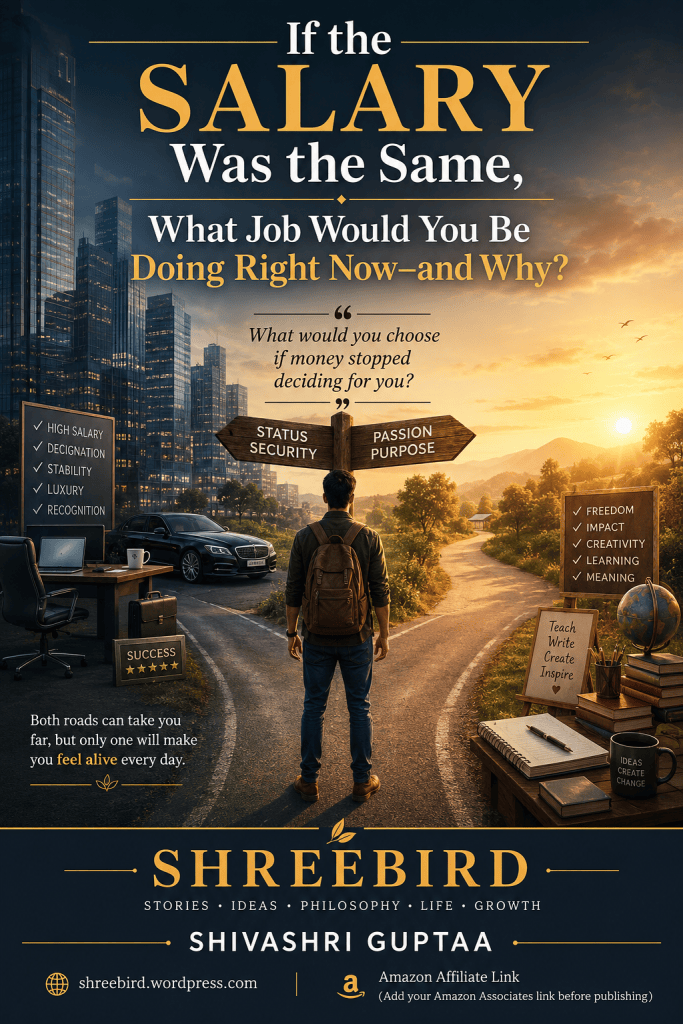
Your current salary, your dream salary, the salary of the job you’ve always wanted—it is all exactly the same.
No financial penalty.
No social judgment.
No comparison with your classmates.
No relatives asking, “Beta, package kitna hai?”
No LinkedIn anxiety.
No fear of starting from zero.
Just one question:
What would you actually choose to do?
Think about it for a moment.
Not what sounds impressive.
Not what your parents would proudly tell relatives.
Not what society considers successful.
Not what gives you the biggest designation.
What would make you want to wake up on Monday morning?
That answer may reveal more about you than your résumé ever could.
🌱 The Job We Choose vs. The Life We Actually Want
Most of us don’t choose careers in a vacuum.
We choose them through a complicated mixture of:
Money + security + family expectations + social status + opportunities + fear + passion.
A child may want to become an artist.
Then someone tells them:
“Art se career nahi banta.”
Someone wants to become a teacher.
“Teacher banoge? Corporate mein jao.”
Someone wants to write.
“Writing se ghar kaise chalega?”
Someone wants to start a small business.
“Pehle stable job karo.”
And slowly, without realizing it, we begin replacing the question:
“What do I love?”
with:
“What is practical?”
Practicality is important.
But sometimes, practicality becomes a prison disguised as responsibility.
💭 The Salary Experiment
Here’s an interesting thought experiment.
Suppose five people earn ₹1 lakh a month.
Person A is an engineer.
Person B is a teacher.
Person C is a filmmaker.
Person D is a civil servant.
Person E runs a small bookstore.
Now remove the salary difference.
Everyone earns exactly ₹1 lakh.
Suddenly, the question changes.
Nobody can say:
“I became an engineer because it pays more.”
Nobody can say:
“I chose this profession because society respects it.”
Now they have to confront something much more uncomfortable:
“What do I actually want to spend my life doing?”
And that’s where the real career question begins.
🧭 Why Purpose Matters More Than We Think
This isn’t merely philosophical.
Gallup’s State of the Global Workplace 2026 reports that only 20% of employees globally were engaged with their work in 2025. In South Asia, engagement was around 21%, while only 16% of employees were classified as thriving in life.
Even more interestingly, Gallup’s analysis found that wellbeing is stronger when people enjoy their work, feel their work improves other people’s lives, and have meaningful choice in what they do.
In other words:
A paycheck can pay your bills.
But it cannot automatically give you belonging, purpose, curiosity or pride.
✨ So, What Job Would I Choose?
If salary were completely equal, I think the answer would become less about a particular job title and more about a particular kind of life.
I’d want work where I could:
- create something that didn’t exist before,
- learn continuously,
- explain complicated things simply,
- write and tell stories,
- teach someone something useful,
- explore ideas,
- work independently,
- and occasionally look at something I created and think:
“I made this.”
Maybe that sounds like a writer.
Maybe a teacher.
Maybe a researcher.
Maybe an entrepreneur.
Maybe all four.
And perhaps that’s the point.
We don’t always want a job.
Sometimes, we want a way of living.
📚 The Teacher Who Never Wanted to Be a Teacher
Consider a hypothetical example.
A brilliant software engineer spends ten years in a multinational company.
Excellent salary.
Beautiful office.
Good designation.
But every weekend, she teaches mathematics to neighbourhood children for free.
One day somebody asks:
“Why don’t you become a teacher?”
She laughs.
“Because teachers don’t earn what I earn.”
Then comes the salary experiment:
“What if teachers earned exactly what you earn?”
Suddenly, there is silence.
Because the problem was never teaching.
The problem was the price society attached to teaching.
🎨 The Artist Who Became an Accountant
Another person loves painting.
But he becomes an accountant because it is stable.
He spends twenty years earning well.
His family is happy.
His bank account is healthy.
But every Sunday morning, he paints.
At 50, someone asks:
“Why didn’t you become an artist?”
His answer is heartbreaking:
“I thought I had time.”
That’s perhaps one of the most dangerous assumptions we make about life.
We assume there will always be a later.
Later I’ll write.
Later I’ll travel.
Later I’ll teach.
Later I’ll start my business.
Later I’ll paint.
Later I’ll create.
Later I’ll become the person I wanted to become.
But life doesn’t promise us an unlimited number of laters.
💰 Money Is Important—But It Is Not the Whole Equation
Let’s not romanticize passion either.
Money matters.
Rent matters.
Food matters.
Healthcare matters.
Family responsibilities matter.
Financial security matters.
A person struggling to pay their electricity bill cannot simply be told:
“Follow your passion.”
That’s not wisdom.
That’s privilege.
The better question is:
How can I build a life where money and meaning don’t have to be enemies?
Perhaps the answer is not quitting everything tomorrow.
Perhaps it is starting slowly.
Write after work.
Teach on weekends.
Paint at night.
Build the business on the side.
Create the YouTube channel.
Learn the skill.
Publish the first article.
Take the first client.
Because sometimes your dream career doesn’t begin with resignation.
It begins with one hour.
🪞 The Most Honest Career Test
Forget aptitude tests for a minute.
Forget personality tests.
Ask yourself these seven questions:
1. What would I do if nobody knew about it?
Because then you remove social validation.
2. What activity makes me lose track of time?
That often reveals curiosity.
3. What problem do I genuinely enjoy solving?
That reveals your natural contribution.
4. What do people constantly ask me for help with?
That may reveal an overlooked strength.
5. What would I still do even if I weren’t famous for it?
That reveals intrinsic motivation.
6. What kind of tiredness feels satisfying?
There is a huge difference between:
“I’m exhausted because I hate this.”
and
“I’m exhausted—but I’m proud of what I did today.”
7. If I had only ten years left, would I still choose this career?
That’s the uncomfortable one.
And perhaps the most honest.
🌍 The World Doesn’t Need More Impressive Résumés
It needs people who care about what they are doing.
The doctor who actually listens.
The teacher who notices the quiet student.
The engineer who builds something useful.
The civil servant who remembers that files represent real human lives.
The entrepreneur who solves a real problem.
The writer who makes someone feel less alone.
The artist who makes someone stop and look.
The researcher who spends ten years answering one difficult question.
None of these people are merely performing a job.
They are contributing something.
And that distinction matters.
🕯️ A Different Definition of Success
Perhaps success isn’t:
“How much did you earn?”
Perhaps it is also:
“How much of yourself did you get to use?”
Because imagine reaching retirement with an enormous bank balance but realizing you spent forty years doing something you never cared about.
And imagine another person earning the same amount, but spending those forty years teaching, creating, discovering, building, healing or serving.
Both earned money.
But they didn’t necessarily live the same life.
Steve Jobs once expressed this idea powerfully when he spoke about not wanting to be remembered simply as wealthy, but wanting to feel that he had created something wonderful.
That idea has stayed relevant because deep down, most people don’t want their life’s final sentence to be:
“I earned well.”
They want it to be:
“I did something that mattered.”
❤️ Maybe Your Dream Job Is Not a Job
And here’s the twist.
Perhaps when you answer:
“If salary were the same, what job would I choose?”
you won’t name a profession.
You might say:
“I want to spend my days creating.”
“I want to help people.”
“I want freedom.”
“I want to travel and write.”
“I want to teach.”
“I want to build something of my own.”
“I want to work with animals.”
“I want to research.”
“I want to make films.”
“I want to work with children.”
“I want to live quietly and grow plants.”
Notice something?
These aren’t job descriptions.
They are descriptions of the life we want.
And perhaps that’s the real question hidden inside the original question.
🌿 The Final Question
So, if your salary were guaranteed to remain exactly the same…
What would you be doing tomorrow morning?
Would you still sit at the same desk?
Would you still attend the same meetings?
Would you still chase the same promotion?
Would you still choose the same career?
Or would you finally allow yourself to say:
“This is what I actually want.”
Maybe you won’t change your career.
And that’s perfectly okay.
Perhaps you’ll realize that you already chose correctly.
But if your answer surprises you—
don’t ignore it.
You don’t necessarily have to quit your job.
You don’t have to burn your résumé.
You don’t have to make a dramatic announcement.
Just listen.
Because sometimes the quiet voice saying,
“I think I was meant to do something else…”
isn’t dissatisfaction.
It is your unexplored self asking for a chance.
🪶 SHREEBIRD THOUGHT
“The richest career isn’t necessarily the one that pays you the most.
It is the one that lets you recognize yourself in the work you do.”
Maybe the question isn’t:
“What job would I choose if the salary were the same?”
Maybe the deeper question is:
“Who would I become if money stopped deciding for me?”
And perhaps that answer is worth discovering.
📌 SHREEBIRD | A Thought Worth Carrying
Don’t choose a life only because it looks successful from the outside.
Choose something that still feels meaningful when nobody is watching.
Written by: SHIVASHRI GUPTAA
SHREEBIRD
🌐 Website: shreebird.wordpress.com
Affiliate suggestion for readers:
📚 Books on purpose, creativity & meaningful work — consider exploring titles such as Man’s Search for Meaning, Ikigai, and Designing Your Life through your preferred book platform.
Amazon Affiliate: Add your official Amazon Associates tracking link here before publishing.
© SHREEBIRD | SHIVASHRI GUPTAA
Stories • Ideas • Philosophy • Life • Growth
Read. Reflect. Reimagine.
🌐 shreebird.wordpress.com
 मैं चिड़िया बनना चाहती हूं ...
टिप्पणी करे