The Subtle Art of Not Giving a Fck — Mark Manson*
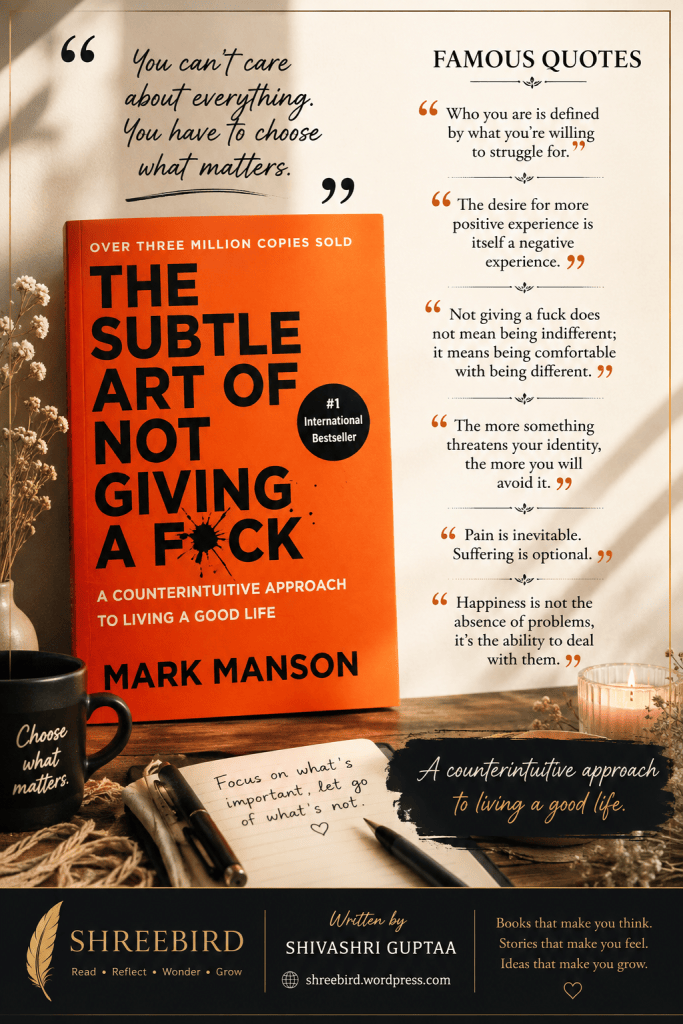
“Who you are is defined by what you’re willing to struggle for.”
— Mark Manson
Some books are unfinished because we don’t like them.
Some are unfinished because life gets busy.
And some…
are unfinished because we lent them to a friend.
And the friend never returned them.
Yes.
That is my story. 😂
I started reading The Subtle Art of Not Giving a Fck* by Mark Manson. I was somewhere in the middle—not finished, but definitely interested.
Then one day, a friend came to meet me.
We talked. We laughed. We spent time together.
And somehow, during that visit, my book went from my bookshelf to my friend’s hands.
The famous last words were probably something like:
“I’ll return it.”
Except…
they didn’t.
And I never bought another copy.
So technically, I never finished the book.
But here’s the strange part:
I still think about it.
Maybe that’s what makes this one of my most memorable unfinished books.
Because sometimes, you don’t need to reach the last page for a book to leave something behind.
Sometimes…
the unfinished book finishes a thought inside you.
📖 The Book That Was Borrowed… and Never Came Back
I still find the whole thing slightly funny.
Imagine writing an article about an unfinished book when the reason you didn’t finish it is not that you hated it, got bored, or couldn’t understand it.
No.
Your friend simply took it.
😂
And instead of buying another copy, I just moved on.
Life continued.
Other books came.
Other priorities appeared.
The bookmark stayed trapped somewhere inside that book.
And eventually, the book became a memory.
But certain ideas from it stayed with me.
Especially one central question:
What deserves my attention?
That question became more meaningful with time.
Because growing up teaches you something school rarely does:
You cannot give your energy to everything.
✍️ Who Is Mark Manson?
Mark Manson is an American author and blogger known for writing about personal development, values, relationships, happiness, and the less glamorous realities of being human.
His breakthrough book, The Subtle Art of Not Giving a Fck*, was published in 2016 and became an international bestseller.
But Manson’s approach is very different from conventional motivational writing.
He doesn’t tell you:
“Think positive and everything will work out.”
Instead, his message is much more uncomfortable:
Life will always have problems.
You will fail.
You will be rejected.
People will misunderstand you.
Some things will not go according to plan.
And you cannot control everything.
So instead of trying to build a life without problems…
choose problems worth having.
That’s a much more realistic definition of personal growth.
🌿 So, What Is the Book Actually About?
Despite its provocative title, the book isn’t really telling us to become careless or insensitive.
It isn’t:
“Stop caring about people.”
It isn’t:
“Do whatever you want.”
And it definitely isn’t:
“Nothing matters.”
It’s almost the opposite.
The book asks us to become selective about what matters.
Because our attention is limited.
Our time is limited.
Our emotional energy is limited.
And yet we often spend all three worrying about things that don’t deserve them.
🎯 Imagine Your Attention Is Money
Suppose you wake up every morning with 100 emotional coins.
You can spend them anywhere.
Someone criticises you.
You spend 10.
Someone doesn’t reply to your message.
Another 10.
Someone compares you to another person.
15 more.
Someone misunderstands you.
Someone doesn’t approve of your decision.
Another 15.
By evening…
you’re broke.
And then you wonder why you’re exhausted.
Meanwhile, the things that actually matter—
your dreams,
your family,
your creativity,
your growth,
your peace—
received almost nothing.
Maybe the problem isn’t that we care too much.
Maybe…
we care about too many things that don’t deserve our care.
💭 The Art Isn’t “Not Caring”
This is where the title can be misunderstood.
Not giving a f*ck doesn’t mean having no feelings.
It means understanding that you cannot care deeply about everything.
Imagine someone leaves a negative comment on something you created.
You can spend the next three hours:
- checking their profile,
- thinking about their words,
- writing a reply,
- deleting the reply,
- rewriting it,
- checking whether they responded.
Or you can say:
“Okay. They don’t like it.”
And continue with your life.
The comment hasn’t changed.
But your relationship with it has.
That is the real power.
📱 The Social Media Trap
This philosophy becomes even more relevant in the age of Instagram.
You open your phone.
Someone got married.
Someone bought a house.
Someone went on an international trip.
Someone got promoted.
Someone launched a business.
Someone looks incredibly happy.
And suddenly…
your own life feels inadequate.
But there’s a problem.
You’re comparing:
their highlight reel
with
your behind-the-scenes.
You don’t see their bad days.
Their doubts.
Their failures.
Their arguments.
Their anxiety.
Their unfinished plans.
You only see what they chose to show.
And then you spend your emotional coins asking:
“Why am I not there yet?”
Maybe a better question is:
“Do I even want what they have—or do I just want the validation that comes with having it?”
That’s a very different question.
🏔️ What Are You Willing to Struggle For?
This is one of the ideas from the book that stayed with me.
We often ask:
What do I want?
I want success.
I want happiness.
I want money.
I want recognition.
I want a peaceful life.
But wanting something is easy.
The more revealing question is:
What are you willing to struggle for?
Because every meaningful goal comes with an uncomfortable side.
Want to become successful?
You have to accept failure.
Want to become excellent?
You have to accept repetition.
Want a meaningful relationship?
You have to accept vulnerability.
Want freedom?
You have to accept responsibility.
Want to write?
You have to accept days when nobody reads your work.
Want to build something of your own?
You have to accept uncertainty.
The struggle is not always an obstacle to the goal.
Sometimes…
the struggle is the price of the goal.
🌧️ Happiness Is Not a Problem-Free Life
One of the book’s most useful ideas is that problems are unavoidable.
Think about it.
You solve one problem.
Another appears.
You finish your studies.
Now comes career anxiety.
You get a job.
Now comes workplace pressure.
You achieve a goal.
Now comes the next goal.
You solve a relationship problem.
Another relationship requires attention.
Life doesn’t reach a stage where it says:
“Congratulations. You have unlocked permanent peace.” 😂
So perhaps the goal isn’t to eliminate problems.
It’s to choose problems that are meaningful.
A meaningful life isn’t problem-free.
It is filled with problems worth solving.
❤️ The Relationship Example
Think about relationships.
Sometimes we spend enormous energy trying to make someone understand us.
We explain.
We clarify.
We apologise.
We prove our intentions.
We wait.
We overthink.
We ask:
“Why don’t they understand how much I care?”
But another question might be more important:
“Is this relationship aligned with the values I want to live by?”
You cannot control another person’s feelings.
You cannot force someone to choose you.
You cannot make everyone understand you.
But you can choose:
your boundaries,
your honesty,
your self-respect,
your response,
and where your energy goes.
Sometimes letting go isn’t weakness.
Sometimes…
letting go is simply refusing to spend another emotional coin on something you cannot control.
🪞 You Don’t Have to Be Right All the Time
Another uncomfortable lesson is accepting that we can be wrong.
We love being right.
In arguments.
In relationships.
In our opinions.
Even in the stories we tell ourselves.
But growth requires the possibility of saying:
“Maybe I’m wrong.”
That’s not weakness.
That’s intellectual humility.
Imagine two people arguing.
Both are convinced they’re right.
Neither is listening.
The argument becomes about winning rather than understanding.
Now imagine one person says:
“Tell me what I’m missing.”
Suddenly, the conversation changes.
You don’t have to agree with someone to learn from them.
And you don’t have to win every argument to win at life.
🔥 Failure Is Part of the Process
We are often taught to avoid failure.
But failure can be information.
You try.
It doesn’t work.
You learn.
You adjust.
You try again.
That’s how almost everything meaningful develops.
Nobody writes their perfect first article.
Nobody gives their perfect first presentation.
Nobody masters a skill on day one.
Nobody gets every life decision right.
Failure doesn’t necessarily mean you’re going in the wrong direction.
Sometimes it simply means:
You’re learning how to move forward.
📚 And Then There Is My Unfinished Book…
Here’s where the entire philosophy becomes almost comically perfect.
I didn’t finish the book.
Not because it was terrible.
Not because I disagreed with everything.
Not because I gave up.
My friend took it.
And I never bought another copy.
😂
There is something beautifully ironic about that.
A book teaching me to be selective about what deserves my attention…
and I apparently decided that buying another copy wasn’t high enough on my priority list.
Maybe Mark Manson would approve.
Maybe not.
I’m not sure.
But the book remained unfinished.
🕰️ Maybe Some Books Return Differently
I sometimes wonder where that copy is now.
Maybe my friend still has it.
Maybe they finished it.
Maybe they also stopped halfway.
Maybe it’s sitting on a shelf somewhere, quietly collecting dust.
And perhaps one day, years later, I’ll see it again.
I’ll open it.
I’ll find my old bookmark.
And I’ll read the same words with a completely different mind.
Because that’s another strange thing about books:
The words remain the same.
But the reader changes.
A sentence that meant nothing at 25 can completely shake you at 33.
A paragraph you ignored years ago can suddenly describe your life perfectly.
That’s why sometimes…
we aren’t ready for the entire book when we first open it.
🌱 What Stayed With Me
Even though I never finished the book, several of its ideas stayed with me:
1. Not everything deserves my attention.
My attention is precious.
2. Problems are unavoidable.
The goal is to choose meaningful ones.
3. Values matter more than temporary feelings.
What we repeatedly choose shapes our lives.
4. Failure is part of growth.
Trying guarantees the possibility of failure.
Not trying guarantees very little change.
5. Other people’s opinions have limits.
People will judge us anyway.
We don’t have to make their opinions the centre of our lives.
✨ Three Quotes That Stayed With Me
“Who you are is defined by what you’re willing to struggle for.”
— Mark Manson
A reminder that our struggles often reveal our real priorities.
“The desire for more positive experience is itself a negative experience.”
— Mark Manson
Sometimes constantly chasing happiness makes us more aware of everything that isn’t perfect.
Accepting difficult emotions can be healthier than running from them.
“The more something threatens your identity, the more you will avoid it.”
— Mark Manson
Sometimes the things we resist most strongly are worth examining—not because resistance proves they’re right, but because they may reveal something about how we see ourselves.
🌙 The Bigger Lesson Wasn’t in the Book
Perhaps the biggest lesson came from what happened to the book itself.
Life doesn’t always let us finish things.
Sometimes books disappear.
Sometimes plans change.
Sometimes opportunities pass.
Sometimes relationships end without the ending we imagined.
Sometimes dreams remain unfinished.
And yet…
unfinished doesn’t always mean meaningless.
A half-read book can still give you a sentence you needed.
A short friendship can still leave a lifelong lesson.
A failed attempt can still change your direction.
An unfinished chapter can still become part of your story.
Completion isn’t the only measure of meaning.
🪶 Some Books We Read. Some Books Read Us.
Maybe that’s why I still think about this particular book.
I don’t remember every chapter.
I don’t remember every argument.
I certainly don’t remember what page I stopped at.
But I remember the questions.
And perhaps questions are more valuable than answers.
Because answers can become outdated.
Questions keep us growing.
The book asked me, directly or indirectly:
What matters?
What doesn’t?
What am I willing to struggle for?
Whose opinion actually matters to me?
Which problems are worth solving?
And those questions don’t require the final page.
They require a lifetime.
❤️ So, Will I Buy the Book Again?
Maybe.
Someday I’ll probably order another copy.
Maybe I’ll finally read the chapters I missed.
Maybe I’ll underline everything.
Maybe I’ll disagree with half of it.
Maybe I’ll discover that the parts I once loved no longer speak to me.
And that’s okay.
Because reading a book isn’t about agreeing with the author.
It’s about entering a conversation.
Sometimes the author gives you an answer.
Sometimes they give you an argument.
Sometimes they give you a question.
And sometimes…
they give you a completely new way of looking at your own life.
🌻 Final Thought
I never finished The Subtle Art of Not Giving a Fck*.
A friend borrowed my copy.
The book never came back.
I never bought another.
And yet, somehow, it remains one of the books I remember.
Maybe that’s the irony.
I lost the book…
but I didn’t lose the idea.
And perhaps that’s what makes a book truly memorable.
Not whether you reached the final page.
Not whether you can quote every chapter.
But whether something from those pages quietly followed you into real life.
Because sometimes…
the book ends.
Sometimes…
the book gets lost.
And sometimes…
the book remains unfinished, but the thought it planted keeps growing.
So maybe I don’t need to feel bad about never finishing it.
Maybe someday I’ll finish the book.
But until then…
I’ll keep finishing the questions it started.
📖 What About You?
What’s a book you never finished but still think about?
Did you abandon it?
Did life interrupt you?
Did you lend it to someone?
Or did someone, like my friend, borrow it and apparently decide:
“This is mine now.” 😂
Tell me your unfinished-but-unforgettable book.
Because maybe the book you never finished…
is the one that left the longest chapter inside you.
📚 SHREEBIRD BOOK CORNER
The Subtle Art of Not Giving a F*ck
Author: Mark Manson
Published: 2016
Genre: Personal Development • Philosophy • Self-Help
Why read it?
If you’re tired of conventional “just stay positive” advice, this book offers a more blunt perspective on values, responsibility, failure, suffering, boundaries and choosing what genuinely deserves your attention.
🛒 Read the Book
Amazon Affiliate Link:
👉 https://www.amazon.in/dp/B0HGBSQCTQ/ref=cm_sw_r_as_gl_apa_gl_i_K87N5FZGZS2QHTABY3VJ?linkCode=ml1&tag=shreebird1904-21&linkId=2be7cdaddae0f1e441fa0c9de20d5d5e
Affiliate Disclosure:
This post may contain affiliate links. If you purchase through one of these links, SHREEBIRD may earn a small commission at no additional cost to you. This helps support SHREEBIRD and future content.
🕊️ SHREEBIRD
Read • Reflect • Wonder • Grow
Written by
SHIVASHRI GUPTAA
🌐 Website: SHREEBIRD
📖 Books that make you think.
🌿 Stories that make you feel.
✨ Ideas that make you grow.
© SHREEBIRD | SHIVASHRI GUPTAA
“Some books are read.
Some books are lived.
And some books disappear with a friend—
but never disappear from your mind.”
 मैं चिड़िया बनना चाहती हूं ...
टिप्पणी करे