A brutally honest review of Mark Manson’s counterintuitive approach to living a good life
“Who you are is defined by what you’re willing to struggle for.”
— Mark Manson
There are some books you read because everyone recommends them.
There are books you read because their covers look interesting.
And then there are books whose titles practically challenge you to pick them up.
The Subtle Art of Not Giving a F*ck is one of those books.
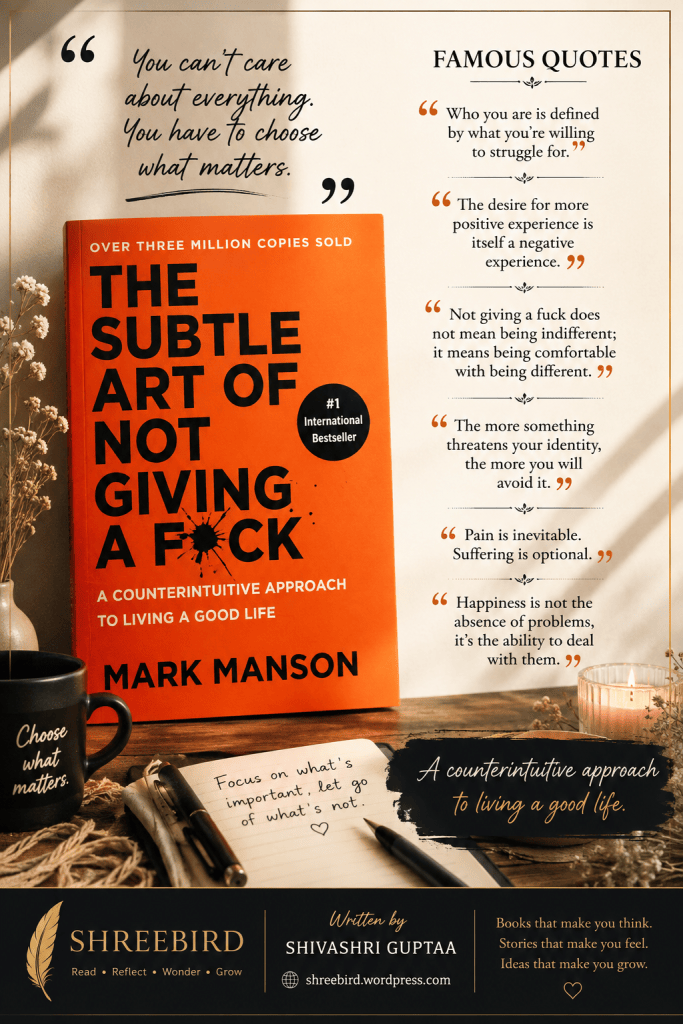
Written by Mark Manson, this 2016 self-help and personal-development book became an international bestseller by doing something unusual: instead of promising a life without problems, it tells us to stop expecting life to be problem-free in the first place.
And honestly, that is what makes this book different.
It doesn’t whisper:
“Everything will be fine.”
It looks you in the eye and says:
“Some things will suck. You will fail. People will disappoint you. Life will be unfair sometimes. Now decide what is still worth caring about.”
And somehow…
that feels more comforting than empty positivity.
📖 First, Let’s Talk About the Title
When you first hear The Subtle Art of Not Giving a Fck*, you might think the book is teaching you to become careless.
It isn’t.
It isn’t telling you to stop loving people.
It isn’t telling you to ignore responsibilities.
It isn’t telling you to become rude.
And it certainly isn’t saying that nothing matters.
The actual idea is much more subtle:
You have a limited number of things you can genuinely care about. Choose them wisely.
Your time is limited.
Your attention is limited.
Your emotional energy is limited.
So if you spend all of it worrying about strangers, criticism, comparison, rejection and things outside your control…
what is left for the things that actually matter?
✍️ Who Is Mark Manson?
Mark Manson is an American author and blogger whose writing focuses on personal development, relationships, values, happiness and the uncomfortable realities of being human.
His writing style is deliberately different from traditional self-help.
Instead of sugar-coating difficult realities, he uses blunt language, humour and uncomfortable questions.
His book was published by HarperOne in 2016 and is categorized around conduct of life, self-realization, personal growth, happiness and success.
And perhaps that’s why the book became so popular.
Because sometimes…
we don’t need another person telling us that we’re perfect.
Sometimes we need someone to tell us:
“You are responsible for what you do next.”
🌿 What Is the Book Really Trying to Teach?
The entire philosophy can be understood through one simple idea:
Don’t try to care about everything. Care deeply about what truly matters.
Manson’s argument is that a good life isn’t created by eliminating negative experiences.
It is created by choosing meaningful values and accepting the difficulties that come with them.
The book’s chapter structure itself reflects this approach, moving through ideas such as Don’t Try, Happiness Is a Problem, The Value of Suffering, Failure Is the Way Forward, The Importance of Saying No, and finally mortality.
Let’s unpack that.
🎯 Lesson One: Choose What Deserves Your F*ck
Imagine that every morning you receive 100 emotional coins.
That’s all you have for the day.
Now imagine spending them on:
- Someone’s Instagram comment
- A stranger’s opinion
- Someone who doesn’t like you
- A person who misunderstood you
- A comparison with someone else’s life
- An argument that doesn’t matter
- Something you cannot control
By evening, you have nothing left.
And then you wonder why you’re exhausted.
But what if you spent those coins on:
your family,
your work,
your health,
your creativity,
your values,
your dreams,
your meaningful relationships?
Same 100 coins.
Different life.
The goal isn’t to care less about everything.
The goal is to care more about the right things.
📱 Example: The Instagram Trap
You open Instagram.
Someone has travelled to Europe.
Someone bought a new car.
Someone got married.
Someone got promoted.
Someone launched a business.
Someone looks incredibly happy.
And suddenly you look at your own life and think:
“Am I falling behind?”
But here’s the problem:
You’re comparing your ordinary Tuesday with someone else’s best photograph.
You don’t see their arguments.
Their failures.
Their doubts.
Their financial stress.
Their bad mornings.
You see one carefully selected moment.
And then you allow that moment to decide how you feel about your entire life.
That’s a terrible bargain.
The book encourages us to question the values behind our desires.
Do we genuinely want something?
Or do we simply want the status and approval associated with it?
That’s a question worth sitting with.
🌧️ Lesson Two: Happiness Is Not a Problem-Free Life
This is probably one of the most important ideas in the book.
We often think:
“Once my problems are solved, I’ll finally be happy.”
But life doesn’t work that way.
You solve one problem.
Another appears.
You graduate.
Now you have career problems.
You get a job.
Now you have workplace problems.
You enter a relationship.
Now you have relationship problems.
You achieve one goal.
Now you want another.
Problems don’t disappear.
They change.
So the goal shouldn’t be:
“How can I create a life with no problems?”
It should be:
“Which problems are worth having?”
🏔️ The Struggle Is Part of the Dream
Suppose you want to become a successful writer.
You want:
✨ recognition
✨ readers
✨ meaningful work
✨ financial success
But are you willing to accept:
- writing when nobody reads,
- criticism,
- rejection,
- rewriting,
- inconsistency,
- self-doubt,
- slow growth?
If the answer is no, perhaps you don’t actually want the writing life.
You want the result of the writing life.
And that’s an important distinction.
Because every dream has a difficult side.
Want fitness?
Accept discipline.
Want meaningful relationships?
Accept vulnerability.
Want mastery?
Accept repetition.
Want freedom?
Accept responsibility.
The question isn’t only what you want.
The question is what you’re willing to struggle for.
❤️ Lesson Three: You Are Responsible for Your Response
One of the most useful distinctions in the book is between fault and responsibility.
Something can happen to you without being your fault.
But what you do afterward can still become your responsibility.
Imagine someone treats you unfairly.
You didn’t choose their behaviour.
You didn’t create their decision.
But eventually, you have to decide:
What am I going to do now?
Will you remain trapped in anger?
Will you learn something?
Will you set a boundary?
Will you walk away?
Will you try again?
Responsibility doesn’t mean blaming yourself for everything.
It means recognising that your next choice still belongs to you.
🪞 Lesson Four: You Are Not Always Right
This chapter is uncomfortable because most of us love being right.
Especially when we’ve already invested emotionally in an opinion.
But what if we are wrong?
What if our memory is incomplete?
What if our interpretation is biased?
What if the other person knows something we don’t?
Growth requires the ability to say:
“Maybe I’m missing something.”
Imagine an argument between two people.
Both are trying to prove themselves right.
Neither is listening.
Now imagine one person asks:
“What am I not seeing?”
Suddenly, the argument becomes a learning opportunity.
You don’t have to surrender your opinion.
You simply have to leave a little room for reality to surprise you.
🔥 Lesson Five: Failure Is Not the Opposite of Success
We are often taught to fear failure.
But failure can be information.
You try.
It doesn’t work.
You learn.
You adjust.
You try again.
A writer gets rejected.
A student fails an exam.
An entrepreneur’s first idea doesn’t work.
An artist creates something nobody notices.
None of these events automatically mean:
“You are incapable.”
They may simply mean:
“This attempt didn’t work.”
And that’s very different.
Failure becomes useful when you allow it to teach you something.
🚪 Lesson Six: Learn to Say No
This is one of the most practical lessons.
Every time you say yes to something, you’re spending time that cannot be spent somewhere else.
Yes to every invitation.
Yes to every request.
Yes to every argument.
Yes to every expectation.
Yes to everyone else’s priorities.
Eventually, you have no time left for your own.
Saying no doesn’t automatically make you selfish.
Sometimes:
No is a boundary.
No is focus.
No is self-respect.
No is choosing your priorities.
A meaningful life requires knowing what you will not spend your energy on.
🌱 Lesson Seven: You Don’t Need to Be Extraordinary All the Time
We live in a culture that constantly tells us:
Be exceptional.
Be successful.
Be productive.
Be special.
Stand out.
Build something extraordinary.
But what happens when you don’t feel extraordinary?
You feel like you’re failing.
Manson challenges this idea.
You don’t need to be the most successful person in the room.
You don’t need everyone’s admiration.
You don’t need to turn your entire existence into a performance.
Sometimes a good life can be surprisingly ordinary:
A meaningful conversation.
A peaceful evening.
Work you respect.
People you love.
A craft you enjoy.
A life aligned with your values.
Ordinary does not mean meaningless.
☠️ Lesson Eight: Remember That You Will Die
The final perspective of the book is mortality.
It sounds dark.
But it can actually be liberating.
We behave as if we have unlimited time.
We’ll start tomorrow.
We’ll call them later.
We’ll travel someday.
We’ll write someday.
We’ll apologise someday.
We’ll pursue that dream someday.
But someday isn’t guaranteed.
Remembering death isn’t necessarily about becoming afraid.
It can be about becoming intentional.
Ask yourself:
If my time is limited, what actually deserves it?
That question can rearrange your priorities very quickly.
💬 Quotes That Capture the Spirit of the Book
“Who you are is defined by what you’re willing to struggle for.”
— Mark Manson
This is one of the strongest ideas in the book.
Your wishes are easy to announce.
Your willingness to struggle reveals what you truly value.
“You are not special.”
— Mark Manson
Sounds harsh.
But the deeper idea is freeing.
You don’t have to believe you’re uniquely entitled to a painless life.
Everyone struggles.
Everyone fails.
Everyone feels lost sometimes.
You are not broken simply because life is difficult.
“Happiness is a problem.”
— Mark Manson
Not because happiness is bad.
But because pursuing a permanently happy, problem-free existence can become another source of frustration.
Sometimes happiness comes not from avoiding difficulty…
but from solving problems that matter to us.
🌻 What I Loved About This Book
1. It’s brutally honest.
It doesn’t pretend life is always beautiful.
2. It challenges conventional positivity.
Not every negative feeling needs to be immediately eliminated.
3. It makes you question your values.
What do you actually care about?
4. It makes failure less frightening.
Failure can become part of the learning process.
5. It talks about boundaries.
You don’t have to give everyone unlimited access to your time and energy.
6. It makes happiness more realistic.
A meaningful life can still contain difficult days.
⚠️ What I Didn’t Love
A good review shouldn’t blindly praise a book.
The language is intentionally blunt and sometimes repetitive.
The provocative title can also make the philosophy sound simpler than it actually is.
Someone might read the title and conclude:
“Just stop caring.”
That would miss the point.
The book isn’t really about caring less.
It’s about caring selectively.
And some readers may also find its tone too aggressive or its philosophy too simplified.
But that’s partly what makes it memorable.
It wants you to react.
It wants you to question.
And sometimes a book that irritates you can make you think more deeply than a book you simply agree with.
⭐ My Verdict
Rating: 9/10
I wouldn’t call it the ultimate answer to life.
No book can be.
But I would call it a useful interruption.
It interrupts the endless chase for approval.
It interrupts the fantasy of a perfect life.
It interrupts the belief that happiness means having no problems.
And it asks a much more important question:
“What is actually worth caring about?”
That question alone can change the way you look at your time.
Your relationships.
Your failures.
Your ambitions.
And yourself.
🕊️ The SHREEBIRD Takeaway
Perhaps the biggest lesson I took from this book is surprisingly simple:
You have a limited amount of attention.
Spend it carefully.
Not every criticism deserves a response.
Not every argument deserves your energy.
Not every person deserves access to your peace.
Not every failure deserves shame.
Not every problem deserves panic.
And not every opinion deserves a place in your head.
But the things that truly matter?
Your values.
Your loved ones.
Your growth.
Your integrity.
Your purpose.
Your dreams.
Give those your whole heart.
Because “not giving a f*ck” was never really about becoming indifferent.
It was about becoming intentional.
🌙 Final Thought
Maybe the secret to a good life isn’t learning how to care about nothing.
Maybe it is learning how to say:
“This matters.”
“This doesn’t.”
“This is worth my energy.”
“This isn’t.”
And having the courage to live according to those choices.
Because at the end of the day, we don’t have unlimited time.
We don’t have unlimited attention.
We don’t have unlimited energy.
We have only a limited number of things we can truly care about.
So choose them carefully.
Choose them honestly.
Choose them consciously.
And once you do…
stop wasting your precious life on things that don’t deserve you.
📚 SHREEBIRD BOOK CORNER
Book: The Subtle Art of Not Giving a Fck: A Counterintuitive Approach to Living a Good Life*
Author: Mark Manson
Publisher: HarperOne
First Published: 2016
Genre: Self-Help • Personal Growth • Life Philosophy
The book was published in 2016 and focuses on self-realization, personal growth, happiness, values and the practical realities of living a meaningful life.
🛒 Want to Read It?
Amazon Affiliate Link:
👉 https://www.amazon.in/dp/B0HGBSQCTQ/ref=cm_sw_r_as_gl_apa_gl_i_K87N5FZGZS2QHTABY3VJ?linkCode=ml1&tag=shreebird1904-21&linkId=1ed24ef215d412e80668d84b630b7907
Affiliate Disclosure: SHREEBIRD may earn a small commission if you purchase through an affiliate link. This comes at no additional cost to you and helps support the creation of more book reviews, reflections and thoughtful content.
🕊️ SHREEBIRD
Read • Reflect • Wonder • Grow
Written by
SHIVASHRI GUPTAA
🌐 Website: SHREEBIRD
📚 Books that make you think.
🌿 Stories that make you feel.
✨ Ideas that make you grow.
© SHREEBIRD | SHIVASHRI GUPTAA
Some books give you answers.
Some give you questions.
The best ones change the way you see your life.
 मैं चिड़िया बनना चाहती हूं ...
टिप्पणी करे