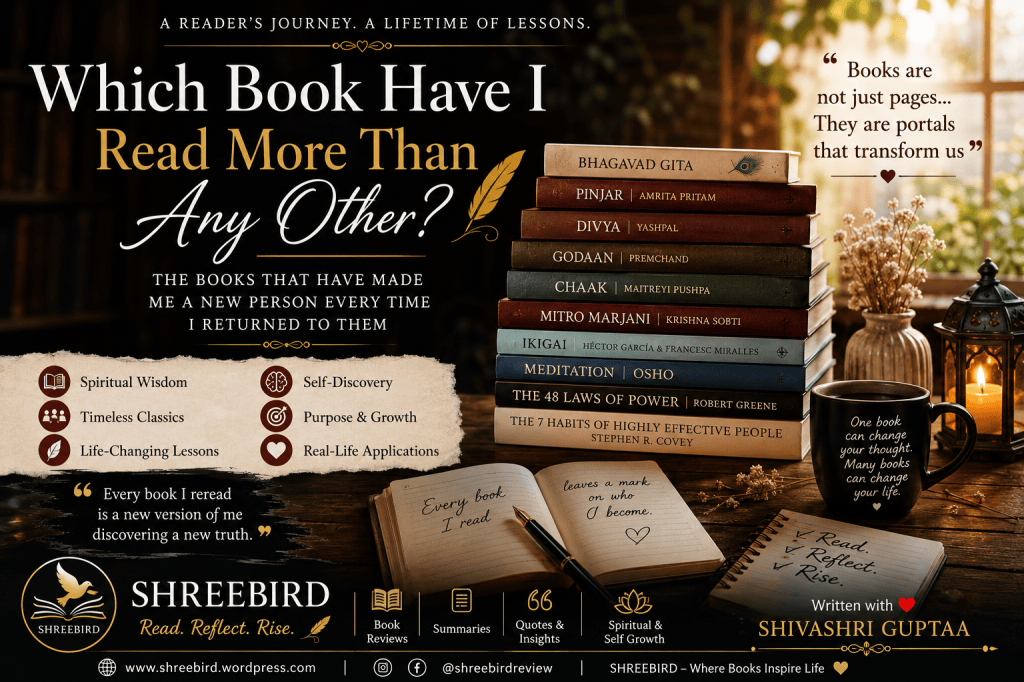
The Books That Have Made Me a New Person Every Time I Returned to Them
Author: SHIVASHRI GUPTAA
Published by: SHREEBIRD
Focus Keyword: Which book have you read more than any other?
Secondary Keywords: Best books to read twice, life-changing books, Bhagavad Gita, Pinjar, Divya, Hindi classics, book reviews, SHREEBIRD.
Some Books Are Not Just Read… They Are Lived.
If someone asked me,
“Which book have you read more than any other?”
they would probably expect me to mention a single title.
But I can’t.
Because my life wasn’t shaped by just one book.
It was shaped by many.
Some books taught me how to think.
Some taught me how to stay silent.
Some taught me how to keep going when life became difficult.
Some taught me how to love without losing myself.
And some gently reminded me that not every question in life demands an immediate answer.
I have read the Bhagavad Gita more times than I can count.
I have read Divya three times.
I have returned twice to Pinjar, Godaan, Chaak, Mitro Marjani, Ikigai, Meditation, The 48 Laws of Power, and The 7 Habits of Highly Effective People.
Was it because I had forgotten their stories?
Not at all.
I had changed.
And when the reader changes, the book changes too.
Why Do We Read Some Books Again and Again?
We often watch our favorite movies more than once because we enjoy them.
Books are different.
We return to great books because they continue to reveal something new.
The first time, we follow the story.
The second time, we begin to understand the characters.
The third time, we realize that the real story has been unfolding within us all along.
That is why truly great books never become old.
They mature as we mature.
Every stage of life unlocks a new meaning hidden inside the same pages.
My Bookshelf Is My Autobiography
If someone were to walk into my room and quietly look at my bookshelf…
they wouldn’t simply see a collection of books.
They would see the different chapters of my life.
There would be the Bhagavad Gita—
the book that taught me every battle is not fought on a battlefield; some are fought silently within the human mind.
There would be Pinjar—
a novel that reminded me history is not written only through dates and political events, but also through broken hearts and untold stories.
There would be Divya—
a timeless reminder that self-respect is worth more than acceptance.
There would be Godaan—
a novel that allows me to rediscover the soul of India every single time I open its pages.
There would be Mitro Marjani and Chaak—
books that continue to remind me that a woman’s voice may be suppressed for generations, but it can never truly be silenced.
And then, on another shelf, I keep the books that helped me understand modern life—
Ikigai, Meditation, The 48 Laws of Power, and The 7 Habits of Highly Effective People.
These books taught me that being a good person is only the beginning.
To live well, we must also learn to understand ourselves, understand people, think wisely, and continue growing every single day.
Can Books Really Change a Person?
I used to think they could.
Today, I believe something slightly different.
Books do not change us.
They simply introduce us to the person who has always been waiting quietly inside us.
The courage we search for…
may already exist within us.
The patience we desperately need…
may already be there.
Books don’t create these qualities.
They gently remove the dust covering them.
That is why I have never considered books to be mere sources of information.
To me, every great book is a conversation.
A conversation between an author and a reader…
two people who may never meet…
yet somehow understand one another completely.
If I Had to Keep Only One Book…
If someone asked me to choose just one book from my entire library…
I would answer without hesitation.
The Bhagavad Gita.
Not because it is one of the world’s greatest spiritual classics.
Not simply because millions of people revere it.
But because it has been my most honest teacher.
Whenever I failed…
it gave me patience.
Whenever I felt lost…
it gave me clarity.
Whenever fear held me back…
it gave me the courage to act.
And whenever I tried to control everything around me…
it gently reminded me:
“You have a right to your actions, but never to the fruits of your actions.”
Perhaps that is why I keep returning to it.
Every time I open its pages…
I don’t merely discover another verse.
I discover another version of myself.
SHREEBIRD Reflection
Some people measure their lives by years.
I measure mine by the books that transformed me.
Because time only makes us older.
Great books make us better.
Why Do I Keep Returning to the Bhagavad Gita?
I have read many remarkable books.
Some inspired me.
Some challenged my beliefs.
Some broke my heart.
Some changed the way I looked at the world.
But the Bhagavad Gita did something none of the others could.
It changed the way I looked at myself.
That is why it is the book I have read more than any other.
Oddly enough, I don’t remember the exact day I read it for the first time.
But I do remember something even more important—
I didn’t truly understand it.
At first, it felt like an ancient conversation about war, duty, and spirituality.
I admired its wisdom, but I couldn’t fully relate to it.
Life, however, has a strange way of becoming our greatest teacher.
As the years passed…
I experienced success.
I faced disappointment.
I made difficult choices.
I lost opportunities.
I questioned myself.
I waited for answers that never arrived on time.
And slowly, I realized something profound.
The battlefield of the Mahabharata wasn’t the only battlefield.
There was another Kurukshetra…
one that existed quietly inside me.
Every fear was an Arjuna.
Every difficult decision was a battlefield.
And every time I felt confused, the Gita patiently waited for me—not to give me easy answers, but to help me ask better questions.
Every Reading Revealed a Different Book
When I was younger…
the Bhagavad Gita taught me discipline.
When my career became uncertain…
it taught me patience.
When hard work didn’t produce immediate results…
it reminded me to focus on effort instead of expectations.
When relationships became complicated…
it taught me the difference between attachment and genuine love.
And whenever life became unbearably noisy…
it quietly whispered,
“Return to yourself.”
That is why I don’t simply reread the Bhagavad Gita.
I return home to it.
Krishna Never Commands. He Converses.
One of the most beautiful aspects of the Bhagavad Gita is that Lord Krishna never forces wisdom upon Arjuna.
He listens first.
He allows Arjuna to express every doubt, every fear, every weakness.
Only then does He begin to guide him.
That, to me, is the mark of a true teacher.
Wisdom does not silence questions.
It welcomes them.
Perhaps that is why the Gita has remained timeless for thousands of years.
It doesn’t ask us to stop thinking.
It teaches us how to think.
It doesn’t demand blind faith.
It encourages conscious understanding.
And that is precisely why every generation continues to discover something new within its pages.
The Lesson That Stays With Me Every Day
People often ask,
“What is the greatest lesson of the Bhagavad Gita?”
Everyone may have a different answer.
Mine has never changed.
The greatest lesson is this:
Give your best to your work, but never surrender your peace of mind to the outcome.
It sounds beautifully simple.
Living it is incredibly difficult.
Most of us don’t lose because we fail.
We lose because we allow fear of the future to steal the strength we need today.
The Gita taught me something that quietly transformed my perspective.
Success is an event.
Character is a lifelong practice.
Achievements may come and go.
Character stays.
And in the end, character always matters more.
The Gita Is More Than a Religious Scripture
If the Bhagavad Gita were only a religious text…
it would never have continued to inspire readers across cultures, professions, and generations.
Some people read it as philosophy.
Some see it as psychology.
Some approach it as a leadership guide.
Others find in it a manual for emotional resilience.
For me…
it is all of these at once.
It is one of those rare books that grows with its reader.
At twenty, it teaches discipline.
At thirty, responsibility.
At forty, detachment.
At every stage of life…
it speaks a different language while remaining the same book.
Very few books possess that extraordinary quality.
Whenever Life Feels Heavy…
I’ve noticed something about myself.
Whenever life becomes overwhelming…
I don’t rush to buy another self-help book.
I reach for my old copy of the Bhagavad Gita.
Because I’ve learned that not every new question requires a new book.
Sometimes…
the answer has been waiting patiently inside a book we’ve already read.
We simply weren’t ready to understand it before.
📖 Read More on SHREEBIRD
🛒 Build Your Personal Library
If you haven’t yet experienced the wisdom of the Bhagavad Gita, this is one book that deserves a permanent place on every bookshelf.
👉 Buy the Bhagavad Gita on Amazon
Affiliate Disclosure: As an Amazon Associate, SHREEBIRD may earn a small commission from qualifying purchases at no additional cost to you. Your support helps us continue creating free, in-depth book reviews, summaries, and educational content for readers around the world.
SHREEBIRD Reflection
I have not read the Bhagavad Gita more than any other book because it is the most famous.
I return to it because…
every reading introduces me to a wiser version of myself.
Some books entertain us.
Some educate us.
Some inspire us.
But the Bhagavad Gita does something far rarer.
It quietly transforms us—one page, one thought, and one conversation with ourselves at a time.
After the Bhagavad Gita, if there are two books that have stayed with me long after I closed their final pages, they are Pinjar and Divya.
I have returned to both more than once.
Not because I forgot their stories.
But because every stage of my life helped me understand them differently.
Some books speak to the mind.
Some speak to the heart.
Pinjar and Divya do both.
They don’t simply tell stories.
They ask difficult questions about identity, freedom, dignity, sacrifice, and what it truly means to be human.
Pinjar — A Novel That Refuses to Leave Your Heart

(Read Twice)
If someone asked me to recommend one novel that captures the emotional cost of the Partition of India, my answer would always be Pinjar by Amrita Pritam.
But calling Pinjar merely a Partition novel would be unfair.
It is so much more.
It is a story about identity.
About loss.
About womanhood.
About humanity.
And above all…
it is about finding hope in a world that has forgotten compassion.
When I first read Pinjar, I cried for Puro.
I saw her pain.
Her helplessness.
Her shattered dreams.
The second time I read it…
I noticed something different.
I no longer saw only her suffering.
I saw her extraordinary strength.
I realized that courage doesn’t always arrive with loud victories.
Sometimes courage quietly survives unimaginable pain.
That is what made Pinjar unforgettable for me.
Great literature never changes.
The reader does.
Puro Still Lives Among Us
One realization stayed with me long after finishing the novel.
Puro isn’t just a woman from 1947.
She exists even today.
She is every woman forced to choose between society and herself.
Every woman whose identity is defined by others before she has the chance to define it herself.
Every woman searching for dignity in a world obsessed with labels.
That is why Pinjar continues to feel relevant decades after it was written.
History changes.
Technology changes.
Governments change.
But the human heart struggles with the same questions generation after generation.
That is the power of timeless literature.
📖 Read the Complete Review on SHREEBIRD
If Pinjar touched you—or if you’re planning to read it—you’ll find a detailed review on SHREEBIRD, including:
- Complete Book Summary
- Character Analysis
- Themes & Symbolism
- Historical Context
- Life Lessons
- Memorable Quotes Explained
🛒 Add Pinjar to Your Library
Buy Pinjar on Amazon
📚 Related Books You May Also Like
If you enjoyed Pinjar, you may also love:
- Divya
- Godaan
- Chaak
- Mitro Marjani
- Aapka Bunty
(Add SHREEBIRD Review Links + Amazon Affiliate Links for each book.)
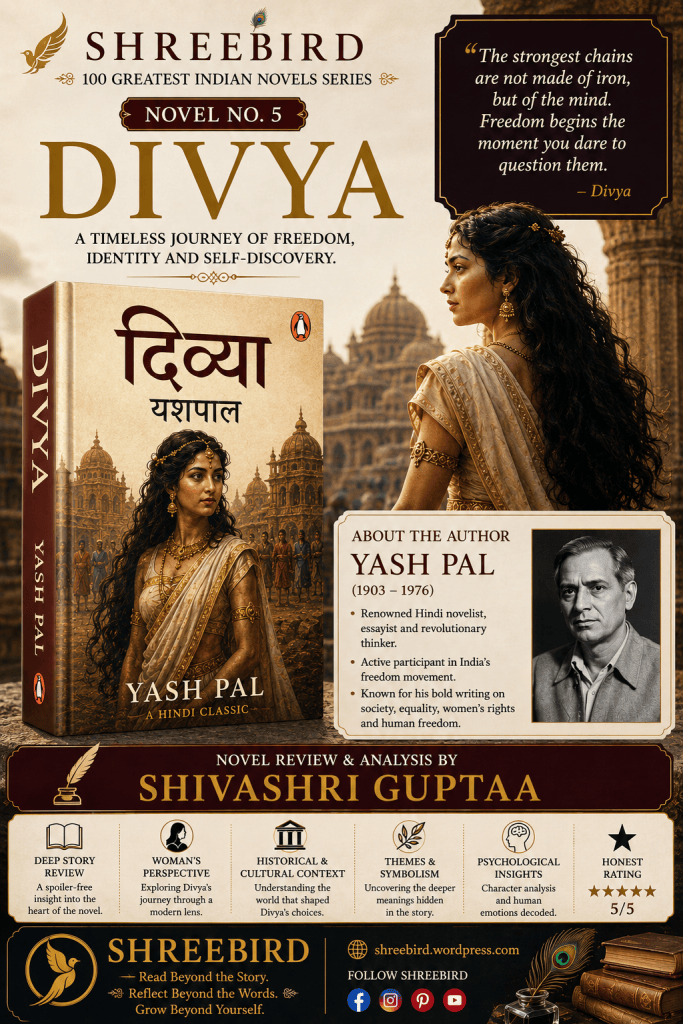
Divya — A Book That Grew With Me
(Read Three Times)
Among all the books on my bookshelf, Divya holds a very special place.
Every time I returned to it…
it felt like reading an entirely different novel.
That is incredibly rare.
Most books remain the same.
Divya evolved because I evolved.
Written by Yashpal, this remarkable novel is often described as historical fiction.
I think it is much more than that.
It is a philosophical exploration of freedom, identity, ambition, love, and self-respect.
The first time I read it…
I followed the plot.
The second time…
I understood the characters.
The third time…
I understood myself.
That is when I realized the novel wasn’t really about the past.
It was about every person trying to remain true to themselves despite society’s expectations.
The Greatest Lesson Divya Taught Me
If I had to summarize Divya in one sentence, it would be this:
Self-respect is the foundation of every meaningful life.
We often spend years trying to earn acceptance.
Approval.
Recognition.
Validation.
But Divya gently reminds us that none of these can replace self-worth.
A person who loses themselves in order to please the world eventually loses both.
That lesson has stayed with me long after finishing the novel.
Perhaps that is why I have read it three times.
And I know I will return to it again someday.
📖 Read the Complete Review on SHREEBIRD
Discover our complete Divya series on SHREEBIRD:
- Complete Review
- Full Summary
- Character Analysis
- Historical Background
- Themes & Philosophy
- Important Quotes
- Life Lessons. https://shreebird.com/2026/07/13/%f0%9f%a6%9a-shreebird-108/
🛒 Build Your Library
Buy Divya on Amazon
📚 Related Books You May Also Like
Readers who enjoy Divya often appreciate:
- Pinjarhttps://shreebird.com/2026/07/13/%f0%9f%a6%9a-shreebird-107/
- Godaan
- Mitro Marjani
- Chaak
- Bhagavad Gita
(Add SHREEBIRD Review Links +
A Pattern I Discovered in My Reading Journey
When I looked back at all the books I have read more than once…
I noticed something fascinating.
The Bhagavad Gita teaches me inner wisdom.
Pinjar teaches me compassion.
Divya teaches me dignity.
Three completely different books.
Three completely different worlds.
Yet all of them are trying to answer the same timeless question:
How do we become better human beings?
Perhaps that is why I never read only for entertainment.
I read to understand people.
I read to understand history.
I read to understand life.
And above all…
I read to understand myself.
SHREEBIRD Reflection
People often ask,
“What makes a book truly unforgettable?”
For me, the answer is simple.
A great book isn’t the one you finish in a single sitting.
A great book is the one that continues reading you long after you’ve finished reading it.
That is why I don’t simply reread these books.
I return to them like old friends—knowing they will always have something new to teach me.
As I looked back at my reading journey, I noticed something unexpected.
The books I returned to were never from the same genre.
Some were spiritual.
Some were literary masterpieces.
Some were modern self-help books.
Some challenged society.
Others challenged me.
At first, I thought I was reading completely different kinds of books.
Today, I realize they were all teaching me the same lesson—
To become a wiser, kinder, and more thoughtful human being.
That realization led me to three extraordinary Hindi novels that continue to hold a permanent place on my bookshelf—
Godaan, Chaak, and Mitro Marjani.
Godaan — Reading the Soul of India

(Read Twice)
If someone asked me,
“Which novel should I read to understand India?”
I wouldn’t recommend a history book.
I would recommend Godaan.
Because Munshi Premchand didn’t simply write a novel.
He captured the heartbeat of an entire civilization.
The struggles of ordinary people.
The dignity of labor.
The burden of poverty.
The complexities of family.
The silent sacrifices made every single day by people history rarely remembers.
The first time I read Godaan, I admired its storytelling.
The second time…
I understood its humanity.
I realized that Hori isn’t just a fictional character.
He represents millions of people whose dreams are constantly tested by circumstances beyond their control.
That is why Godaan remains timeless.
Societies evolve.
Technology changes.
But human struggles remain remarkably familiar.
Why Every Reader Should Experience Godaan
There are books that entertain.
There are books that educate.
And then there are books that quietly make you more compassionate.
Godaan belongs to the third category.
It teaches us that dignity isn’t measured by wealth.
Character isn’t determined by status.
And kindness often survives even in the harshest realities.
Very few novels achieve that balance.
📖 Read the Complete Review on SHREEBIRD
Explore our in-depth Godaan series:
- Complete Book Review
- Full Summary
- Character Analysis
- Social Themes
- Literary Importance
- UPSC & Literature Perspective
👉 https://shreebird.com/2026/07/13/%f0%9f%a6%9a-shreebird-109/
🛒 Buy Godaan on Amazon
📚 Related Books
If you loved Godaan, you may also enjoy:
- Pinjarhttps://shreebird.com/2026/07/13/%f0%9f%a6%9a-shreebird-107/
- Divyahttps://shreebird.com/2026/07/13/%f0%9f%a6%9a-shreebird-108/
- Chaak
- Mitro Marjani
(Add SHREEBIRD Review Links + Amazon Affiliate Links.)
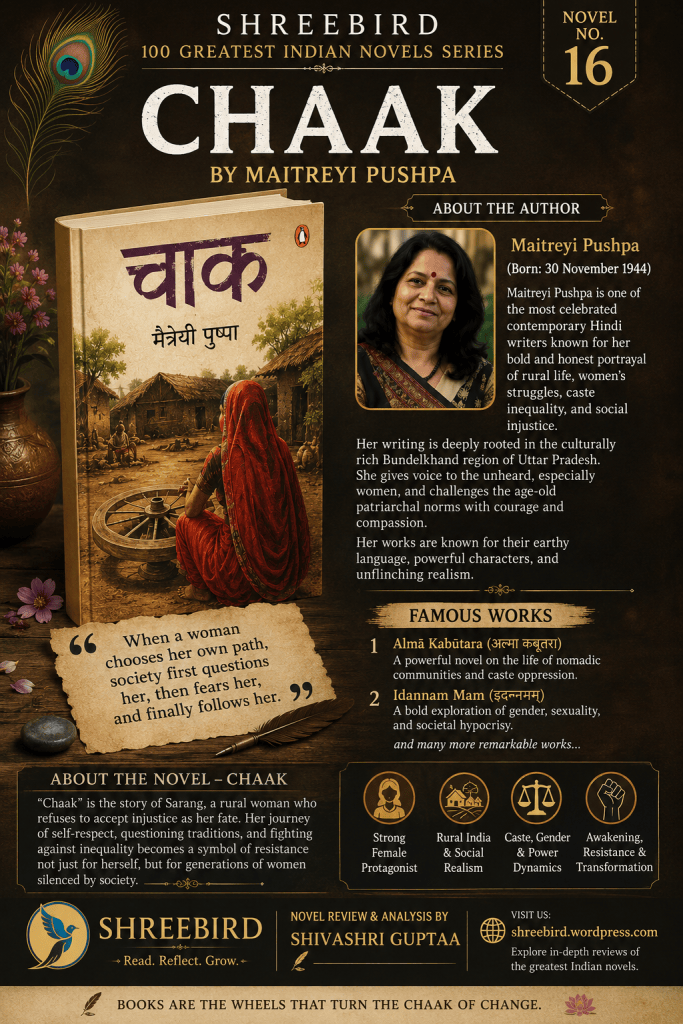
Chaak — When Literature Becomes a Voice of Resistance
(Read Twice)
Some books comfort us.
Some books disturb us.
And sometimes…
being disturbed is exactly what a great book should do.
That is how I felt while reading Chaak by Maitreyi Pushpa.
It doesn’t attempt to impress the reader.
It challenges the reader.
It forces us to question traditions we often accept without thinking.
Through powerful female characters, Chaak speaks about dignity, courage, identity, and survival.
The first time I read it…
I saw the conflict.
The second time…
I saw the courage hidden beneath that conflict.
I realized that bravery doesn’t always look dramatic.
Sometimes…
the bravest thing a person can do is simply refuse to remain silent.
That lesson stayed with me.
📖 Read the Complete Review on SHREEBIRD
Discover:
- Complete Summary
- Character Analysis
- Feminist Themes
- Literary Review
- Important Quotes
https://shreebird.com/2026/07/13/%f0%9f%a6%9a-shreebird-105/
🛒 Buy Chaak on Amazon
📚 Related Books
Readers who enjoyed Chaak may also appreciate:
- Mitro Marjanihttps://shreebird.com/2026/07/13/%f0%9f%a6%9a-shreebird-103/
- Pinjarhttps://shreebird.com/2026/07/13/%f0%9f%a6%9a-shreebird-107/
- Divyahttps://shreebird.com/2026/07/13/%f0%9f%a6%9a-shreebird-108/
- Aapka Bunty
(Add Review Links + Affiliate Links.)
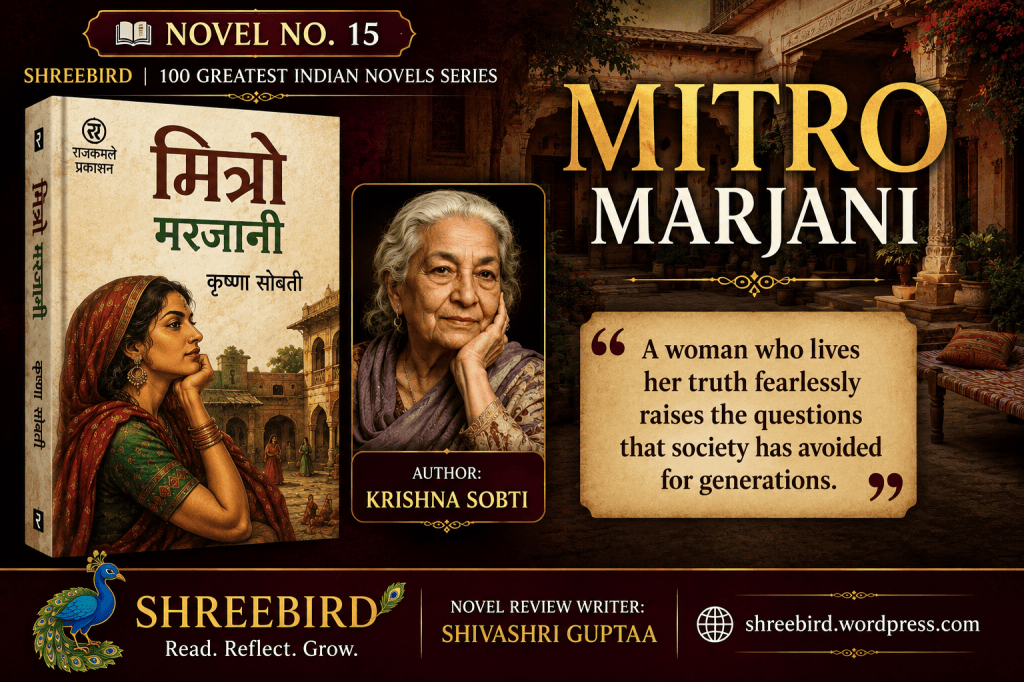
Mitro Marjani — A Woman Who Refused to Apologize for Being Herself
(Read Twice)
Some fictional characters disappear once the novel ends.
Others stay with us forever.
Mitro is one of them.
Created by Krishna Sobti, she remains one of the boldest and most unforgettable women in Hindi literature.
She is honest.
Fearless.
Unapologetically herself.
At first, I thought Mitro Marjani was simply a novel about a rebellious woman.
The second time I read it…
I realized it was actually about freedom.
The freedom to speak.
To question.
To desire.
To exist without constantly seeking society’s approval.
Even decades after its publication, the novel still feels surprisingly modern.
That is the mark of timeless literature.
It arrives before society is ready for it.
📖 Read the Complete Review on SHREEBIRD
Find:
- Complete Review
- Summary
- Character Study
- Women’s Perspective
- Literary Significance
🛒 Buy Mitro Marjani on Amazon
📚 Related Books
You may also enjoy:
Then My Reading Journey Took a Different Turn…
For years, I immersed myself in timeless classics.
They helped me understand history.
Society.
Relationships.
Human emotions.
But eventually, another question began to occupy my mind.
How do I live better today?
That curiosity introduced me to modern books like Ikigai, Meditation, The 48 Laws of Power, and The 7 Habits of Highly Effective People.
Initially, I believed classical literature and self-help books belonged to completely different worlds.
Now I think differently.
Classics teach us who we are.
Self-help books teach us who we can become.
Together, they create a complete reading journey.
Ikigai — Finding Meaning in Everyday Life

(Read Twice)
When I first picked up Ikigai, I expected another motivational bestseller.
Instead, I discovered something far more valuable.
It wasn’t really about success.
It was about living with purpose.
The book reminded me that happiness rarely comes from extraordinary moments.
It grows quietly through ordinary habits.
A morning walk.
Meaningful work.
Time with loved ones.
Continuous learning.
Gratitude.
A healthy body.
A peaceful mind.
That, perhaps, is the true meaning of Ikigai.
Simple.
Meaningful.
Sustainable.
📖 Read the Complete Review on SHREEBIRD
- Complete Book Review
- Summary
- Key Lessons
- Practical Applications
- Best Quotes
🛒 Buy Ikigai on Amazon
📚 Related Books
SHREEBIRD Reflection
When I look at my bookshelf today…
I no longer see separate genres.
I see conversations.
A conversation between Premchand and Ikigai.
Between Krishna Sobti and modern psychology.
Between Bhagavad Gita and personal development.
Different languages.
Different centuries.
Different writing styles.
Yet every one of these books asks the same timeless question:
“How can we become better human beings?”
And perhaps…
that is the only reason I have ever loved reading.
Every book on my shelf has given me something valuable.
Some gave me wisdom.
Some gave me courage.
Some gave me clarity.
Some taught me discipline.
And some simply reminded me that slowing down is not a weakness—it is a way of understanding life more deeply.
The final books in my “read more than once” list did exactly that.
Meditation — The Journey Inward
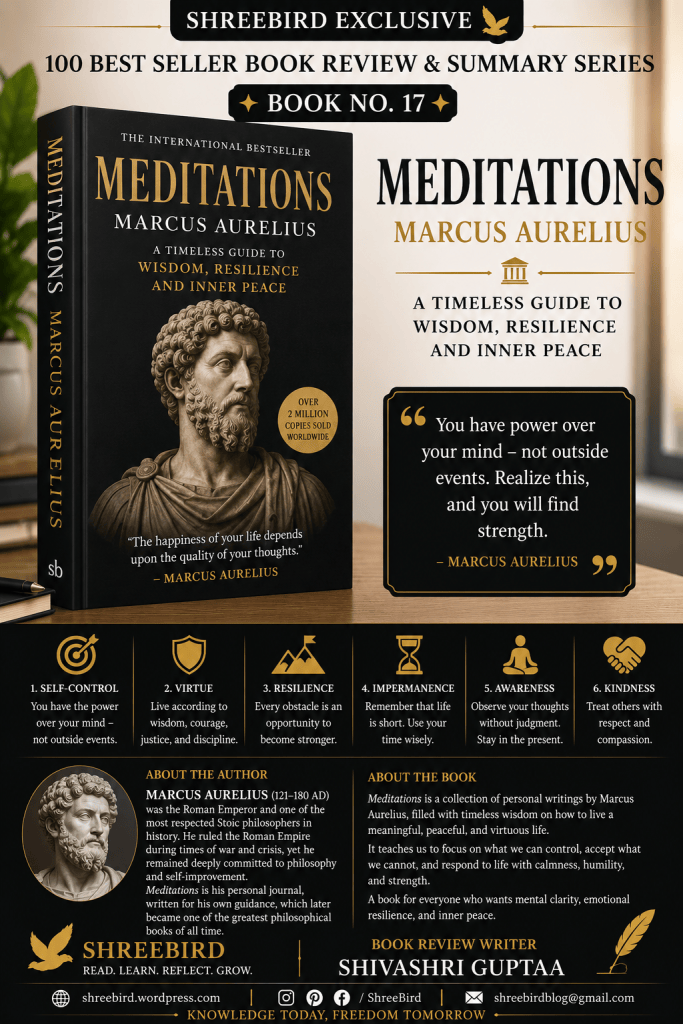
(Read Twice)
We spend so much of our lives trying to understand the world around us.
But very few of us spend enough time understanding ourselves.
That is why Meditation became one of the most meaningful books in my reading journey.
The first time I read it, I thought it was simply about mindfulness.
The second time, I realized it was about awareness.
There is a profound difference between the two.
Mindfulness teaches us to be present.
Awareness teaches us to understand why our mind reacts the way it does.
This book reminded me that peace is not something we find after everything becomes perfect.
Peace is something we practice—even when life is imperfect.
In a world filled with endless notifications, distractions, and comparisons, Meditation quietly teaches one timeless lesson:
The most important conversation you’ll ever have is the one with yourself.
📖 Read the Complete Review on SHREEBIRD
Explore our detailed guide:
- Complete Book Review
- Chapter Summary
- Key Lessons
- Practical Applications
- Favorite Quotes
🛒 Buy Meditation on Amazon
📚 Related Books
- Bhagavad Gita
- Ikigaihttps://shreebird.com/2026/07/13/%f0%9f%93%9a-shreebird-exclusive-3/
- The Diary of a CEOhttps://shreebird.com/2026/07/13/%f0%9f%93%9a-shreebird-exclusive-6/
- The 7 Habits of Highly Effective People
(Add SHREEBIRD Review Links + Affiliate Links.)
The 48 Laws of Power — Understanding Human Nature

(Read Twice)
Among all the books on my shelf, this is probably the most misunderstood.
Many readers assume The 48 Laws of Power teaches manipulation.
I read it differently.
To me, it is a book about understanding people, influence, and the realities of power.
It doesn’t tell us to become ruthless.
It reminds us that the world is complex.
Not every person thinks like we do.
Not every situation rewards honesty alone.
Reading this book taught me an important lesson:
Wisdom is not blindly following every rule.
Wisdom is knowing when a principle should be applied—and when it shouldn’t.
That balance is what makes this book valuable.
📖 Read the Complete Review on SHREEBIRD
Discover:
- Chapter-by-Chapter Summary
- Key Laws Explained
- Practical Lessons
- Famous Quotes
- Real-Life Applications
🛒 Buy The 48 Laws of Power on Amazon
📚 Related Books
The 7 Habits of Highly Effective People — Building a Better Life, One Habit at a Time

(Read Twice)
If someone asked me to recommend just one personal development book for beginners, I would confidently choose The 7 Habits of Highly Effective People.
Stephen R. Covey doesn’t promise overnight success.
Instead, he offers something much more meaningful:
A framework for living with purpose, integrity, and consistency.
Every time I revisit this book, I discover a new habit that deserves more attention.
It reminds me that extraordinary lives are not built through extraordinary moments.
They are built through ordinary habits repeated every single day.
That idea has stayed with me ever since.
📖 Read the Complete Review on SHREEBIRD
Read our complete guide:
- Detailed Book Review
- Complete Summary
- Habit-by-Habit Breakdown
- Key Takeaways
- Best Quotes
🛒 Buy The 7 Habits of Highly Effective People on Amazon
📚 Related Books
- Ikigai
- Meditation
- The Diary of a CEOhttps://shreebird.com/2026/07/13/%f0%9f%93%9a-shreebird-exclusive-6/
- Bhagavad Gita
(Add Review Links +
The Diary of a CEO — Lessons They Never Teach in School

(Read Once — and a book I’ll gladly return to.)
Some books give answers.
Others encourage better questions.
The Diary of a CEO belongs to the second category.
What I appreciated most about this book is its honesty.
It doesn’t pretend that success is a straight path.
Instead, it speaks openly about failure, self-doubt, discipline, relationships, leadership, confidence, and personal growth.
It reminded me that behind every successful person is a human being still learning, still failing, and still growing.
That message felt refreshingly real.
It is one of those modern books that complements timeless classics beautifully.
📖 Read the Complete Review on SHREEBIRD
- Complete Book Review
- Chapter Highlights
- Best Lessons
- Quotes Worth Remembering
🛒 Buy The Diary of a CEO on Amazon
What These Books Have Given Me
If I had to describe my reading journey in just a few lines, it would look like this:
- Bhagavad Gita taught me inner peace.
- Pinjar taught me compassion.
- Divya taught me self-respect.
- Godaan taught me humanity.
- Chaak taught me courage.
- Mitro Marjani taught me fearless authenticity.
- Ikigai taught me purpose.
- Meditation taught me awareness.
- The 48 Laws of Power taught me strategy.
- The 7 Habits of Highly Effective People taught me discipline.
- The Diary of a CEO taught me that growth begins with honest self-reflection.
Together, these books didn’t simply fill my bookshelf.
They shaped my worldview.
Frequently Asked Questions
Which book have you read more than any other?
Without a doubt, the Bhagavad Gita.
Why do you reread books?
Because every time I grow, I discover something new in the same pages.
Which books have you read more than once?
- Bhagavad Gita (Many times)
- Divya (3 Times)
- Pinjar (2 Times)
- Godaan (2 Times)
- Chaak (2 Times)
- Mitro Marjani (2 Times)
- Ikigai (2 Times)https://shreebird.com/2026/07/13/%f0%9f%93%9a-shreebird-exclusive-3/
- Meditation (2 Times)
- The 48 Laws of Power (2 Times)
- The 7 Habits of Highly Effective People (2 Times)
Explore More on SHREEBIRD
📚 Spiritual Reads
- Bhagavad Gita
📚 Hindi Literary Classics
- Pinjar
- Divya
- Godaan
- Chaak
- Mitro Marjani
- Aapka Bunty
📚 Personal Growth
- Ikigaihttps://shreebird.com/2026/07/13/%f0%9f%93%9a-shreebird-exclusive-3/
- Meditation
- The 48 Laws of Powerhttps://shreebird.com/2026/07/13/%f0%9f%93%9a-shreebird-exclusive-5/
- The 7 Habits of Highly Effective People
- The Diary of a CEO
Build Your Personal Library
If this article inspired you to explore these remarkable books, consider adding them to your personal library.
📖 Read our complete reviews on SHREEBIRD before you buy.
🛒 Purchase through our Amazon Affiliate Links to support our work—at no extra cost to you.
Affiliate Disclosure: As an Amazon Associate, SHREEBIRD earns from qualifying purchases. Every purchase helps us continue creating free, thoughtful, and in-depth book reviews for readers around the world.
Final Reflection
People often ask me,
“Which book changed your life?”
I don’t think life changes because of one book.
Life changes because of the books we choose to return to.
The books that comfort us in difficult times.
The books that challenge our beliefs.
The books that quietly wait for us until we are ready to understand them.
When someone asks,
“Which book have you read more than any other?”
My answer will always be:
The Bhagavad Gita.
But when they ask,
“Which books made you who you are today?”
I simply smile…
and point toward my bookshelf.
Because I am not only a collection of memories.
I am also a collection of the books I have loved, learned from, and returned to—again and again.
“The greatest books don’t just give us new answers.
They teach us how to ask better questions—and become better people in the process.”
🌿 About SHREEBIRD
SHREEBIRD is more than a book review website.
It is a home for readers who believe that books are not just meant to be read—but to be reflected upon, discussed, and lived.
Here you’ll discover:
- 📚 In-Depth Book Reviews
- 📝 Complete Summaries
- 👥 Character Analysis
- 💡 Philosophy Made Simple
- 🌸 Women-Centric Literature
- 🕉️ Spiritual Wisdom
- 🚀 Personal Growth & Self-Help
- 📖 Reading Guides
- ✨ Timeless Quotes & Life Lessons
🌐 Website
https://shreebird.wordpress.com
❤️ Written by
SHIVASHRI GUPTAA
© SHREEBIRD | Read. Reflect. Rise.


टिप्पणी करे